Choosing Polymer Modified Mortar for Stone Veneer: Buyer's Guide
Compare top polymer modified mortar for stone veneer systems. Learn ANSI standards, substrate pairing, coverage rates, and current pricing for your project.
The Shift from Traditional to Polymer-Modified Systems
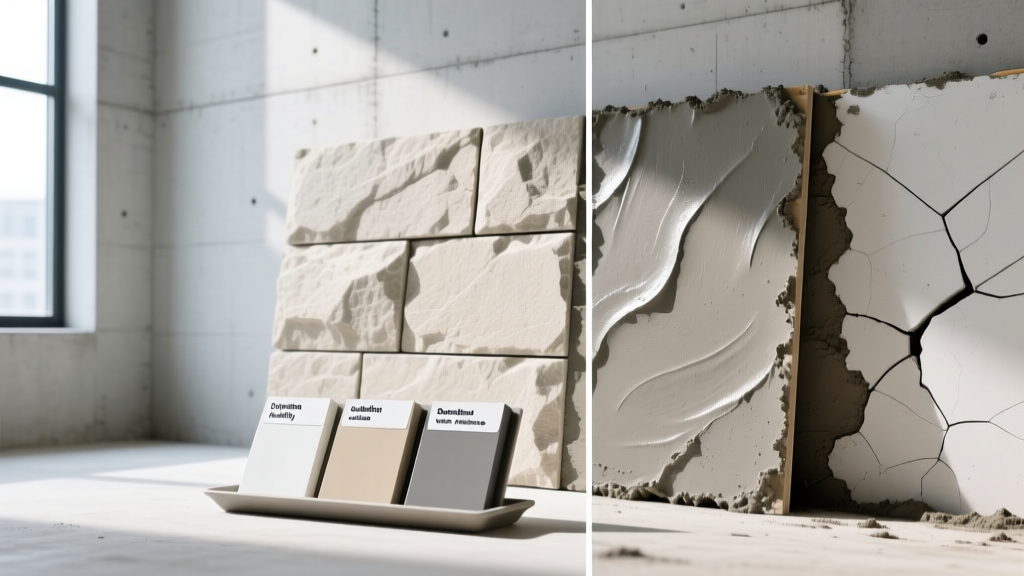
For decades, masons relied on traditional Type S or Type N lime-cement mortars for adhering stone veneer. While adequate for thick, load-bearing masonry, these traditional mixes fail to meet the structural and environmental demands of modern thin-stone and manufactured veneer applications. The industry standard has decisively shifted to polymer modified mortar for stone veneer installations. By integrating redispersible polymer powders (such as VAE or acrylics) into the cementitious matrix, these mortars achieve superior flexural strength, reduced water absorption, and enhanced bond adhesion to non-porous or challenging substrates.
Traditional high-lime mortars introduce excess free calcium hydroxide into the wall assembly. When moisture migrates through the substrate, it carries these salts to the stone surface, resulting in severe efflorescence. Polymer-modified mortars significantly reduce capillary water migration and free-lime content, mitigating this aesthetic and structural failure mode.
Decoding ANSI Standards: A118.4 vs. A118.15
When procuring materials, you must verify the mortar's ANSI classification. According to guidelines published by the National Tile Contractors Association (NTCA) and the Tile Council of North America, stone veneer mortars generally fall into two critical categories:
- ANSI A118.4 (Modified Dry-Set Cement Mortar): The baseline standard for polymer-modified mortars. Suitable for interior applications, lightweight manufactured stone, and stable substrates like cured CMU or concrete.
- ANSI A118.15 (Improved Modified Dry-Set Cement Mortar): A higher-performance tier requiring greater tensile and shear adhesion. This is mandatory for exterior installations, freeze-thaw climates, heavy natural stone, and installations over dimensional lumber framing with metal lath.
For structural stability on vertical walls, look for the "T" designation (e.g., ANSI A118.15T), which indicates a thixotropic, non-sag formula engineered to hold heavy stacked stone in place without mechanical fasteners while the mortar cures.
Substrate Pairing Matrix
The efficacy of polymer modified mortar for stone veneer is highly dependent on substrate preparation. Use the following matrix to determine the correct mortar profile and primer requirements for your specific wall assembly.
| Substrate Type | Required Mortar Profile | Primer / Prep Requirement |
|---|---|---|
| Open-Face CMU Block | ANSI A118.4 or A118.15 | Dampen block; no liquid primer required. |
| Wood Framing + Lath + Scratch Coat | ANSI A118.15T (Non-Sag) | Ensure scratch coat is fully cured (min 48 hours). |
| Exterior EPS / XPS Rigid Foam | ANSI A118.15 (High Flex) | Must be applied over manufacturer-approved mesh base coat. |
| Poured Concrete / Tilt-Up | ANSI A118.15 | Acid etch or shot-blast to remove form release agents. |
Top Product Profiles and Current Pricing
Based on current market availability and contractor performance data, here are three leading polymer modified mortar for stone veneer systems, categorized by project scope.
1. LATICRETE® MVIS™ Premium Veneer Mortar
Engineered specifically for masonry veneer, this product meets ANSI A118.15T. It features an extended open time of up to 30 minutes and a high polymer content that allows for direct application over properly prepared rigid insulation and challenging substrates.
- Best For: Exterior commercial facades, heavy natural stone, and EPS foam substrates.
- Coverage: ~45 sq ft per 50 lb bag (using 1/2" x 1/2" trowel).
- Estimated Cost: $60 - $68 per 50 lb bag.
- Source: Available via specialized distributors; see LATICRETE official resources for technical data sheets.
2. Custom Building Products Natural Stone & Large Tile Mortar
A versatile, non-sag ANSI A118.15 mortar. While frequently used for large-format porcelain, its rheology modifiers make it an excellent choice for interior and exterior stone veneer where anti-slump properties are critical for stacked ledger stone.
- Best For: Interior feature walls, fireplace surrounds, and stacked manufactured stone.
- Coverage: ~50 sq ft per 50 lb bag.
- Estimated Cost: $42 - $48 per 50 lb bag.
3. Sakrete Stone Veneer Mortar
A pre-blended, polymer-fortified mortar meeting ANSI A118.4. It is formulated with a coarser aggregate profile designed to mimic traditional masonry joints while providing the chemical adhesion of a modified thin-set.
- Best For: Residential exterior wainscoting, retaining wall caps, and CMU block applications.
- Coverage: ~35 sq ft per 80 lb bag (thicker bed application).
- Estimated Cost: $26 - $32 per 80 lb bag.
- Source: Widely available at big-box retailers; refer to Custom Building Products or Sakrete for SDS and TDS documentation.
Trowel Selection and Coverage Calculations
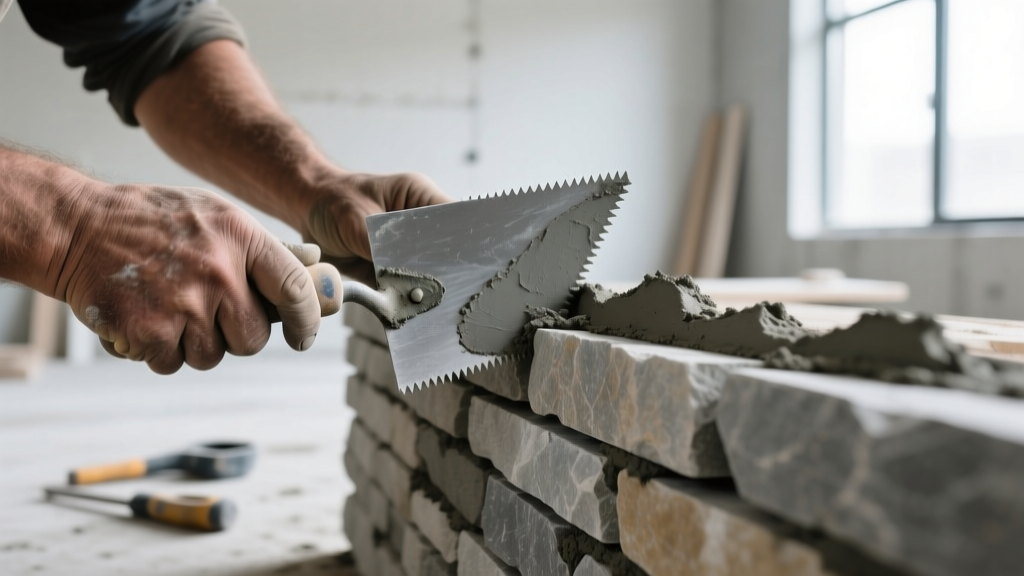
Yield is highly variable based on the stone profile and trowel notch. Underestimating mortar volume is a primary cause of project delays and inconsistent bond coats.
Industry standards dictate 100% back-buttering (applying a flat coat of mortar to the back of the stone) for any stone unit exceeding 12 inches in any dimension, weighing more than 5 lbs, or featuring a deep cleft/riven back profile. Factor an additional 20% to 30% into your mortar yield calculations if back-buttering is required.
| Stone Type | Trowel Notch Size | Approx. Coverage (50lb Bag) |
|---|---|---|
| Flat Manufactured Veneer | 1/2" x 1/2" Square | 50 - 60 sq ft |
| Stacked / Ledger Stone | 1/4" x 3/8" Square | 70 - 85 sq ft |
| Heavy Natural Fieldstone | 3/4" x 3/4" Square | 30 - 40 sq ft |
Application Edge Cases and Failure Modes
Even premium polymer modified mortar for stone veneer will fail if environmental and mechanical edge cases are ignored during installation.
Freeze-Thaw Spalling in Climate Zones 5-8
In northern climates, moisture trapped behind the stone face freezes and expands. If the mortar lacks sufficient polymer flexibility (specifically VAE copolymers), the shear stress will exceed the mortar's tensile strength, causing the stone to pop off the substrate. Always mandate ANSI A118.15 for exterior applications in freeze-thaw zones, and ensure the wall assembly includes a continuous weather-resistive barrier (WRB) with a drainage mat.
Open Time Expiration (Skimming)
Polymer-modified mortars form a plastic skin on the surface of the ridges when exposed to air. In high-temperature or low-humidity environments, the "open time" can drop from 20 minutes to under 10 minutes. If a stone is pressed into skinned-over mortar ridges, the bond strength drops by up to 60%. Installers must strictly adhere to the "fingerprint test"—if pressing a finger into the mortar ridge does not yield clean mortar transfer, the batch must be scraped off and re-troweled.
Final Procurement Checklist
Before finalizing your material order, verify the following specifications with your supplier:
- Confirm the bag explicitly prints ANSI A118.15 (for exterior/heavy stone) or ANSI A118.4 (for interior/lightweight).
- Check the manufacturing date code. Polymer powders degrade over time; do not use mortar that has been sitting in a warehouse for more than 12 months.
- Ensure you have purchased the matching polymer-fortified pointing/grouting mortar to maintain consistent thermal expansion coefficients across the entire wall assembly.
- Verify that the substrate primer (if required by the mortar manufacturer for highly porous or sealed surfaces) is from the exact same chemical family as the mortar.
Written by
Marcus ChenMarcus Chen is a licensed structural engineer (PE) and building materials analyst with over 12 years of experience across residential, commercial, and industrial construction. He holds a Master of Science in Civil Engineering from UC Berkeley and spent six years at Thornton Tomasetti before transitioning to independent consulting and technical writing. Marcus specializes in material selection for seismic-prone regions, concrete reinforcement strategies, and lifecycle cost analysis. His work has been cited by the American Concrete Institute (ACI) and the Structural Engineers Association of California (SEAOC). When he is not on a job site or at his desk, you will find him hiking the Sierra Nevada or restoring a 1920s craftsman bungalow in Oakland, CA.
More from Marcus Chen
View all
Construction Cost
How Much Did the Eiffel Tower Cost to Build?
How much did the Eiffel Tower cost to build in 1889? We adjust for inflation and compare its budget to modern skyscraper construction.
Aug 4, 2026

Fire Resistance
What Is a Fire Resistant Material? Testing & Certification Guide
Discover what is a fire resistant material through ASTM and UL testing. Learn how fire ratings, certifications, and assemblies work in construction.
Aug 4, 2026

Construction Cost
How Much Did the Burj Khalifa Cost to Build?
How much did the Burj Khalifa cost to build? We break down the $1.5B project and extract 5 money-saving strategies for your next build.
Jul 30, 2026