Real Stone Veneer Panels vs Manufactured Stone: Complete Comparison
Compare real stone veneer panels vs manufactured stone. Explore costs, weight limits, installation labor, and longevity to choose the best exterior cladding.
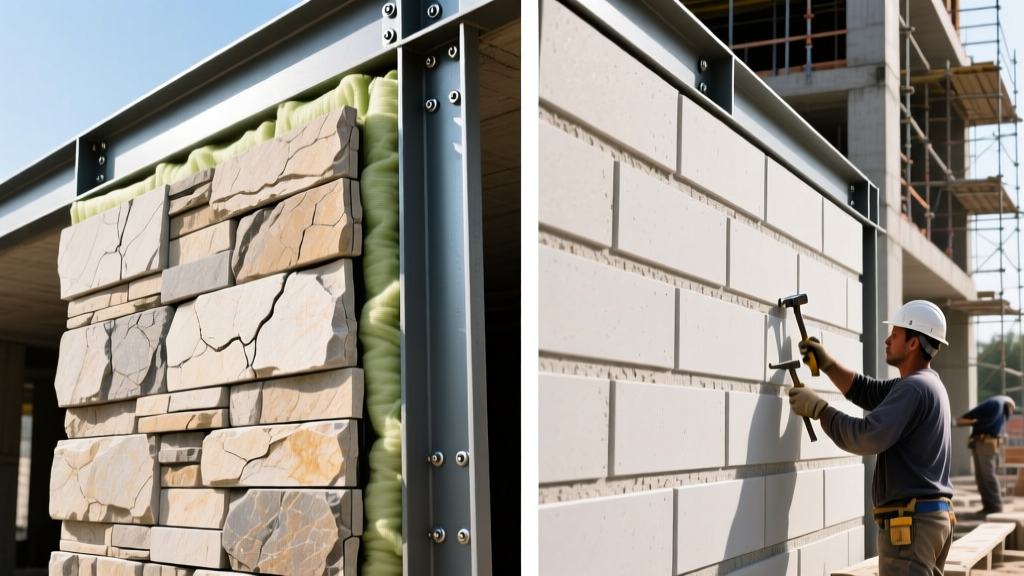
The Core Difference: Sliced Natural Stone vs. Cast Concrete
The cladding market has shifted dramatically toward panelized systems, but a critical distinction remains between real stone veneer panels and manufactured (faux) stone panels. Real stone veneer panels consist of natural stone—such as slate, granite, quartzite, or limestone—that has been precision-sliced to a uniform thickness (typically 0.5 to 1.5 inches) and pre-mounted on interlocking mesh, fiberglass, or polyurethane backings. Manufactured stone, conversely, is a cast concrete product poured into rubber molds and colored with iron oxide pigments to mimic natural rock.
While both offer a masonry aesthetic without the structural footprint of full-bed stone, their physical properties, installation requirements, and aging characteristics diverge significantly after year five. Understanding these differences is critical for architects, contractors, and homeowners evaluating long-term building envelope performance.
Head-to-Head Comparison Matrix
The following matrix breaks down the technical and financial specifications of premium real stone panels (e.g., Norstone Rock Panels, Stone Panels Inc.) versus high-end manufactured stone (e.g., Eldorado Stone, Cultured Stone).
| Feature | Real Stone Veneer Panels | Manufactured Stone Panels |
|---|---|---|
| Material Composition | 100% Natural sliced stone on mesh backing | Portland cement, aggregates, iron oxide pigments |
| Weight per Sq. Ft. | 10 - 15 lbs (varies by stone density) | 7 - 10 lbs |
| Material Cost | $13.00 - $24.00 / sq. ft. | $6.50 - $12.00 / sq. ft. |
| Installation Labor | $8.00 - $12.00 / sq. ft. (Interlocking speeds process) | $12.00 - $18.00 / sq. ft. (Requires individual piece fitting) |
| UV Stability | 100% UV stable; will never fade | Pigments may fade or chalk after 15-25 years |
| Impact Resistance | Extremely high; chips reveal identical natural stone | Moderate; deep chips reveal grey concrete core |
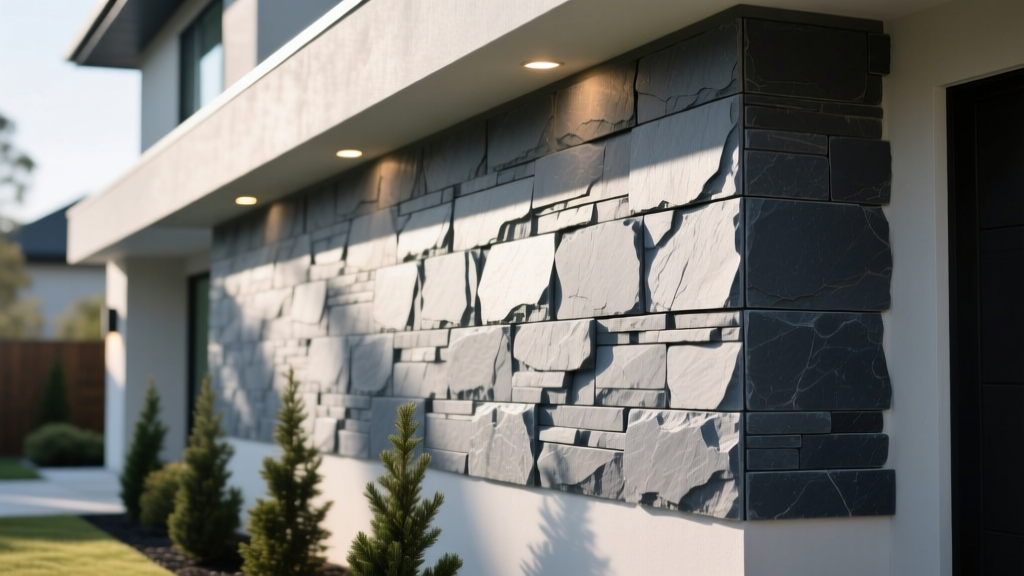
Cost Breakdown: Material vs. Labor Savings
Sticker shock often drives buyers toward manufactured stone, but analyzing the total installed cost reveals a narrower gap than expected. According to HomeGuide's national cost data, the total installed cost for natural stone veneer averages $18 to $35 per square foot, while manufactured stone ranges from $15 to $28 per square foot.
Real Stone Panel Pricing Specifics
Real stone veneer panels are priced based on the rarity and density of the quarried rock. Standard slate or quartzite panels (like Norstone's Standard Rock Panels) typically retail between $14 and $18 per square foot. Premium granite or basalt profiles can push past $22 per square foot. However, because these panels feature precision-engineered interlocking edges, they eliminate the need for separate corner pieces—a major hidden cost in traditional masonry. Pre-formed corners for real stone panels usually cost $15 to $25 per linear foot, but many modern panel systems wrap corners seamlessly without them.
The Hidden Labor Factor
Manufactured stone requires a skilled mason to individually select, trim, and place each piece to avoid repeating patterns, a process that demands significant labor hours. Real stone veneer panels, conversely, install much like large-format tile. A two-person crew can typically install 150 to 200 square feet of interlocking real stone panels in a single day, compared to 80 to 100 square feet of traditional manufactured stone. This 40% reduction in labor hours frequently offsets the premium paid for the natural stone material.
Installation Realities: Weight, Substrates, and Mortar
Installing real stone veneer panels requires strict adherence to building codes regarding weight loads and moisture management. The International Residential Code (IRC Section R703) mandates specific weather-resistive barriers and weep screeds for all exterior adhered masonry veneers.
Substrate and Mortar Requirements
Neither real nor manufactured stone can be adhered directly to drywall or painted surfaces. Proper preparation involves:
- Weather Barrier: Two layers of Grade D building paper or a code-approved housewrap over wood sheathing.
- Metal Lath: 2.5 lb self-furring galvanized diamond mesh lath, fastened with corrosion-resistant nails or staples every 6 inches into studs.
- Scratch Coat: A 0.5-inch layer of Type S masonry mortar, scored horizontally to provide a mechanical key.
- Setting Mortar: For real stone veneer panels, use a polymer-modified thinset (such as Laticrete 4-XLB or Mapei Ultraflex) or a high-quality Type S mortar. The Natural Stone Institute strongly recommends polymer-modified mortars for natural stone to prevent efflorescence and ensure superior bond strength in freeze-thaw climates.
Longevity and Maintenance: The 50-Year Horizon
The most significant divergence between real stone veneer panels and manufactured stone occurs decades after installation. Natural stone is a geological product forged under immense heat and pressure. It is entirely immune to UV degradation. A slate or quartzite panel installed today will retain its exact color profile 100 years from now.
Manufactured stone relies on surface-level iron oxide pigments. While high-end manufacturers bake color throughout the concrete mix, the cementitious binder is still susceptible to micro-cracking, efflorescence (white salt deposits), and gradual UV fading. Furthermore, if a manufactured stone is struck by a lawnmower or landscaping equipment, the resulting chip exposes the uncolored grey concrete aggregate beneath the surface, requiring tedious touch-up painting.
"When evaluating exterior cladding in harsh freeze-thaw environments, natural stone's inherent density and low absorption rates make it vastly superior to cast concrete, which can spall if water penetrates the porous cement matrix and freezes."
— Technical Bulletin, Natural Stone Institute
Sealing and Maintenance Protocols
Real stone veneer panels are not entirely maintenance-free. Because the sliced stone exposes natural pores, exterior installations in wet or freezing climates must be sealed with a breathable, penetrating silane/siloxane sealer. This prevents water ingress without trapping moisture vapor inside the wall cavity. Avoid film-forming acrylic sealers, which will peel, yellow, and trap moisture, leading to substrate rot. Reapply the penetrating sealer every 5 to 7 years depending on sun and rain exposure.
Final Decision Framework
Selecting between real stone veneer panels and manufactured alternatives requires aligning material properties with project constraints. Use the following framework to finalize your specification:
Specify Real Stone Veneer Panels If:
- The application is an exterior facade in a high-UV or freeze-thaw climate.
- You require a 100-year lifespan with zero color fading.
- The project features many outside corners (interlocking panels reduce corner trim costs).
- Impact resistance is critical (e.g., commercial exteriors, high-traffic landscaping walls).
- The structural framing has been verified to support 12-15 lbs/sq. ft.
Specify Manufactured Stone If:
- The project is an interior accent wall, fireplace surround, or basement where UV stability is irrelevant.
- The budget is strictly constrained, and material costs must be minimized.
- The design includes curved walls or radiuses (manufactured stone can be scored and bent more easily).
- The structure is an older retrofit where adding 3,000+ lbs of dead load is structurally unfeasible.
- You require a specific, uniform color match that natural stone variation cannot guarantee.
For comprehensive technical specifications on mortar selection and substrate preparation, always consult the Fine Homebuilding masonry guides and verify local building code requirements for adhered veneers before finalizing your material order.
Written by
Priya KapoorPriya Kapoor is a real estate market analyst and construction economics researcher with expertise in housing affordability, development feasibility, and infrastructure investment. She holds a Master of Regional Planning from Cornell University and previously worked as a senior analyst at CBRE's Investment Properties group, where she modeled returns for $4B in mixed-use development pipelines. Priya now runs an independent research practice advising developers, municipalities, and REITs on construction cost forecasting and market timing. She publishes the quarterly "BuildMat Market Pulse" report tracking material price indices across 12 commodity categories. Based in Austin, TX, Priya serves on the board of Habitat for Humanity Austin and is a marathon runner.
More from Priya Kapoor
View all
Construction Cost
Cost to Build a 1600 Sq Ft Home in 2026: Full Breakdown
Accurate 2026 cost to build a 1600 sq ft home—material, labor, and regional pricing breakdowns included. Plan your budget with real-time estimates.
Aug 11, 2026

Wood & Lumber
Name the Types of Wood for Pressure Treatment and Preservation
Learn how to name the types of wood best suited for pressure treatment. Compare species treatability, chemical retention levels, and 2026 preservation costs.
Aug 4, 2026

Stone & Masonry
Stone Veneer Suppliers Lindenhurst: 2026 Cost Analysis
Analyze 2026 stone veneer costs in Lindenhurst, NY. Compare local supplier pricing, delivery fees, and Suffolk County installation labor rates.
Aug 4, 2026