River Rock Stone Veneer: The Ultimate Buyer's Selection Guide
Discover how to choose the best river rock stone veneer. Compare natural vs. manufactured options, 2026 costs, and precise installation requirements.
Understanding River Rock Stone Veneer Profiles
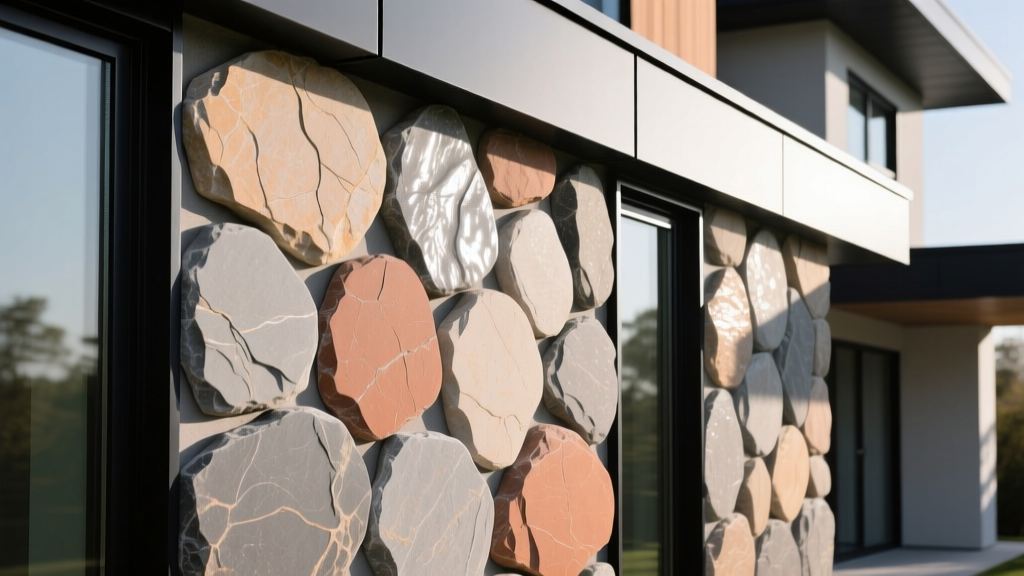
River rock stone veneer replicates the smooth, water-tumbled stones found in natural riverbeds. Unlike stacked stone or ledgestone profiles that rely on flat, linear edges, river rock features rounded, irregular faces ranging from 2 inches to 8 inches in diameter. This organic geometry creates deep shadow lines and a highly textured, three-dimensional surface. For buyers, the primary decision hinges on choosing between sliced natural river rock and cast manufactured stone veneer (MSV). Both deliver the same aesthetic, but their structural weights, material costs, and installation tolerances differ significantly.
Choose Natural River Rock if: You require 100% authentic geological variation, are building a ground-level retaining feature, and have a budget exceeding $15 per square foot.
Choose Manufactured River Rock if: You are cladding upper-story exterior walls, require strict adherence to ASTM C1670 weight limits, or want to keep material costs between $7 and $11 per square foot.
Natural vs. Manufactured River Rock: A Deep Comparison
The modern manufactured stone market has advanced to the point where high-end architectural veneers are virtually indistinguishable from natural stone once installed. However, the physical properties of the materials dictate where and how they can be used.
| Feature | Natural Sliced River Rock | Manufactured River Rock (MSV) |
|---|---|---|
| Weight per Sq. Ft. | 12 – 18 lbs | 6 – 9 lbs |
| Average Thickness | 1.5 – 3 inches | 0.75 – 2 inches |
| Material Cost (2026) | $13.00 – $19.00 / sq. ft. | $7.50 – $11.50 / sq. ft. |
| Governing Standard | ASTM C568 / C616 | ASTM C1670 |
| Color Consistency | High variance between batches | Controlled via oxide pigments |
Top Manufactured Brands and Specific Profiles
When sourcing manufactured river rock, avoid unbranded big-box options that often suffer from repetitive molds and flat coloring. Instead, specify architectural-grade profiles from established manufacturers:
- Eldorado Stone (River Rock Profile): Known for deep, rounded molds that capture the exact geometry of water-tumbled stones. Their colorways, such as 'Nantucket' and 'Sierra', utilize integrated iron-oxide pigments that prevent fading.
- Cultured Stone by Boral (Dressed Fieldstone): While slightly more angular than pure river rock, this profile offers a similar rounded-face aesthetic with tighter joint tolerances, making it ideal for interior fireplace surrounds.
- Coronado Stone (River Rock): Offers a slightly larger average stone diameter (up to 9 inches), which reduces the number of grout joints and speeds up installation on large exterior facades.
Calculating Coverage, Waste, and Material Costs
Estimating river rock veneer requires a different mathematical approach than flat ledgestone. Because the stones are rounded and irregular, the grout joints are wider, meaning you need less stone per square foot of wall area, but the waste factor during cutting is higher.
The Corner Conversion Formula
River rock corners are critical for maintaining the illusion of full-depth masonry. Corners are sold by the linear foot (LF), while flat stones are sold by the square foot (SF). The industry standard conversion is that 1 linear foot of corner pieces covers approximately 0.75 square feet of flat wall area.
Calculation Example: If your project features 100 SF of wall space and 30 LF of outside corners, you must subtract the corner coverage (30 LF x 0.75 = 22.5 SF) from your total wall area. You will need to order 30 LF of corners and 77.5 SF of flats.
Substrate Preparation and Moisture Management
The most common failure mode for exterior stone veneer is not the stone itself, but moisture entrapment behind the cladding. According to Building Science Corporation's guidelines on water-resistive barriers, a drained and vented air space is highly recommended for veneers in wet climates.
Step-by-Step Substrate Requirements
- Weather-Resistive Barrier (WRB): Apply two layers of Grade D building paper or a high-performance housewrap (like Tyvek CommercialWrap) over the OSB or plywood sheathing. The dual-layer approach creates a micro-drainage plane.
- Weep Screed Installation: Install a corrosion-resistant weep screed at the base of the wall. The screed must maintain a minimum clearance of 4 inches above grade (soil) or 2 inches above paved surfaces to prevent capillary action and termite ingress.
- Wire Lath Attachment: Use 2.5 lb per square yard, 18-gauge galvanized wire lath. Fasten it using corrosion-resistant stucco nails or staples that penetrate the structural studs by at least 1 inch. Fasteners must be spaced no more than 6 inches apart vertically and 16 inches horizontally.
- Scratch Coat: Apply a 1/2-inch thick scratch coat of Type S mortar. Scarify the surface horizontally with a raking tool to provide a mechanical key for the final stone-setting mortar.
Mortar Selection and Grouting Techniques
Do not use Type N mortar for exterior river rock installations. Type N has a compressive strength of roughly 750 psi, which is insufficient for exterior freeze-thaw cycles. You must specify Type S mortar, which delivers a minimum compressive strength of 1,800 psi and superior bond strength.
The 'Over-Grouting' Trap
Because river rock stones are rounded, the natural crevices between them are deep. Inexperienced masons often attempt to fill these crevices completely with mortar (over-grouting) to ensure a watertight seal. This is a critical aesthetic and structural mistake. Over-grouting obscures the stone's profile, creating a flat, muddy appearance.
The Correct Technique: Apply mortar only to the back of the stone (buttering) and press it into the scratch coat, leaving a 1/2-inch to 1-inch recessed joint between the stones. Once the mortar has set to a thumbprint hardness, use a stiff-bristle brush to clean the stone faces and texture the recessed joints. This preserves the deep shadow lines while maintaining structural integrity.
Frequently Asked Questions (FAQ)
Can I install river rock veneer directly over painted brick or drywall?
No. Painted surfaces prevent mortar adhesion, and drywall cannot support the sheer weight of the veneer or withstand the moisture introduced during installation. You must strip the drywall and install a proper cement backer board or metal lath over structural sheathing. For painted brick, the paint must be entirely removed via sandblasting or chemical strippers before attaching wire lath with masonry anchors.
Does manufactured river rock require a sealant?
High-quality manufactured stone colored with integral iron-oxide pigments (such as those meeting Eldorado Stone's manufacturing specifications) does not require sealing for color retention. However, if the installation is in a high-splash zone (like a backyard water feature or exterior wainscoting near soil), applying a breathable, silane-siloxane penetrating sealer will prevent efflorescence and water staining without altering the stone's matte finish.
How does river rock veneer perform in seismic zones?
When installed to ASTM C1670 and local building codes, manufactured stone veneer performs exceptionally well in seismic zones. Its lightweight nature (under 10 lbs/sq ft) means it exerts significantly less lateral force on wall assemblies during an earthquake compared to full-bed natural masonry. Ensure that control joints in the underlying framing are mirrored in the veneer installation to accommodate structural deflection.
Written by
Priya KapoorPriya Kapoor is a real estate market analyst and construction economics researcher with expertise in housing affordability, development feasibility, and infrastructure investment. She holds a Master of Regional Planning from Cornell University and previously worked as a senior analyst at CBRE's Investment Properties group, where she modeled returns for $4B in mixed-use development pipelines. Priya now runs an independent research practice advising developers, municipalities, and REITs on construction cost forecasting and market timing. She publishes the quarterly "BuildMat Market Pulse" report tracking material price indices across 12 commodity categories. Based in Austin, TX, Priya serves on the board of Habitat for Humanity Austin and is a marathon runner.
More from Priya Kapoor
View all
Construction Cost
Cost to Build a 1600 Sq Ft Home in 2026: Full Breakdown
Accurate 2026 cost to build a 1600 sq ft home—material, labor, and regional pricing breakdowns included. Plan your budget with real-time estimates.
Aug 11, 2026

Wood & Lumber
Name the Types of Wood for Pressure Treatment and Preservation
Learn how to name the types of wood best suited for pressure treatment. Compare species treatability, chemical retention levels, and 2026 preservation costs.
Aug 4, 2026

Stone & Masonry
Stone Veneer Suppliers Lindenhurst: 2026 Cost Analysis
Analyze 2026 stone veneer costs in Lindenhurst, NY. Compare local supplier pricing, delivery fees, and Suffolk County installation labor rates.
Aug 4, 2026