Sourcing Stone Veneer for Sale Near Me: A Complete Buyer's Guide
Discover how to source, evaluate, and price stone veneer for sale near you. Compare local freight costs, material specs, and supplier vetting frameworks.
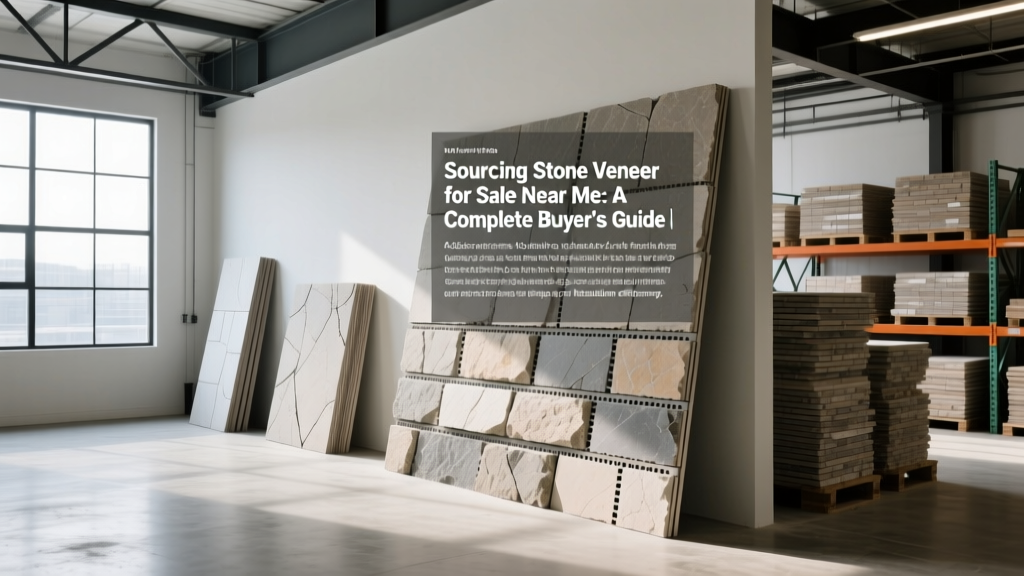
Searching for 'stone veneer for sale near me' is the most critical first step in any masonry cladding project. Unlike lightweight siding materials, stone veneer is exceptionally dense, meaning localized sourcing is not just a matter of convenience—it is a strict logistical and financial necessity. Manufactured stone veneer (MSV) typically weighs between 10 and 13 pounds per square foot, while natural stone veneer can exceed 15 pounds per square foot. When you factor in a standard residential facade requiring 800 to 1,200 square feet, you are moving 10,000 to 18,000 pounds of material. This guide provides a technical framework for evaluating local suppliers, calculating hidden freight costs, and specifying the correct materials for your regional climate.
The Hidden Variable: Local Freight and Weight Logistics
When evaluating stone veneer for sale near you, the sticker price per square foot is only half the equation. The delivered cost is heavily skewed by freight. Big box retailers often advertise low national prices, but their localized delivery fees for palletized masonry can erase any perceived savings. Dedicated local masonry yards, conversely, often bundle delivery into a flat radius fee or offer customer pickup for heavy-duty trucks.
| Delivery Radius | Estimated Freight Cost (Per Pallet) | Sourcing Strategy |
|---|---|---|
| 0 - 25 Miles | $95 - $175 | Utilize local masonry yards; customer pickup is viable if you have a 3/4-ton truck and equipment trailer. |
| 26 - 75 Miles | $180 - $350 | Compare regional distributors. Look for yards offering 'route days' where multiple deliveries in your zip code share a flatbed truck. |
| 76 - 150 Miles | $400 - $750+ | LTL (Less Than Truckload) freight rates apply. At this distance, you must source locally or absorb a 20-30% premium on total material cost. |
Most local delivery trucks are equipped with a Moffett (truck-mounted forklift). However, if your job site has soft grading, steep inclines, or narrow access gates, the driver will perform a 'curbside drop' only. Always verify site access conditions with the local yard's dispatch team before the delivery date to avoid pallets being left in the street.

Big Box Retailers vs. Dedicated Masonry Yards
Not all local stone veneer suppliers offer the same inventory depth. Understanding the difference between retail home centers and professional masonry suppliers will dictate the quality and variety of your project.
Big Box Home Centers
- Inventory: Limited to 3-5 core profiles of manufactured stone veneer (typically brands like Eldorado Stone or Cultured Stone).
- Pros: Immediate availability for small patches; easy returns; integrated financing.
- Cons: High waste factors due to limited corner piece availability; staff lack technical masonry knowledge regarding mortar mixes and weep screeds.
Professional Masonry & Landscape Supply Yards
- Inventory: Full catalogs from premium manufacturers (Coronado Stone, Dutch Quality Stone, Boral), plus regional natural stone quarries (limestone, fieldstone, slate).
- Pros: Access to specialized transition pieces, hearthstones, and exact mortar-matching pigments; expert technical support.
- Cons: Often require a minimum order quantity (e.g., one full pallet) and may charge a restocking fee for specialized orders.
Material Specifications to Demand from Local Dealers
When you find stone veneer for sale near you, do not rely solely on visual appeal. You must verify the material's structural and environmental ratings. According to the Masonry Veneer Manufacturers Association (MVMA), adhered manufactured stone must meet strict performance criteria to prevent delamination and moisture intrusion.
'Always request the manufacturer's compliance certificate for ASTM C1670 (Standard Specification for Adhered Manufactured Stone Masonry Veneer). If the local dealer cannot provide this documentation, the product may be a non-compliant decorative concrete mix prone to spalling and efflorescence.'
For natural stone veneer, ask the supplier for the stone's water absorption rate tested under ASTM C97. In climates with freezing winter temperatures, the natural stone must have an absorption rate of less than 3% to survive freeze-thaw cycles without micro-fracturing.
Regional Climate Matching Framework
The 'best' stone veneer is entirely dependent on your local microclimate. Use this framework when consulting with your local supplier to ensure the material can withstand regional environmental stressors.
- Freeze/Thaw Zones (Midwest, Northeast): Avoid highly porous natural sandstones. Opt for high-density manufactured stone or sealed granite/slate veneers. Ensure the local yard supplies a polymer-modified mortar mix designed for high-flexibility to accommodate thermal expansion.
- Coastal & Salt-Air Environments (Gulf, Eastern Seaboard): Natural limestone and marble are highly susceptible to acid erosion from salt spray. Specify manufactured stone with integral iron-oxide pigments that are UV and salt-stable. Avoid metal lath; demand Galfan-coated (zinc-aluminum) or stainless steel woven wire lath from the supplier to prevent rust bleeding through the mortar.
- Arid & High-UV Zones (Southwest, Mountain West): UV degradation can fade cheap topical stains. Ensure the local supplier confirms the MSV uses 'integral color' (pigment mixed throughout the concrete matrix) rather than surface-applied stains.
The Complete Local Sourcing Checklist: Beyond the Stone
Amateur buyers focus solely on the stone. Professional masons know that a successful installation requires sourcing a complete weather-resistive barrier (WRB) and drainage system from the local yard. When pricing your local stone veneer, ensure the quote includes the following ancillary materials:
- Weather-Resistive Barrier (WRB): Two layers of Grade D felt paper or a specialized rainscreen mat (like Keene DriWall) to create a capillary break.
- Corrosion-Resistant Lath: 2.5 lb self-furring galvanized woven wire lath. (Do not use standard chicken wire or non-galvanized stucco netting).
- Weep Screed: A minimum 26-gauge galvanized steel weep screed with a 3.5-inch nailing flange, installed at the base of the wall to allow trapped moisture to escape.
- Mortar Mix: Type S masonry cement. Type S provides the higher compressive and bond strength required for vertical adhered veneer applications compared to Type N.
Calculating Your Local Order: Pallet Configurations and Waste Factors
Local masonry yards sell stone veneer in specific pallet configurations. Understanding these metrics prevents costly mid-project shortages, which can result in severe dye-lot variations if the yard has to order a secondary batch.
Flat Veneer: Sold by the square foot. A standard pallet contains 250 to 300 sq. ft. and weighs roughly 3,000 lbs.
Corner Pieces: Sold by the linear foot (LF). Corners cover approximately 0.75 sq. ft. of flat wall area per LF. Always measure corners first and deduct their coverage from your flat square footage calculation.
Waste Factor: Add 10% for standard field cuts. Add 15-20% if you are installing a complex profile (like dry-stack ledgestone) around multiple windows, doors, and outside corners.
By applying these logistical, technical, and mathematical frameworks to your search for local stone veneer, you transition from a passive consumer to an informed project manager. This ensures the material you source from a nearby yard is not only visually striking but structurally sound, correctly priced, and fully supported by the right ancillary masonry components.
Written by
Elena RodriguezElena Rodriguez is a civil engineer and technical writer specializing in concrete technology, masonry systems, and ASTM/ACI compliance. She earned her B.S. in Civil Engineering from Texas A&M University and spent a decade at a materials testing laboratory, performing over 2,000 concrete compressive strength tests and masonry prism evaluations. Elena is an ACI-certified Field Testing Technician (Grade I) and a member of ASTM Committee C12 on Natural Building Stone. She currently consults on forensic engineering cases involving concrete failures and moisture intrusion. Based in San Antonio, TX, Elena is a proud member of the Society of Women Engineers (SWE) and coaches her daughter's FIRST Robotics team.
More from Elena Rodriguez
View all
Walls & Panels
Cost Analysis: Light Gauge Steel Framing Advantages and Disadvantages
Evaluate light gauge steel framing advantages and disadvantages through a strict cost analysis lens, comparing material, labor, and lifecycle expenses.
Aug 4, 2026

Walls & Panels
Gypsum Board Types: Exact Specifications, Thickness & Dimensions
Compare standard, Type X, and moisture-resistant gypsum board types. Get exact specifications, thicknesses, dimensions, and ASTM standards for your project.
Aug 4, 2026

Fire Resistance
Best Fire-Resistant Outdoor Decking Materials: 2026 Buyer Guide
Discover the best fire-resistant outdoor decking materials for 2026. Compare Class A PVC, aluminum, and hardwood options for WUI compliance and safety.
Aug 4, 2026