Stone Veneer vs Real Stone: Complete Cost Analysis & ROI
Compare stone veneer vs real stone costs. Discover material pricing, installation labor, structural requirements, and long-term ROI for your project.
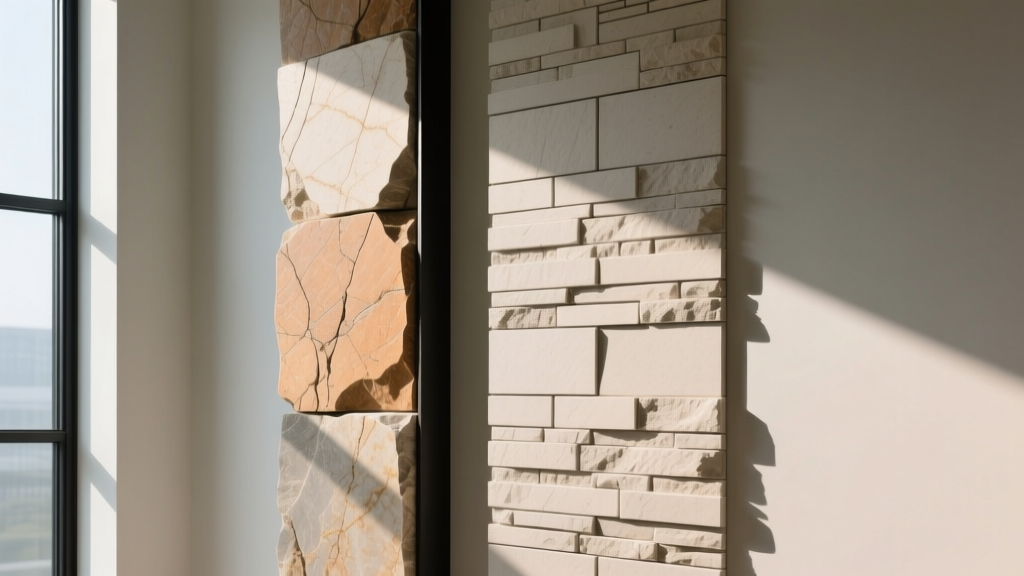
The Structural Divide: Weight and Load-Bearing Requirements
When evaluating stone veneer vs real stone (often referred to in the trade as full-bed or full-thickness natural stone), the primary cost driver is not the material itself, but the structural preparation required to support it. Full-bed natural stone typically weighs between 35 and 50 pounds per square foot (psf). Because of this immense dead load, building codes mandate a continuous, reinforced concrete footing that extends below the local frost line. For a standard two-story residential elevation, this means excavating and pouring a footing that is at least 12 inches wide and 8 to 12 inches deep, adding significant upfront labor and material costs.
Manufactured stone veneer (MSV), conversely, is engineered from Portland cement, lightweight aggregates, and iron oxide pigments. It weighs between 10 and 15 psf. According to the Masonry Veneer Manufacturers Association (MVMA), this lightweight profile allows MSV to be anchored directly to standard wood or steel stud framing using a weather-resistive barrier, corrosion-resistant metal lath, and a scratch coat. No structural footing is required, which immediately eliminates thousands of dollars in excavation and concrete work from the project budget.
Comprehensive Cost Breakdown: Material, Labor, and Prep
The following data reflects current national averages for exterior residential applications. Prices fluctuate based on regional labor rates, stone rarity, and site accessibility.
| Cost Category | Manufactured Stone Veneer (MSV) | Full-Bed Real Stone |
|---|---|---|
| Material Cost (per sq. ft.) | $8.00 - $16.00 | $18.00 - $45.00+ |
| Labor & Installation (per sq. ft.) | $10.00 - $18.00 | $20.00 - $35.00 |
| Structural Footing & Prep | $0 (Not required) | $15.00 - $30.00 per linear ft. |
| Corner Pieces (per linear ft.) | $12.00 - $25.00 | $25.00 - $60.00 |
| Total Installed Cost (per sq. ft.) | $18.00 - $34.00 | $38.00 - $80.00+ |
The Hidden Cost of Full-Bed: Footings and Excavation
Contractors often quote full-bed stone on a per-square-foot basis that excludes the footing. For a 500-square-foot facade, you are likely looking at 80 to 100 linear feet of footing. At an average of $22 per linear foot for trenching, forming, rebar tying, and pouring concrete, the hidden structural cost adds $1,760 to $2,200 to the project before a single stone is laid. Furthermore, if the site requires heavy machinery access for excavators and concrete pump trucks, site prep fees can escalate rapidly.
Material Science: Mortar Selection and Moisture Management
The longevity of any masonry application relies heavily on the mortar mix and moisture management systems. The Natural Stone Institute emphasizes that improper mortar selection is the leading cause of spalling and efflorescence in natural stone installations.
- Type N Mortar (1:1:6 ratio): One part Portland cement, one part hydrated lime, and six parts sand. This is the standard for most manufactured stone veneer and softer natural stones (like sandstone or limestone). Its lower compressive strength (approx. 750 psi) allows for slight thermal expansion and contraction without cracking the stone.
- Type S Mortar (1:0.5:4.5 ratio): Higher compressive strength (approx. 1,800 psi). Required for full-bed hard stones like granite or quartzite, and for applications below grade or in high-seismic zones where lateral shear resistance is critical.
Moisture Management Edge Case: When installing MSV over wood framing, a weep screed is non-negotiable. Per ASTM C1063 standards, a corrosion-resistant weep screed must be installed at the base of the wall to allow trapped moisture to escape behind the weather-resistive barrier. Omitting this $3-per-linear-foot component leads to water pooling at the sill plate, resulting in wood rot and efflorescence (white, powdery salt deposits) on the stone face within 12 to 18 months.
Long-Term ROI and Appraisal Value
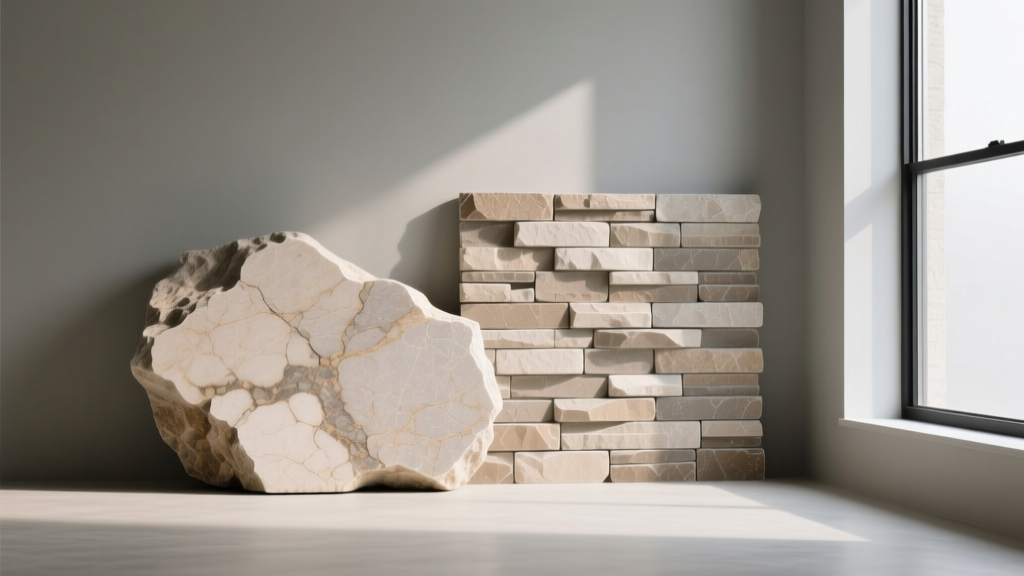
From a pure financial perspective, the return on investment (ROI) differs significantly between the two materials. Full-bed natural stone is universally recognized by appraisers as a premium, luxury finish. In high-end residential markets, a full natural stone exterior can increase the appraised value of a home by 1% to 3% above the baseline construction cost, effectively yielding a 100% to 150% ROI at resale.
Manufactured stone veneer, while highly realistic in modern iterations (with high-end architectural lines featuring 3D shadowing and varied mineral oxide pigments), is still classified as a synthetic cladding. It typically yields an 85% to 95% cost recovery at resale. However, because the initial capital expenditure for MSV is roughly 50% lower than full-bed stone, the actual dollar amount required to recoup the investment is much smaller, making it the superior choice for mid-market renovations where keeping the total project cost under the neighborhood comps is vital.
💡 Pro-Tip for Maximizing MSV ROI
To prevent manufactured stone from looking flat or repetitive on large facades, specify a 'blended' color palette from the manufacturer and insist the mason uses a 'dry-stack' layout technique before mortaring. Furthermore, always purchase 15% overage rather than the standard 10% to ensure the mason has enough unique pieces to avoid placing identical stones adjacent to one another, which is the primary visual giveaway of synthetic veneer.
Specification Decision Matrix
Use the following framework to determine which material aligns with your project's structural, financial, and aesthetic parameters.
| Project Scenario | Specify MSV | Specify Full-Bed Real Stone |
|---|---|---|
| Retrofitting an existing wood-framed exterior wall | YES | NO (Requires structural retrofit) |
| New build luxury custom home with engineered foundation | Acceptable | YES (Maximizes appraisal) |
| Interior fireplace surround (non-combustible backing) | YES (Easier DIY/Lightweight) | YES (If hearth can support load) |
| High-moisture environment (e.g., retaining walls, water features) | NO (Prone to freeze-thaw spalling) | YES (Use high-density granite/basalt) |
| Budget-constrained facade update for quick resale | YES (Faster payback period) | NO (Over-improvement risk) |
Ultimately, the choice between stone veneer vs real stone hinges on the structural capacity of the substrate and the financial ceiling of the project. While full-bed natural stone remains the undisputed king of permanence and luxury valuation, modern manufactured stone veneer offers a highly pragmatic, code-compliant, and cost-effective alternative that delivers 90% of the aesthetic impact at 50% of the total installed cost.
Written by
Sarah WhitfieldSarah Whitfield is a chartered quantity surveyor (MRICS) and construction cost analyst with 15 years of experience in material pricing, procurement strategy, and project budgeting. She earned her degree in Construction Management from the University of Reading (UK) and has worked on projects ranging from $2M custom homes to $180M mixed-use developments across North America and Europe. Sarah currently leads cost estimating for BuildMat Insight, maintaining a proprietary database of 4,000+ material price points updated quarterly. She is a frequent contributor to RSMeans cost data panels and has presented at the International Cost Engineering Council (ICEC) congress. Based in Denver, CO, Sarah is an avid trail runner and volunteer mentor for Women in Construction.
More from Sarah Whitfield
View all
Wood & Lumber
What Are the Different Types of Wood? A Builder's Guide
Compare structural softwoods, finish hardwoods, and engineered lumber. Analyze Janka ratings, MOE values, and 2026 pricing for construction.
Aug 4, 2026

Walls & Panels
Steel Framing vs Wood Framing: Corrosion and Moisture Defense
Compare steel framing vs wood framing for moisture resistance. Learn about galvanized coatings, condensation risks, and corrosion protection strategies.
Jul 21, 2026

Stone & Masonry
How to Cut Stone Veneer: Wet Saw vs Grinder Comparison
Compare the best tools for cutting stone veneer. We review wet saws, angle grinders, and chop saws to help you achieve clean, chip-free cuts.
Jul 21, 2026