Stucco Stone Veneer Exteriors: Cost & Cladding Comparison
Compare stucco and stone veneer exteriors for 2026. Explore costs, moisture management at material transitions, and durability data for mixed facades.
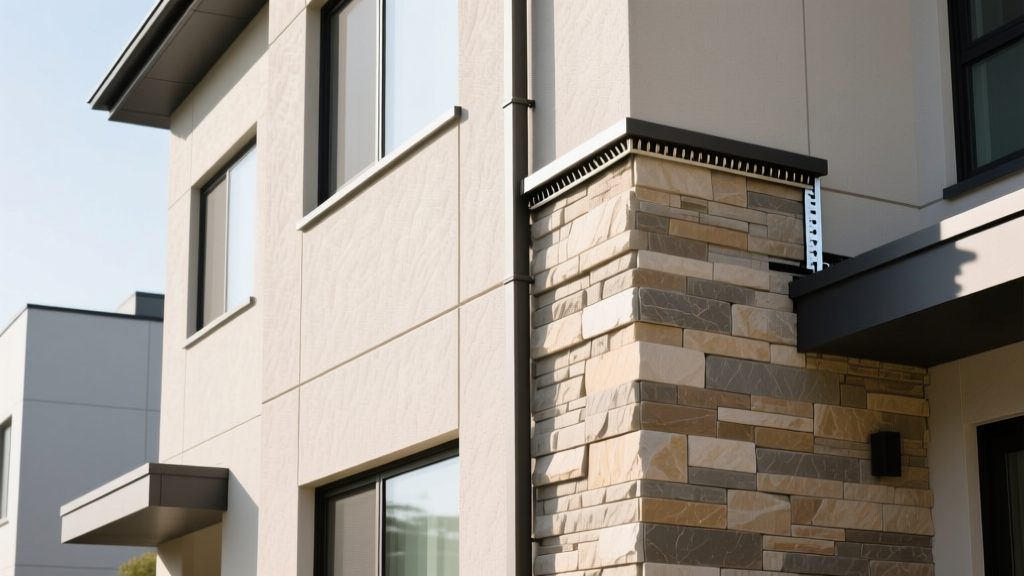
The Architecture of Mixed-Material Exteriors
Integrating multiple cladding materials on a single facade has become a defining characteristic of contemporary residential architecture. When designing a stucco stone veneer exterior, builders and homeowners are typically attempting to balance the sleek, monolithic aesthetic of traditional Portland cement stucco with the tactile, grounded weight of manufactured or natural stone veneer. However, combining these two distinct cementitious systems introduces complex structural and moisture-management challenges that single-material facades do not face.
This comparison review evaluates traditional three-coat stucco against Manufactured Stone Veneer (MSV) across critical performance metrics, provides updated 2026 cost data, and details the exact flashing assemblies required to prevent catastrophic water intrusion at the material transition points.
Material Breakdown: Traditional Stucco vs. Manufactured Stone Veneer
While both systems rely on Portland cement as a primary binder, their physical properties, weight loads, and installation methodologies differ significantly. Traditional stucco (applied in three coats: scratch, brown, and finish) over metal lath provides a continuous, semi-rigid shell. MSV, governed by ASTM C1670/C1670M standards, consists of individual cast units adhered to a mortar bed over a similar lath and weather-resistive barrier (WRB) base.
| Metric | Traditional 3-Coat Stucco | Manufactured Stone Veneer (MSV) |
|---|---|---|
| Average Weight | 10.4 lbs / sq. ft. | 6.0 to 8.5 lbs / sq. ft. |
| Thickness (Total Assembly) | 7/8" to 1" | 1.5" to 2.5" (including mortar bed) |
| R-Value (Cladding Only) | 0.20 per inch | 0.10 to 0.15 per inch |
| Impact Resistance | High (continuous shell) | Moderate (individual units can chip) |
| Expected Lifespan | 50 to 80 years | 50+ years (color fading may occur) |
2026 Cost Analysis: Stucco, Stone Veneer, and Combined Facades
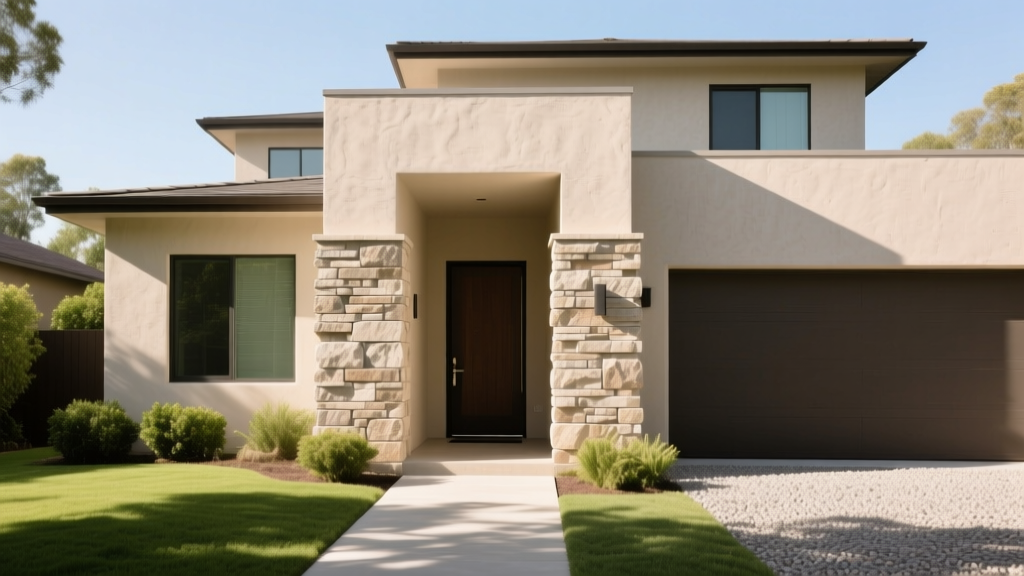
Material and labor costs for exterior cladding have stabilized in 2026 following the supply chain volatility of the early 2020s, but specialized masonry labor remains at a premium. The financial decision between stucco and stone veneer often dictates the material allocation on mixed facades, with builders frequently using stucco for upper stories and field walls, reserving stone veneer for wainscoting, entryways, and foundation accents.
Installed Cost Ranges (Per Square Foot)
- Traditional 3-Coat Stucco: $9.50 – $14.00 / sq. ft.
- Manufactured Stone Veneer (Standard Profiles): $16.00 – $22.00 / sq. ft.
- Premium MSV (Hand-Placed, Custom Blends): $24.00 – $32.00 / sq. ft.
- Transition Detailing (Flashing & Casing Beads): Adds $3.50 – $6.00 per linear foot at material intersections.
Moisture Management: The Stucco-to-Stone Transition
The most common failure mode in mixed-material exteriors is water intrusion at the intersection where stucco meets stone veneer. Because MSV is highly porous and can absorb significant rainwater, it acts as a reservoir cladding. If a horizontal transition places stucco below stone veneer without proper Z-flashing, water migrating through the stone mortar bed will drain directly behind the stucco finish coat, leading to efflorescence, freeze-thaw spalling, and structural framing rot.
Step-by-Step Transition Assembly
To ensure compliance with Stucco Manufacturers Association (SMA) guidelines and ASTM C1063, execute the following sequence at horizontal transitions where stone veneer sits above stucco:
- Base WRB Integration: Apply the primary weather-resistive barrier continuously across the entire wall plane before any lath is installed.
- Lath Overlap: Install self-furring metal lath. Where the two materials meet, the lath for the upper material (stone) must overlap the lath for the lower material (stucco) by a minimum of 2 inches to shed water outward.
- Z-Flashing Installation: Install a corrosion-resistant Z-flashing (minimum 26-gauge galvanized steel or 0.019" aluminum) at the horizontal transition line. The upper leg must extend behind the WRB of the upper section, and the lower leg must extend at least 2 inches over the scratch coat of the lower stucco section.
- Casing Bead Placement: Terminate the stucco finish coat against a weep casing bead just below the Z-flashing to maintain a 3/8" gap, preventing capillary action from drawing water upward into the stucco.
- Sealant Joint: Do not hard-mortar the joint between the stone and the flashing. Leave a 3/8" gap and fill it with a high-quality, paintable polyurethane sealant (such as Sika Flex or OSI Quad) to accommodate differential thermal expansion between the two cementitious masses.
Climate Performance & Maintenance Realities
The longevity of a stucco stone veneer facade is heavily dictated by the regional climate. The two materials react differently to thermal cycling and moisture exposure.
Freeze-Thaw Regions (Northeast, Midwest)
In climates with severe freeze-thaw cycles, MSV is highly susceptible to spalling if the mortar joints are tooled improperly or if a non-breathable masonry sealer is applied. Stucco performs better here, provided the mix design includes an air-entraining agent (typically 3% to 6% air content) to allow for microscopic expansion when trapped water freezes. Maintenance: Expect to re-caulk the transition joints every 7 to 10 years. Never apply acrylic elastomeric coatings over MSV in these regions, as it traps moisture inside the stone units.
High UV and Arid Regions (Southwest, Southern California)
Stucco is the undisputed performer in high-UV environments. The integral pigments in modern Portland cement stucco are completely UV-stable. Conversely, some lower-tier manufactured stone veneers utilize iron-oxide pigments that can experience slight UV fading or chalking after 15 to 20 years of intense, direct solar exposure. Maintenance: Stucco may require fog-coating (a thin cement-pigment slurry) every 20 years to refresh minor hairline crazing, while MSV in arid climates is virtually maintenance-free beyond occasional rinsing to remove dust accumulation.
Expert Decision Framework: Specifying the Facade
Choosing the right ratio of stucco to stone veneer requires balancing budget, architectural style, and structural load limits. Use this framework to finalize your exterior cladding specification:
- Your budget is capped below $16/sq. ft. for exterior cladding.
- The architectural style is Mediterranean, Spanish Revival, or Contemporary Minimalist.
- You are retrofitting an older structure where the foundation cannot support the additional 8 lbs/sq. ft. load of full-stone wainscoting without underpinning.
- The design calls for Craftsman, Tudor, or French Country aesthetics requiring heavy textural grounding.
- The structure is located in a high-impact zone (e.g., near heavy foot traffic, driveways, or landscaping equipment) where stucco would easily chip or crack upon impact.
- You are utilizing a rain-screen drainage mat system (like Mortairvent) behind the cladding, which is easier to integrate continuously behind the thicker stone veneer profile.
Ultimately, a successful stucco stone veneer exterior relies less on the aesthetic selection of the stone profile and more on the rigorous execution of the underlying moisture-management assembly. By treating the transition lines as critical structural joints rather than mere cosmetic seams, builders can ensure the facade remains watertight and visually pristine for decades.
Written by
Sarah WhitfieldSarah Whitfield is a chartered quantity surveyor (MRICS) and construction cost analyst with 15 years of experience in material pricing, procurement strategy, and project budgeting. She earned her degree in Construction Management from the University of Reading (UK) and has worked on projects ranging from $2M custom homes to $180M mixed-use developments across North America and Europe. Sarah currently leads cost estimating for BuildMat Insight, maintaining a proprietary database of 4,000+ material price points updated quarterly. She is a frequent contributor to RSMeans cost data panels and has presented at the International Cost Engineering Council (ICEC) congress. Based in Denver, CO, Sarah is an avid trail runner and volunteer mentor for Women in Construction.
More from Sarah Whitfield
View all
Wood & Lumber
What Are the Different Types of Wood? A Builder's Guide
Compare structural softwoods, finish hardwoods, and engineered lumber. Analyze Janka ratings, MOE values, and 2026 pricing for construction.
Aug 4, 2026

Walls & Panels
Steel Framing vs Wood Framing: Corrosion and Moisture Defense
Compare steel framing vs wood framing for moisture resistance. Learn about galvanized coatings, condensation risks, and corrosion protection strategies.
Jul 21, 2026

Stone & Masonry
How to Cut Stone Veneer: Wet Saw vs Grinder Comparison
Compare the best tools for cutting stone veneer. We review wet saws, angle grinders, and chop saws to help you achieve clean, chip-free cuts.
Jul 21, 2026