Acceptance of Recycled Plastic Building Materials: 2026 Trends
Explore the 2026 market acceptance of recycled plastic building materials, comparing HDPE lumber, PET insulation, and composite structural panels.
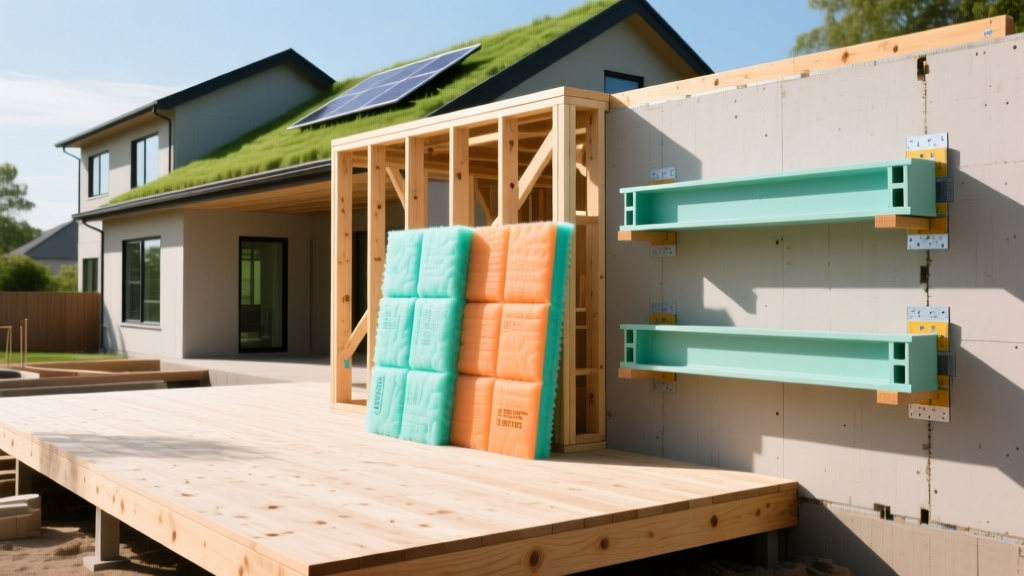
The Shift Toward Circular Construction
The acceptance of recycled plastic building materials has transitioned from a niche landscaping trend to a core component of commercial and residential envelope specifications. In 2026, advancements in polymer sorting and compatibilizer additives have resolved historical issues with delamination and structural inconsistency. Today, post-consumer recycled (PCR) plastics are routinely engineered into high-performance building products that meet or exceed ASTM standards for moisture resistance, thermal insulation, and load-bearing capacity.
Architects and general contractors are no longer viewing recycled plastics merely as a 'green' alternative, but as a technically superior solution for high-moisture, high-decay environments where traditional timber and mineral-based materials fail. This shift is heavily driven by stringent embodied carbon mandates and the widespread adoption of Environmental Product Declarations (EPDs).
- Market Penetration: Recycled Plastic Lumber (RPL) now accounts for 22% of the commercial boardwalk and marine decking market.
- Carbon Reduction: Utilizing 100% PCR HDPE lumber sequesters approximately 3.2 kg of CO2e per linear foot compared to pressure-treated Southern Yellow Pine.
- Waste Diversion: A standard 2,500 sq. ft. residential build utilizing rPET insulation and recycled PVC roofing diverts an average of 850 lbs of plastic from landfills.
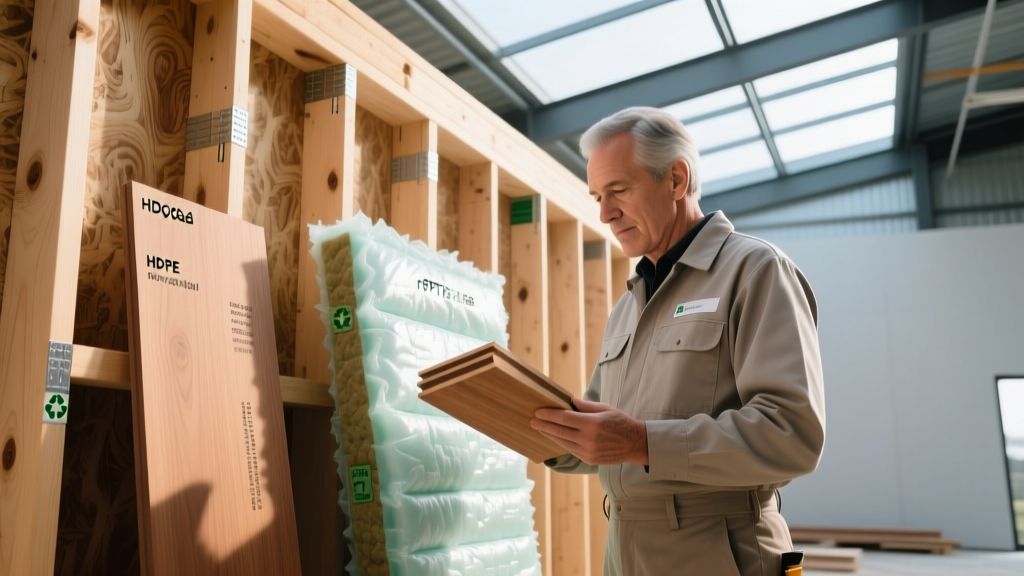
Material Comparison Matrix: Recycled Plastics vs. Traditional Alternatives
To understand the current market acceptance of recycled plastic building materials, we must compare their physical properties and lifecycle costs directly against conventional materials. The table below outlines the three most widely specified PCR plastic products in 2026.
| Material | Primary Application | PCR Content | Key Performance Metric | Est. Cost (2026) | Primary Limitation |
|---|---|---|---|---|---|
| Recycled HDPE Lumber | Marine decking, boardwalks, landscaping | 90-100% | 0% water absorption; immune to rot/insects | $9.50 - $14.00 / sq.ft. | High thermal expansion; structural creep under sustained load |
| rPET Insulation Batts | Exterior wall cavities, acoustic panels | 80-90% | R-4.2 per inch; Class A fire rating (borate treated) | $1.10 - $1.45 / sq.ft. | Lower compressive strength than rigid mineral wool |
| Recycled PVC Membrane | Commercial flat roofing, waterproofing | 30-50% | 400+ PSI tensile strength; 30-year weathering | $3.50 - $5.20 / sq.ft. | Plasticizer migration over time if not properly formulated |
| Traditional Wood (PT) | General framing, decking | 0% | High structural stiffness (MOE) | $3.50 - $6.00 / sq.ft. | Susceptible to rot, warping, and chemical leaching |
Key Drivers Accelerating Market Acceptance
The rapid integration of these materials into mainstream construction documents is not accidental. Three primary regulatory and market forces are driving the acceptance of recycled plastic building materials in 2026:
1. LEED v4.1 and Living Building Challenge Credits
Under the USGBC LEED Materials and Resources (MR) credits, projects earn significant points for sourcing materials with verified post-consumer recycled content. Recycled HDPE and rPET products easily satisfy the 'Building Product Disclosure and Optimization' credit, helping projects achieve Platinum certification. Furthermore, the Living Building Challenge's Red List restrictions heavily favor inert, non-leaching recycled plastics over traditional pressure-treated woods that contain copper azole or alkaline copper quaternary (ACQ).
2. Standardization of Environmental Product Declarations (EPDs)
Historically, the lack of transparent lifecycle data hindered the specification of recycled plastics. Today, major manufacturers provide ISO 14025 compliant EPDs. According to the EPA's guidelines on plastics recycling and material management, verified EPDs allow structural engineers to accurately calculate the Global Warming Potential (GWP) of a project, making PCR plastics highly attractive for firms targeting net-zero embodied carbon.
3. Circular Economy Mandates
With extended producer responsibility (EPR) laws expanding across North America and Europe, the construction industry is under pressure to close the loop on materials. The Ellen MacArthur Foundation's circular economy frameworks highlight construction as a critical sector for absorbing hard-to-recycle mixed plastics, transforming waste streams into durable, 50-year building envelopes.
Real-World Failure Modes and Edge Cases
Despite the growing acceptance of recycled plastic building materials, improper specification leads to catastrophic field failures. Engineers and contractors must account for the unique behavioral characteristics of polymers.
Recycled HDPE lumber has a coefficient of thermal expansion roughly 10 times greater than natural wood. A 20-foot board can expand or contract up to 1/2 inch across a 100°F temperature swing. Fix: Never butt joints tightly. Always use slotted holes for fastening and leave a minimum 1/8-inch gap per 10 feet of material length. Failure to do so will result in severe buckling and popped fasteners.
Structural Creep in Recycled Plastic Lumber (RPL)
Unlike wood, which exhibits immediate deflection under load and then stabilizes, RPL is viscoelastic. It experiences 'creep'—a continuous, slow deformation under sustained weight. If a contractor uses RPL for structural joists spaced at 24 inches on-center (standard for wood), the boards will permanently sag over 12 to 18 months. Specification Rule: RPL must be supported at a maximum of 16 inches on-center for decking, and 12 inches on-center for structural boardwalks. Always require the manufacturer's specific span tables based on ASTM D6109 testing.
Fire Performance Limitations
While rPET insulation can be treated with borates to achieve a Class A fire rating, solid HDPE and PVC lumber present different challenges. HDPE melts and drips when exposed to high heat, which can spread secondary fires in vertical applications. Therefore, recycled HDPE is strictly prohibited in interior fire-rated assemblies or exterior cladding on Type I and Type II non-combustible buildings without specific intumescent coatings or fire-break integrations.
Cost Analysis: Upfront Premium vs. Lifecycle ROI
The primary barrier to the acceptance of recycled plastic building materials remains the initial capital expenditure. However, a 2026 lifecycle cost analysis reveals a different financial reality for commercial developers and municipal projects.
- Marine Boardwalks (HDPE vs. Composite/PT Wood): While pressure-treated wood costs $4.50/sq.ft. installed and requires $1.20/sq.ft. in annual maintenance (sealing, board replacement), recycled HDPE costs $11.00/sq.ft. installed with near-zero maintenance. The ROI crossover point occurs at year 6. Over a 30-year lifecycle, HDPE saves municipalities approximately 45% in total cost of ownership.
- Insulation (rPET vs. Fiberglass): rPET batts carry a 15-20% premium over standard fiberglass. However, rPET does not slump or lose R-value when exposed to high humidity, a common failure mode in fiberglass that leads to HVAC energy losses. The energy savings typically recoup the material premium within 3 to 4 heating/cooling seasons.
Sourcing and Specification Framework for Architects
To successfully integrate these materials into your next project, follow this four-step specification framework to ensure performance and compliance:
- Demand Third-Party Certification: Require SCS Global Services or UL ECOLOGO certification to verify the exact percentage of post-consumer versus post-industrial recycled content. Vague claims of 'made from recycled materials' are insufficient for LEED documentation.
- Specify UV Stabilizers: For exterior HDPE or PVC applications, explicitly require the inclusion of Hindered Amine Light Stabilizers (HALS) and carbon black or titanium dioxide pigments to prevent UV-induced embrittlement and chalking.
- Mandate Stainless Steel Fasteners: Recycled plastics expand and contract, creating friction against fasteners. Specify 304 or 316 stainless steel screws with oversized, pan-head designs to prevent the screw head from pulling through the material during thermal contraction.
- Verify Acoustic Ratings: When using rPET for interior partitions, require an independent Sound Transmission Class (STC) test report. While rPET excels at dampening high-frequency noise, it requires decoupling channels to achieve an STC 50+ rating for low-frequency impact noise.
The acceptance of recycled plastic building materials is no longer a question of viability, but of precise engineering. By understanding the thermal, structural, and fire-performance nuances of PCR polymers, construction professionals can leverage these materials to build highly durable, low-carbon structures that stand the test of time.
Written by
Marcus ChenMarcus Chen is a licensed structural engineer (PE) and building materials analyst with over 12 years of experience across residential, commercial, and industrial construction. He holds a Master of Science in Civil Engineering from UC Berkeley and spent six years at Thornton Tomasetti before transitioning to independent consulting and technical writing. Marcus specializes in material selection for seismic-prone regions, concrete reinforcement strategies, and lifecycle cost analysis. His work has been cited by the American Concrete Institute (ACI) and the Structural Engineers Association of California (SEAOC). When he is not on a job site or at his desk, you will find him hiking the Sierra Nevada or restoring a 1920s craftsman bungalow in Oakland, CA.
More from Marcus Chen
View all
Construction Cost
How Much Did the Eiffel Tower Cost to Build?
How much did the Eiffel Tower cost to build in 1889? We adjust for inflation and compare its budget to modern skyscraper construction.
Aug 4, 2026

Fire Resistance
What Is a Fire Resistant Material? Testing & Certification Guide
Discover what is a fire resistant material through ASTM and UL testing. Learn how fire ratings, certifications, and assemblies work in construction.
Aug 4, 2026

Construction Cost
How Much Did the Burj Khalifa Cost to Build?
How much did the Burj Khalifa cost to build? We break down the $1.5B project and extract 5 money-saving strategies for your next build.
Jul 30, 2026