Stucco Paint Cost Calculator: 2026 Pricing & Coverage Guide
Calculate exact stucco paint costs, coverage rates by texture, and material pricing. Includes 2026 estimators for elastomeric and masonry coatings.
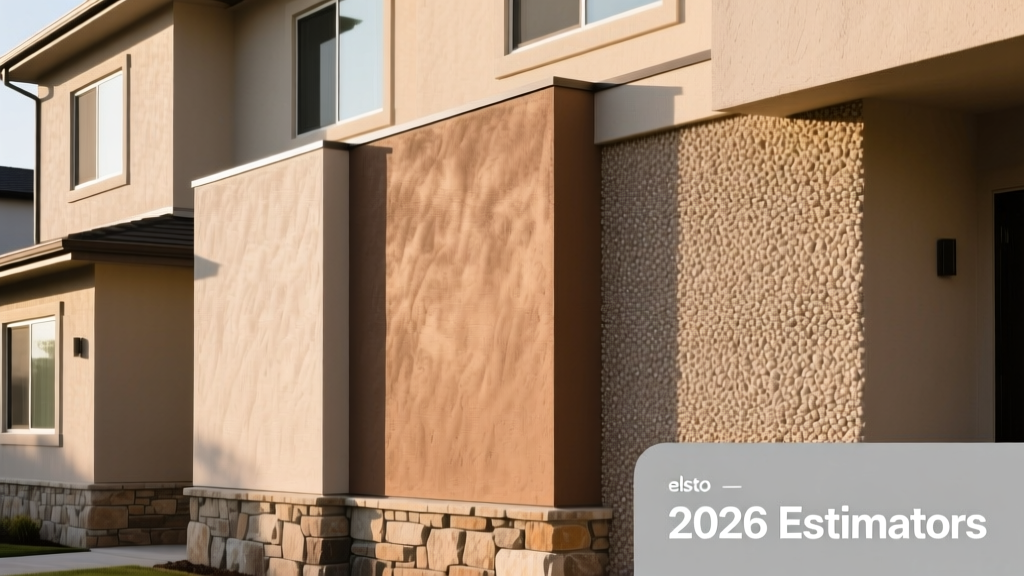
The True Cost of Painting Stucco in 2026
Estimating the cost to paint stucco requires abandoning standard exterior painting metrics. Unlike smooth wood or fiber cement siding, stucco is a porous, highly textured cementitious substrate that demands specialized masonry or elastomeric coatings. Standard exterior latex paints will fail prematurely due to alkali burn, moisture entrapment, and inadequate film thickness.
- Material Only (DIY): $0.85 – $1.60 per sq. ft.
- Professional Installation: $2.75 – $4.80 per sq. ft.
- Average 2,500 sq. ft. Home (Exterior Walls): $6,875 – $12,000 (Painted)
This guide provides the precise mathematical frameworks, texture multipliers, and product-specific pricing required to build an accurate stucco paint budget, eliminating the guesswork that leads to mid-project material shortages.
Stucco Paint Quantity Calculator: Coverage Rates & Math
The most common estimation error is applying standard smooth-surface coverage rates (350-400 sq. ft. per gallon) to stucco. Stucco's surface area is exponentially larger than its flat footprint due to peaks, valleys, and porosity. To calculate your exact gallon requirement, you must apply a Texture Multiplier to your net square footage.
The Texture Multiplier Framework
Measure your gross wall area, subtract windows and doors (typically 15% of gross area), and then multiply by the factor corresponding to your specific stucco finish below.
| Stucco Finish Type | Texture Profile | Multiplier | Estimated Coverage (per Gallon) | Recommended Roller Nap |
|---|---|---|---|---|
| Smooth / Sand Finish | Minimal aggregate, flat trowel | 1.25x | 220 - 250 sq. ft. | 3/4' to 1' |
| Dash / Knockdown | Medium splatter, flattened peaks | 1.75x | 150 - 180 sq. ft. | 1' to 1-1/4' |
| Heavy Lace / Spanish | Deep ridges, high-relief trowel marks | 2.25x | 110 - 140 sq. ft. | 1-1/4' to 1-1/2' |
| Roughcast / Pebbledash | Exposed aggregate, thrown-on pebbles | 3.0x | 80 - 110 sq. ft. | 1-1/2' (Airless Sprayer Preferred) |
Formula: (Gross Wall Sq. Ft. - Openings) × Texture Multiplier ÷ Product Coverage Rate = Total Gallons Required (per coat).
Material Costs: Top Elastomeric & Masonry Coatings
For stucco, you must choose between high-build 100% acrylic masonry paints or elastomeric coatings. Elastomeric paints are applied at 10 to 20 wet mils (compared to 4 wet mils for standard paint), allowing them to bridge hairline cracks up to 1/16 inch wide. Below are the benchmark commercial and residential products for 2026.
1. Sherwin-Williams Loxon Concrete & Masonry Coating
- Type: 100% Acrylic Masonry Coating (Non-Elastomeric, highly breathable)
- 2026 Pricing: $95.00 – $115.00 / gallon
- Best For: New stucco, high-moisture environments where vapor transmission is critical.
- Alkali Resistance: Withstands pH up to 13 without a primer.
2. Behr Premium Elastomeric Masonry, Stucco & Brick Paint
- Type: Elastomeric Acrylic
- 2026 Pricing: $48.00 – $58.00 / gallon
- Best For: Older stucco with hairline cracking, budget-conscious residential repaints.
- Warning: Low vapor permeability. Do not apply to stucco with internal moisture issues or unsealed parapet walls.
3. Dunn-Edwards FLEX-PRIME Masonry Primer
- Type: Alkali-Resistant Elastomeric Primer
- 2026 Pricing: $75.00 – $85.00 / gallon
- Best For: Priming stucco that has cured for less than 30 days or exhibits high pH levels.
Step-by-Step Estimation Formula
Follow this sequence to generate a precise materials bill of materials (BOM) for a 2,500 sq. ft. home with a dash finish (approx. 2,000 net sq. ft. of wall space).
- Calculate Net Area: 2,500 sq. ft. gross - 15% (windows/doors) = 2,125 net sq. ft.
- Apply Texture Multiplier: 2,125 × 1.75 (Dash finish) = 3,718 'effective' sq. ft.
- Determine Primer Volume: Using an alkali-resistant primer covering 250 sq. ft./gal: 3,718 ÷ 250 = 14.8 gallons (Round up to 15 gallons).
- Determine Topcoat Volume (2 Coats Required): Using elastomeric topcoat covering 150 sq. ft./gal: (3,718 ÷ 150) = 24.7 gallons per coat. × 2 coats = 49.4 gallons (Round up to 50 gallons).
- Calculate Material Cost: (15 gal primer × $80) + (50 gal topcoat × $55) = $1,200 + $2,750 = $3,950 Total Material Cost.
Hidden Costs & Critical Failure Modes
Accurate cost estimation must account for surface preparation and substrate remediation. According to the Painting Contractors Association (PCA) Standard P14, proper surface preparation is the primary determinant of coating lifespan. Ignoring these factors will result in catastrophic coating failure within 12 to 18 months.
New stucco (less than 30-60 days old) has a pH level between 12 and 13. Standard acrylic binders saponify (turn to soap) at this alkalinity, causing the paint to peel in sheets. Fix: Test with a pH pencil. If pH is above 10, budget for a specialized alkali-resistant primer or wait 30 days for carbonation to lower the pH naturally.
Water migrating through the stucco dissolves soluble salts, depositing them on the surface as a white, crystalline powder. Paint applied over efflorescence will blister and detach. Fix: Budget for a 10% muriatic acid wash or commercial efflorescence remover, followed by thorough rinsing and 48 hours of drying time before priming.
Elastomeric paints have very low perm ratings (often < 5 perms). If your stucco lacks a proper weather-resistant barrier (WRB) or if roof flashings are leaking, water will enter the wall cavity, become trapped behind the elastomeric film, and cause massive blistering. Always consult the Stucco Manufacturers Association guidelines on vapor transmission before selecting an elastomeric over a breathable acrylic masonry paint.
Labor vs. DIY: When to Hire a Professional
Spraying and back-rolling stucco requires specialized airless spray equipment (capable of handling high-viscosity elastomeric materials) and significant physical labor. Use this matrix to determine if DIY is viable for your project.
| Project Variable | DIY Feasibility | Professional Recommendation |
|---|---|---|
| Single-Story, Smooth/Sand Finish | High (Roller application viable) | Optional (Cost-effective DIY) |
| Two-Story, Dash/Lace Finish | Low (Requires scaffolding & sprayer) | Highly Recommended |
| Heavy Chalking / Peeling Existing Paint | None (Requires pressure washing & scraping) | Mandatory (PCA prep standards apply) |
| High Wind / Coastal Salt Environment | Low (Warranty voided if DIY applied) | Mandatory (Manufacturer certified pro required for warranty) |
Professional Labor Cost Breakdown (2026)
When hiring a licensed exterior painting contractor, expect labor to constitute 60% to 70% of the total invoice. Professional stucco painting labor rates range from $2.00 to $3.50 per square foot of wall area. This includes pressure washing (at 1,500-2,000 PSI with a wide 40-degree tip to avoid etching the stucco), masking, priming, and a two-coat spray-and-back-roll application. Back-rolling is non-negotiable; it forces the coating into the porous substrate and ensures uniform mil thickness across the textured peaks and valleys.
Frequently Asked Estimation Questions
Do I need to power wash stucco before painting?
Yes. Stucco accumulates chalky oxidation, dirt, and biological growth. Power washing at a maximum of 2,000 PSI using a wide-angle tip is required. Budget $0.15 to $0.25 per sq. ft. for professional washing, or allocate a full day for DIY. Allow 48 to 72 hours of drying time before applying primer.
Can I use standard exterior house paint on stucco?
No. Standard 100% acrylic exterior house paints lack the alkali resistance required for cementitious substrates and do not build a thick enough film to bridge micro-cracking. You must use a product explicitly labeled for 'Concrete and Masonry' or an 'Elastomeric' coating.
How long does stucco paint last?
High-quality acrylic masonry paints (like Loxon) typically last 10 to 15 years. Elastomeric coatings can last 15 to 20 years, provided the substrate remains dry and the coating is not subjected to hydrostatic pressure from behind.