When to Choose Stucco Siding: Climate and Scenario Matching
Discover when to use traditional, 1-coat, or EIFS stucco siding. Match stucco systems to your climate, budget, and structural needs with expert data.
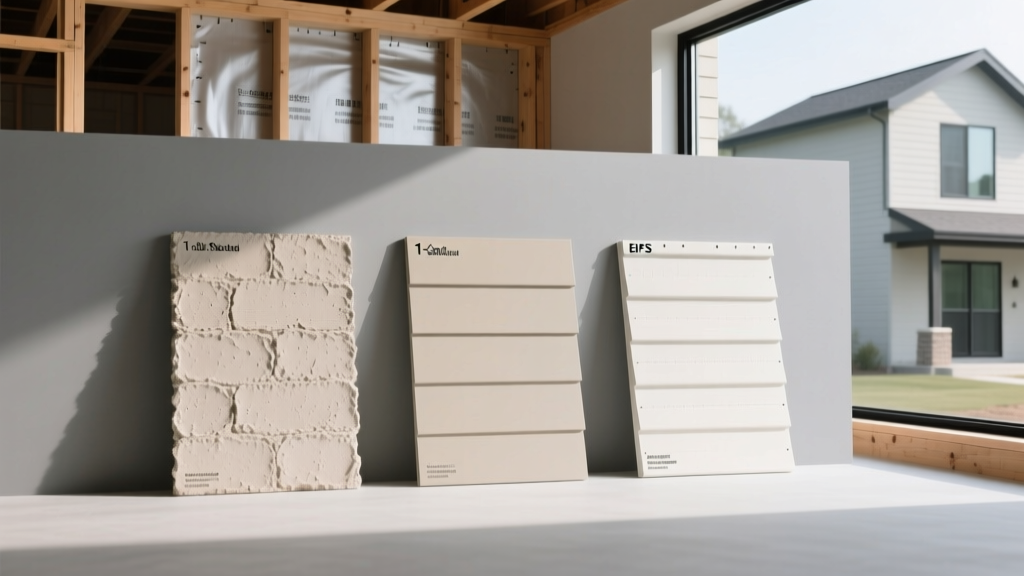
The Stucco Spectrum: Material Breakdown and Performance
Stucco is not a single product; it is a category of cementitious and polymer-based cladding systems with vastly different structural weights, thermal properties, and moisture tolerances. Selecting the wrong system for your specific building envelope is the primary cause of premature cracking, efflorescence, and moisture intrusion. According to the National Institute of Building Sciences, understanding the distinction between traditional hard-coat systems and synthetic barriers is the first step in application-fit matching.
| System Type | Composition & Layers | Thickness & Weight | R-Value (Insulation) | Avg. Installed Cost (2026) |
|---|---|---|---|---|
| Traditional 3-Coat | Portland cement, sand, lime, water over wire lath and WRB (scratch, brown, finish) | 7/8" to 1" thick ~10.4 lbs/sq ft |
R-0.20 (negligible) | $10.50 - $14.50 / sq ft |
| 1-Coat System | Fiberglass-reinforced Portland cement applied over rigid foam insulation board | 1/2" to 3/4" thick ~6.5 lbs/sq ft |
R-4.0 to R-5.0 (from foam) | $8.50 - $11.50 / sq ft |
| EIFS (Synthetic) | Polymer-based (PB) or Polymer-modified (PM) finish over EPS foam board | 2" to 4" total ~1.5 lbs/sq ft |
R-8.0 to R-16.0 | $12.00 - $16.50 / sq ft |
Climate Matching Matrix: Where Stucco Thrives and Fails
Stucco's performance is heavily dictated by local hygrothermal conditions. A system that lasts a century in Arizona will fail in a decade in the Pacific Northwest if detailing is ignored.
Hot & Arid Climates (IECC Zones 2 & 3)
Best Fit: Traditional 3-Coat Stucco.
In regions with low annual rainfall and high solar gain (e.g., Phoenix, Las Vegas), traditional stucco excels. Its high thermal mass absorbs heat during the day and releases it at night, smoothing out diurnal temperature swings. Because moisture intrusion is rare, the lack of an integrated drainage plane in standard 3-coat applications is rarely a liability.
Marine & Heavy Rain Climates (IECC Zones 4 & 5 Coastal)
Best Fit: 1-Coat over Drained WRB or EIFS with Drainage.
In areas with wind-driven rain (e.g., Seattle, coastal Carolinas), traditional stucco acts like a sponge. If you must use hard-coat stucco here, the U.S. Department of Energy recommends a ventilated rainscreen gap between the weather-resistive barrier (WRB) and the stucco lath. Alternatively, EIFS with a dedicated drainage track allows incidental moisture to escape without compromising the thermal envelope.
Scenario-Based Decision Framework
Use this framework to match your specific project scenario to the optimal stucco application.
- Scenario A: Wildland-Urban Interface (WUI) / High Fire Risk
Recommendation: Traditional 3-Coat Stucco. It achieves a Class A fire rating and provides a non-combustible barrier against airborne embers. EIFS should be avoided unless the specific manufacturer's assembly has passed rigorous WUI testing, as the EPS foam core can melt under extreme radiant heat. - Scenario B: Budget-Conscious Tract Housing
Recommendation: 1-Coat Stucco. By eliminating the scratch and brown coats and applying a single 1/2" fiberglass-reinforced layer directly over XPS foam, labor costs drop by 20-30% while simultaneously upgrading the wall's continuous insulation to meet modern energy codes. - Scenario C: Historic Masonry Renovation
Recommendation: Direct-Applied 3-Coat (No Lath). If applying over existing, sound, unpainted brick or concrete block, you can often bypass the metal lath and apply a bonding agent followed by the scratch and finish coats, saving significant material weight and cost. - Scenario D: High-End Custom Architecture with Complex Curves
Recommendation: EIFS. The EPS foam boards can be easily hot-wired or rasped to create sweeping radii, arches, and custom cornices that would require expensive, complex framing and lathing to achieve with traditional cement.
Critical Installation Details That Prevent Failure
Even the best-matched stucco system will fail if the installer ignores the micro-details of moisture management and structural movement. Ensure your contract explicitly mandates the following ASTM C1063 standards:
1. Weep Screed Clearance
A corrosion-resistant weep screed must be installed at the base of all framed walls. The weep screed must be positioned minimum 4 inches above finished earth grade and minimum 2 inches above paved surfaces (like concrete patios). This prevents capillary action from drawing soil moisture into the stucco and allows trapped water to drain out of the wall assembly.
2. Control Joint Spacing
Stucco shrinks as it cures and expands/contracts with temperature. Control joints must be installed to divide wall areas into sections not exceeding 144 square feet, with no single dimension exceeding 12 feet. Furthermore, control joints must be placed at all floor line transitions, above and below window/door openings, and where the substrate changes (e.g., where wood framing meets concrete block).
3. Lath Fastening and Overlap
For traditional and 1-coat systems, use minimum 2.5 lb/sq yd galvanized self-furring diamond mesh lath. The lath must overlap by 1 inch at vertical edges and 2 inches at horizontal edges. Fasteners must penetrate the structural framing (studs) by at least 1 inch, spaced no more than 6 inches apart along the studs.
Frequently Asked Questions
Can I paint traditional stucco, or should I use integral color?
Always opt for integral color (pigment mixed directly into the finish coat) for traditional stucco. Paint forms a non-breathable film on the surface. If moisture gets behind the stucco, paint traps it inside, leading to blistering and peeling. If you must change the color later, use a breathable mineral silicate or elastomeric coating specifically rated for high moisture vapor transmission (MVT).
Are hairline cracks in new stucco normal?
Yes. Micro-cracking (less than 1/16" wide) is an inherent characteristic of curing Portland cement and does not compromise the water resistance of the wall. However, cracks wider than 1/16", or cracks that radiate diagonally from the corners of doors and windows, indicate structural settlement, missing control joints, or improper framing deflection limits and require professional evaluation.
How does stucco compare to fiber cement in high-wind coastal zones?
While fiber cement (like HardiePlank) is excellent for coastal salt spray, traditional 3-coat stucco offers superior impact resistance against wind-borne debris. A 7/8" cementitious matrix over metal lath can withstand small missile impact (2x4 timber shot at 34 mph) required for Miami-Dade hurricane codes, whereas fiber cement lap siding may shatter under the same kinetic force unless specifically reinforced.