Types of Siding: Technical Performance Ratings and Specs
Compare types of siding by ASTM performance ratings, wind resistance, fire codes, and R-values to select the right cladding for your build.
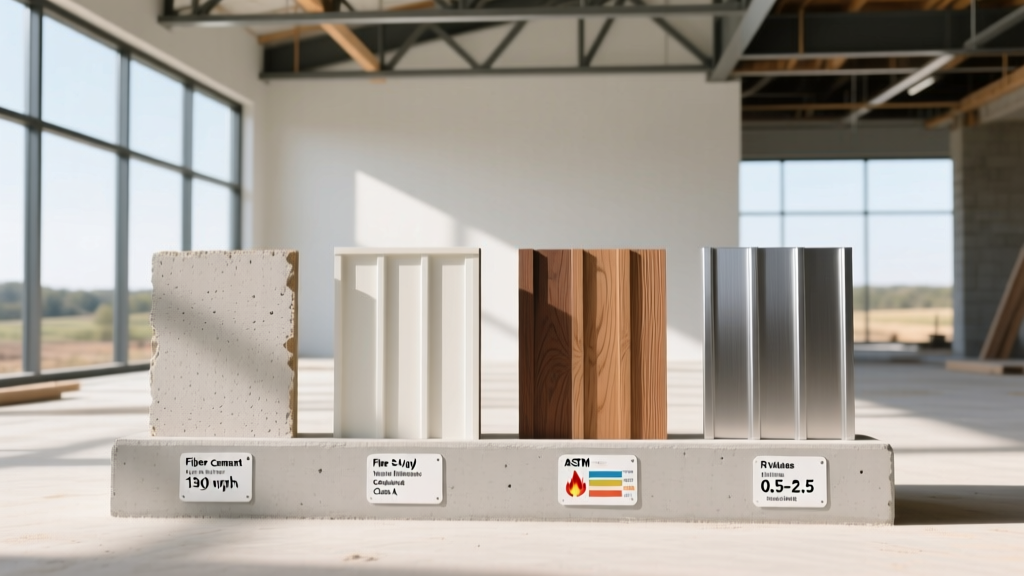
The Specification-Driven Approach to Cladding
Selecting exterior cladding requires moving beyond aesthetic preferences to evaluate rigorous engineering metrics. In 2026, building codes like the IECC and regional mandates for Wildland-Urban Interface (WUI) zones demand strict adherence to material testing standards. Understanding the technical specifications of different types of siding ensures structural longevity, code compliance, and optimal thermal performance.
- Wind Load Resistance: Measured in pounds per square foot (psf) and maximum sustained mph.
- Flame Spread Index (FSI): Classified via ASTM E84 surface burning characteristics.
- Impact Resistance: Rated by UL 2218 or FM 4473 for hail and debris.
- Thermal Emittance and R-Value: Critical for continuous insulation (ci) code compliance.
Wind Load and Structural Attachment Standards
Wind uplift and sheer pressure are primary failure modes for exterior cladding. The American Society for Testing and Materials (ASTM) provides the baseline testing protocols, but real-world performance depends heavily on the fastener schedule and substrate integration.
ASTM D5206 and Fastener Spacing
ASTM D5206 is the standard test method for windload resistance of rigid PVC siding. While a standard 0.040-inch vinyl siding panel might be rated for 90 mph winds when nailed at 16 inches on-center (O.C.), upgrading to a 0.046-inch premium profile and reducing the fastener spacing to 12 inches O.C. can increase the allowable design pressure to withstand 130+ mph winds. For engineered wood, such as LP SmartSide ExpertFinish, the proprietary zinc borate treatment and dense wood strand composition allow it to achieve Miami-Dade Notice of Acceptance (NOA) ratings for wind speeds up to 200 mph when installed with specific ring-shank nail patterns.
Field Insight: The most common wind-failure in fiber cement siding (ASTM C1186) is not the panel breaking, but the fastener pulling through the board during cyclic wind loading. Always use hot-dipped galvanized or stainless steel roofing nails with a minimum 0.27-inch head diameter, penetrating at least 1 inch into the structural sheathing or studs.
Fire Resistance and Flame Spread Classifications
Fire performance is evaluated using ASTM E84 (Standard Test Method for Surface Burning Characteristics of Building Materials), which assigns a Flame Spread Index (FSI) and Smoke Developed Index (SDI). Materials are grouped into Class A (FSI 0-25), Class B (FSI 26-75), and Class C (FSI 76-200).
| Siding Material | ASTM Standard | Fire Class | WUI Compliance |
|---|---|---|---|
| Fiber Cement (e.g., James Hardie) | ASTM C1186 | Class A (FSI ≤ 15) | Approved |
| Traditional 3-Coat Stucco | ASTM C926 | Class A (FSI 0) | Approved |
| Engineered Wood (e.g., LP SmartSide) | APA Standards | Class C (Untreated) | Requires Fire-Retardant Coating |
| Standard Vinyl Siding | ASTM D3679 | Class C (FSI ~160) | Restricted / Prohibited |
| 24-Gauge Steel Panels | ASTM A792 | Class A (Non-combustible) | Approved |
For projects in California, Colorado, or other high-fire-risk areas, the National Institute of Standards and Technology (NIST) heavily recommends non-combustible cladding or specifically tested WUI-compliant assemblies. Standard vinyl melts at approximately 350°F and can expose the underlying weather-resistive barrier (WRB) to direct flame impingement, leading to rapid structural ignition.
Impact Resistance and Hail Ratings
In regions prone to severe convective storms, impact resistance is a critical specification. The FM 4473 standard tests roofing and siding materials by firing 2-inch ice spheres at varying speeds. Class 3 withstands impacts at 112 mph, while Class 4 survives 150 mph impacts.
- Steel Siding: 24-gauge Galvalume steel easily achieves FM 4473 Class 4. It may dent under extreme hail but will not puncture or compromise the moisture envelope.
- Fiber Cement: While highly rigid, 5/16-inch fiber cement lap siding is brittle. High-velocity hail can cause localized spalling or shatter the panel edge, requiring board replacement.
- Vinyl Siding: Standard PVC becomes highly brittle below 40°F. ASTM D4226 impact tests show that standard vinyl is highly susceptible to shattering in cold-weather hail events unless modified with acrylic or ASA (Acrylonitrile Styrene Acrylate) capstocks.
Thermal Performance and Continuous Insulation
Siding materials alone provide negligible thermal resistance. Uninsulated vinyl offers an R-value of roughly 0.61, while fiber cement sits at R-0.15. To meet the 2024 and 2026 IECC mandates for continuous insulation (ci) in Climate Zones 4 and higher, contractors must integrate rigid foam or mineral wool behind the cladding.
When adding 1.5 inches of exterior continuous insulation (R-7.5 polyiso) behind fiber cement siding, standard 2-inch siding nails will fail to reach the structural studs. You must calculate the fastener length to include the cladding thickness, WRB, continuous insulation, sheathing, and a minimum 1-inch penetration into the framing. This often requires 4-inch or 4.5-inch specialized structural screws, significantly increasing labor and material costs.
Insulated vinyl siding, which features factory-laminated expanded polystyrene (EPS) backing, can boost the assembly R-value by R-2.0 to R-5.0. However, according to the Vinyl Siding Institute Certification Program, the primary structural benefit of insulated siding is the reduction of thermal expansion and contraction, which minimizes panel buckling and waviness on long, sun-exposed elevations.
Moisture Management and Vapor Permeability
Exterior cladding acts as a rain screen, but the underlying assembly must manage vapor drive. The perm rating of a material dictates its ability to allow moisture to dry to the exterior. Traditional hard-coat stucco (ASTM C926) is highly vapor-permeable (approx. 15-20 perms), allowing trapped moisture to escape. Conversely, foil-backed insulated siding panels act as a Class I vapor retarder (< 0.1 perms). If installed over a low-perm interior insulation like closed-cell spray foam, this can trap moisture within the wall cavity, leading to OSB sheathing rot.
2026 Siding Specifications and Cost Matrix
The following matrix outlines the baseline technical specifications and average installed costs for premium-grade cladding in the 2026 market.
| Material Profile | Max Wind Rating | Impact Class | 2026 Installed Cost (per sq.ft.) |
|---|---|---|---|
| 0.046" Reinforced Vinyl | 130 mph | Class 2 | $8.50 - $11.00 |
| 5/16" Fiber Cement Lap | 150 mph | N/A (Brittle) | $12.00 - $15.50 |
| Engineered Wood (LP ExpertFinish) | 200 mph | Class 3 | $10.50 - $13.00 |
| 24-Gauge Steel Vertical Panels | 160 mph | Class 4 | $14.00 - $18.00 |
For comprehensive structural panel testing and load-span data regarding engineered wood and composite claddings, refer to the APA - The Engineered Wood Association technical resources. Proper specification ensures that the selected cladding not only meets local building codes but performs reliably under the specific environmental stressors of the project site.