Drywall Compound Taxonomy: Selecting the Right Mud for Every Coat
Master drywall compound selection with our taxonomy guide. Compare all-purpose, topping, and setting-type muds for optimal shrinkage and finish.
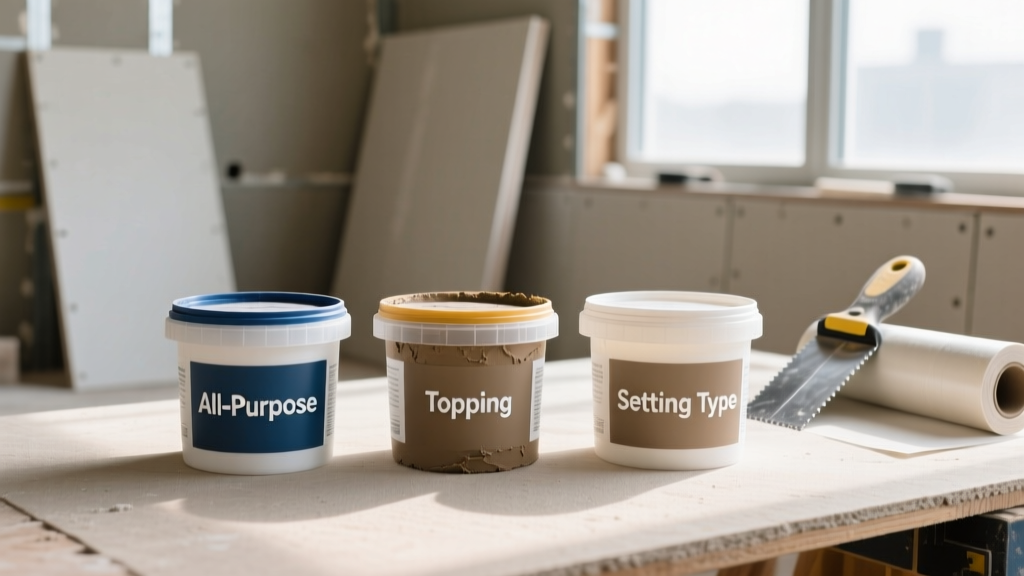
The Core Taxonomy of Drywall Compounds
Selecting the correct drywall compound (commonly referred to as "mud") is not a one-size-fits-all decision. Under Gypsum Association standards and ASTM C474 test methods, joint treatment materials are strictly categorized by their curing mechanism and aggregate composition. Misclassifying these materials leads to excessive shrinkage, joint banding, and paint flashing. The taxonomy splits into two primary branches: air-drying (evaporative) compounds and setting-type (chemical) compounds.
Air-Drying Compounds (Evaporative Cure)
These compounds cure as water evaporates into the ambient air. Because water constitutes a significant volume of the wet mixture, air-drying compounds experience volumetric shrinkage—typically between 10% and 15% as they dry. This shrinkage necessitates multiple coats to fill depressions. They are further subdivided by aggregate size and binder strength:
- All-Purpose: Contains larger limestone aggregates and higher vinyl binder content. Designed for embedding tape and the first coat over fasteners. High bond strength but difficult to sand.
- Taping Compound: Similar to all-purpose but with a slightly higher moisture content for smoother application over paper tape. Rarely used outside of commercial high-volume taping.
- Topping Compound: Formulated with finer, smaller aggregates and less binder. It shrinks less than all-purpose mud and sands exceptionally smooth, but lacks the tensile strength to embed tape.
Within the air-drying taxonomy, you will encounter "Lightweight" variants (e.g., USG Sheetrock Plus 3). These incorporate vinyl microspheres or perlite to reduce bucket weight by up to 35% and decrease drying time. While they sand easier, standard-weight compounds still offer superior edge-abrasion resistance in high-traffic commercial corridors.
Setting-Type Compounds (Chemical Cure)
Often called "hot mud," setting-type compounds cure via an exothermic chemical reaction rather than evaporation. The base material is calcium sulfate hemihydrate (calcined gypsum). When mixed with water, it recrystallizes into calcium sulfate dihydrate. Because the water is chemically bound into the crystal lattice rather than evaporating, volumetric shrinkage is virtually zero (less than 1%).
Selection Matrix: Matching Compound to the Coat
A standard Level 4 or Level 5 finish requires a phased approach. Using a single compound for all coats is the most common cause of callback repairs. The following matrix dictates the optimal material sequence for flat seams and inside corners.
| Coat Phase | Primary Function | Recommended Compound Type | Product Example (2026) | Shrinkage Profile |
|---|---|---|---|---|
| Coat 1 (Embedding) | Bedding paper/fiberglass tape, filling deep gaps | Setting-Type (45 or 90 min) or Standard All-Purpose | USG Easy Sand 45 / Sheetrock All-Purpose | Near Zero (Setting) / High (Air-dry) |
| Coat 2 (Filling) | Building the crown, covering fasteners, widening seams | All-Purpose or Lightweight All-Purpose | ProForm Plus 3 All-Purpose | Moderate (10-15%) |
| Coat 3 (Finishing) | Feathering edges, creating a smooth plane for paint | Lightweight Topping Compound | USG Sheetrock Topping (Plus 3) | Low (5-8%) |
| Skim Coat (Level 5) | Full-surface micro-thin layer to eliminate drywall paper texture | Specialty Skim / Ultra-Light Topping | USG Topping Compound / First Coat | Low |
The Science of Setting-Type Compounds
Setting compounds are categorized by their working time, which is controlled by the concentration of potassium sulfate or other chemical accelerators in the dry mix. According to USG technical specifications, a "45-minute" mud (like Easy Sand 45) does not mean it dries in 45 minutes; it means the chemical crystallization process reaches its final set in 45 minutes under standard conditions (70°F and 50% relative humidity).
Because the cure is chemical, setting compounds can be recoated immediately once they harden, bypassing the 24-hour evaporative wait time. However, they are highly sensitive to contamination. Introducing dried mud flakes from a previous batch or using hard water with high mineral content can drastically alter the set time, causing "flash sets" where the mud becomes unworkable in the pan within 10 minutes.
Specialty Compounds: Moisture and Mold Resistance
For high-humidity environments (bathrooms, commercial kitchens) or areas prone to moisture intrusion, standard air-drying compounds are insufficient. They are hygroscopic and will absorb ambient moisture, leading to softening and mold growth.
Mold-resistant compounds incorporate biocides (such as zinc borate or proprietary fungicidal encapsulations) directly into the binder. Products like USG Sheetrock Brand Mold Tough Joint Compound score a 10 out of 10 on the ASTM D3273 mold resistance test. These must be paired with moisture-resistant (green board) or glass-mat gypsum panels to maintain the integrity of the assembly. Never use standard topping compound over a mold-resistant panel in a wet area; the joint will become the weak link in the moisture barrier.
2026 Cost, Yield, and Coverage Data
Accurate estimating requires understanding the yield differences between compound types. Pricing reflects early 2026 national averages for commercial-grade materials.
- Standard All-Purpose (5-Gallon Bucket): $22.00 - $28.00. Covers approximately 450 to 500 square feet of wall area per bucket (assuming standard 3-coat application). Yields about 110 linear feet of joints.
- Lightweight Topping (5-Gallon Bucket): $26.00 - $32.00. Covers roughly the same area but requires less physical effort to sand, reducing labor costs by up to 15% on large commercial jobs.
- Setting-Type (25 lb Bag): $16.00 - $21.00. Covers approximately 110 linear feet of joints for the embedding coat. Highly cost-effective for deep-gap filling where air-dry mud would require three separate coats due to shrinkage.
Common Selection Failures and Edge Cases
Even experienced finishers encounter failures when the taxonomy of the compound is ignored. Watch for these specific edge cases:
1. The "Flashing" Phenomenon on Level 5 Finishes
Symptom: Joint lines are visible under critical lighting (e.g., skylights, gloss paint) despite being physically smooth to the touch.
Cause: Using an all-purpose compound for the final skim coat. All-purpose mud has a high vinyl binder content, which creates a different porosity and light-refraction index than the surrounding drywall paper.
Fix: Always use a dedicated, fine-aggregate topping compound or a specialty Level 5 skim product. Follow AWCI guidelines for applying a continuous, unbroken skim coat that unifies the surface porosity.
2. Fastener Pops in Setting-Type Mud
Symptom: Circular cracks appearing over screw heads a few weeks after completion.
Cause: Applying a setting-type compound over a screw that was driven too deep, breaking the paper face of the gypsum core. The rigid chemical cure of the hot mud does not flex with the natural expansion/contraction of the wood framing.
Fix: If the paper is broken, drive a second screw 2 inches away. Use an all-purpose air-drying compound for the first coat over fasteners to allow for microscopic structural movement.
3. Delamination at Inside Corners
Symptom: Paper tape bubbling or peeling away from internal 90-degree angles.
Cause: Using a lightweight topping compound to embed the tape. Topping compounds lack the necessary adhesive binder strength to hold paper under tension as it dries.
Fix: Strictly use standard-weight all-purpose or a dedicated taping compound for embedding. The higher vinyl content is non-negotiable for tape adhesion.
Frequently Asked Questions
Can I add water to a drying bucket of all-purpose compound to extend its life?
No. Adding water to partially cured air-drying compound breaks down the vinyl binder matrix, severely reducing its tensile strength and causing it to chalk or dust when sanded. If a skin forms, remove the skin entirely; do not mix it into the wet mud below.
Do I need to sand setting-type compounds before applying the next coat?
Setting compounds (like Easy Sand) are designed to be recoated without aggressive sanding. However, you must knock off any high ridges or "boogers" with a 6-inch drywall knife while the mud is in its semi-hard "cheese" state, roughly 10 minutes after the final set.