Gold Bond High Strength Lite Gypsum Board vs. USG UltraLight Firecode
Compare Gold Bond High Strength Lite gypsum board against USG UltraLight Firecode. Analyze weight, fire ratings, cost, and installation labor savings.
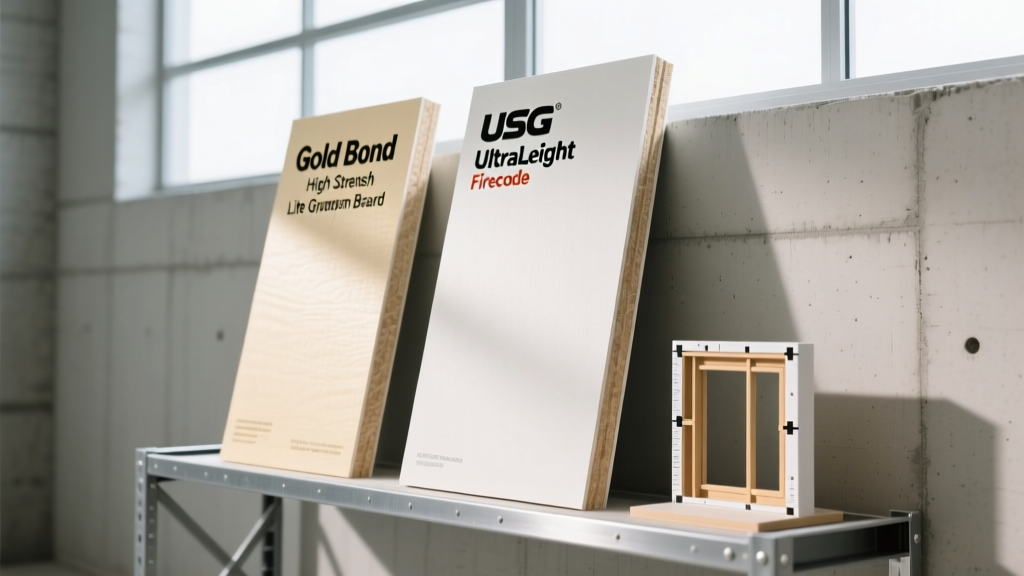
The Physics of Fire-Rated Drywall: Weight vs. Core Integrity
For decades, the commercial construction industry accepted a rigid tradeoff: achieving a 1-hour fire resistance rating required installing 5/8-inch Type X gypsum board, which inherently meant dealing with heavy, dense panels. Standard 5/8-inch Type X boards typically weigh around 2.2 pounds per square foot. When multiplied across a 4x12-foot sheet (48 square feet), a single panel tips the scales at roughly 105 pounds. This mass creates severe ergonomic bottlenecks, particularly during overhead ceiling installations and high-wall framing.
National Gypsum disrupted this paradigm with the Gold Bond High Strength Lite Gypsum Board. Engineered to meet ASTM C1396 specifications for Type X while dropping the weight to approximately 1.65 pounds per square foot, this board brings the weight of a 4x12 sheet down to roughly 79 pounds. This 25% reduction in mass fundamentally alters job site logistics, hanging speeds, and long-term labor costs. However, general contractors and architects must weigh this specific product against its primary market rival: USG’s Sheetrock UltraLight Firecode X. This analysis breaks down the technical specifications, installation economics, and structural edge cases of specifying Gold Bond High Strength Lite in 2026.
Head-to-Head Matrix: Gold Bond vs. UltraLight Competitors
When evaluating lightweight fire-rated assemblies, specifiers generally choose between a direct 5/8-inch lightweight replacement or a high-performance 1/2-inch alternative. The matrix below compares Gold Bond High Strength Lite against USG’s direct 5/8-inch competitor and Georgia-Pacific’s 1/2-inch fire-rated alternative.
| Specification | Gold Bond High Strength Lite 5/8" | USG Sheetrock UltraLight Firecode X 5/8" | GP ToughRock Fireguard 45 1/2" |
|---|---|---|---|
| Nominal Thickness | 5/8 inch (15.9 mm) | 5/8 inch (15.9 mm) | 1/2 inch (12.7 mm) |
| Weight per Sq. Ft. | ~1.65 lbs | ~1.55 lbs | ~1.50 lbs |
| 4x12 Sheet Weight | ~79 lbs | ~74 lbs | ~72 lbs |
| Fire Rating (1-layer) | 1 Hour (specific assemblies) | 1 Hour (specific assemblies) | 45 Minutes |
| Flexural Strength (Parallel) | ≥ 110 lbs | ≥ 105 lbs | ≥ 90 lbs |
| Avg. Cost per 4x12 (2026) | $29.00 - $33.00 | $31.00 - $36.00 | $24.00 - $28.00 |
| Core Technology | Proprietary lightweight aggregate + glass fiber | Aerated core + glass fiber | High-density proprietary core |
Decoding the Gold Bond High Strength Lite Formulation
Core Density and Sag Resistance
The primary concern when transitioning from standard Type X to any lightweight variant is sag resistance, particularly on ceiling grids with 24-inch on-center framing. According to the Gypsum Association, lightweight boards must maintain strict dimensional stability to prevent deflection over time. Gold Bond achieves this through a proprietary blend of expanded perlite and glass fibers that create a rigid, interlocking crystalline matrix within the gypsum core. While USG’s UltraLight Firecode X is marginally lighter (saving about 5 pounds per 4x12 sheet), Gold Bond’s slightly denser core yields higher flexural strength, making it less prone to edge-crushing during transport and hoisting.
Fire Performance and UL Assemblies
Fire resistance in gypsum board is dictated by the calcination process—the release of chemically combined water (roughly 21% of the board's mass) when exposed to temperatures exceeding 212°F (100°C). Both Gold Bond High Strength Lite and USG UltraLight Firecode X are tested under ASTM E119 and NFPA 251 standards via Underwriters Laboratories (UL). Gold Bond qualifies for critical UL designs, including U419 (1-hour wood stud) and V450 (1-hour steel stud). Because the core is lighter, National Gypsum compensates by optimizing the glass-fiber distribution to hold the calcined core together longer under direct flame impingement, ensuring the board does not collapse prematurely during a fire event.
The True Cost of Installation: Material Premium vs. Labor ROI
Purchasing agents often hesitate at the upfront material premium of lightweight fire-rated boards. In 2026, a standard 5/8-inch Type X 4x12 sheet costs roughly $22 to $25, while Gold Bond High Strength Lite commands a $7 to $9 premium per sheet. However, evaluating drywall solely on material cost ignores the dominant expense in commercial finishing: labor.
A standard two-person hanging crew can comfortably lift and secure a 79-pound Gold Bond Lite sheet to a 10-foot ceiling without mechanical assistance. Attempting the same with a 105-pound standard Type X board requires a drywall lift, a third laborer, or results in severe fatigue by mid-shift. By eliminating the need for a third hanger on ceiling crews and increasing the daily square-footage output by an estimated 15% to 20%, the labor savings typically eclipse the material premium by the second floor of a commercial build.
Ergonomic Threshold Callout
The Occupational Safety and Health Administration (OSHA) and the National Institute for Occupational Safety and Health (NIOSH) recommend minimizing repetitive lifting of materials exceeding 51 pounds under optimal conditions. Because a 4x12 sheet of standard Type X weighs over 100 pounds, two-person lifts place 50+ pounds of awkward, off-center load on each worker. Gold Bond High Strength Lite reduces the per-worker load to roughly 39.5 pounds, keeping the crew safely within ergonomic guidelines and significantly reducing the risk of rotator cuff and lumbar injuries over a multi-week hanging schedule.
When to Specify Alternatives Instead
While Gold Bond High Strength Lite is an exceptional choice for standard interior partitions and ceiling membranes requiring a 1-hour rating, it is not a universal substitute. Specifiers should pivot to alternative boards in the following scenarios:
- High-Impact and Abuse Zones: In hospital corridors, school hallways, or elevator lobbies, the lightweight core is more susceptible to puncture and blunt-force damage. Specify Gold Bond Abuse-Resistant or Extreme Impact boards, which utilize high-density cores and fiberglass face mats.
- Moisture and Mold Prone Areas: Standard High Strength Lite is not moisture-resistant. For bathroom surrounds, commercial kitchens, or exterior soffits, transition to Gold Bond XP (Moisture and Mold Resistant) or eXtreme Impact/Moisture variants. Note that XP boards are available in lightweight formulations, but they carry a different SKU and price point.
- Shaftliners and Elevator Shafts: For 2-hour and 3-hour area separation walls, standard 5/8-inch lightweight boards are insufficient. You must specify 1-inch thick shaftliner panels or specialized multi-layer Firecode assemblies.
- Acoustic Isolation (STC 50+): While adding mass is a traditional way to improve Sound Transmission Class (STC), lightweight boards inherently reduce mass. To achieve high STC ratings with lightweight boards, you must incorporate resilient channels, sound-damping compound (green glue), or specialized acoustic sealants to compensate for the reduced core density.
Sourcing and Supply Chain Considerations
National Gypsum operates a robust network of manufacturing plants and distribution centers across North America, giving Gold Bond products strong regional availability. However, supply chain proximity matters. If a job site is located in a region where USG or Georgia-Pacific maintain a dominant distribution footprint, the freight costs to ship Gold Bond High Strength Lite from a distant plant can erase the product's cost advantages. Always request delivered pricing quotes from local commercial drywall distributors rather than relying on national list prices. In 2026, with freight rates remaining volatile, specifying the lightweight board manufactured at the plant closest to your job site is the most financially sound strategy.
Written by
Marcus ChenMarcus Chen is a licensed structural engineer (PE) and building materials analyst with over 12 years of experience across residential, commercial, and industrial construction. He holds a Master of Science in Civil Engineering from UC Berkeley and spent six years at Thornton Tomasetti before transitioning to independent consulting and technical writing. Marcus specializes in material selection for seismic-prone regions, concrete reinforcement strategies, and lifecycle cost analysis. His work has been cited by the American Concrete Institute (ACI) and the Structural Engineers Association of California (SEAOC). When he is not on a job site or at his desk, you will find him hiking the Sierra Nevada or restoring a 1920s craftsman bungalow in Oakland, CA.
More from Marcus Chen
View all
Construction Cost
How Much Did the Eiffel Tower Cost to Build?
How much did the Eiffel Tower cost to build in 1889? We adjust for inflation and compare its budget to modern skyscraper construction.
Aug 4, 2026

Fire Resistance
What Is a Fire Resistant Material? Testing & Certification Guide
Discover what is a fire resistant material through ASTM and UL testing. Learn how fire ratings, certifications, and assemblies work in construction.
Aug 4, 2026

Construction Cost
How Much Did the Burj Khalifa Cost to Build?
How much did the Burj Khalifa cost to build? We break down the $1.5B project and extract 5 money-saving strategies for your next build.
Jul 30, 2026