Gypsum Board Taxonomy: How to Select the Right Drywall Type
Navigate the complete gypsum board taxonomy. Learn how to select standard, Type X, moisture-resistant, and glass mat drywall for any project.
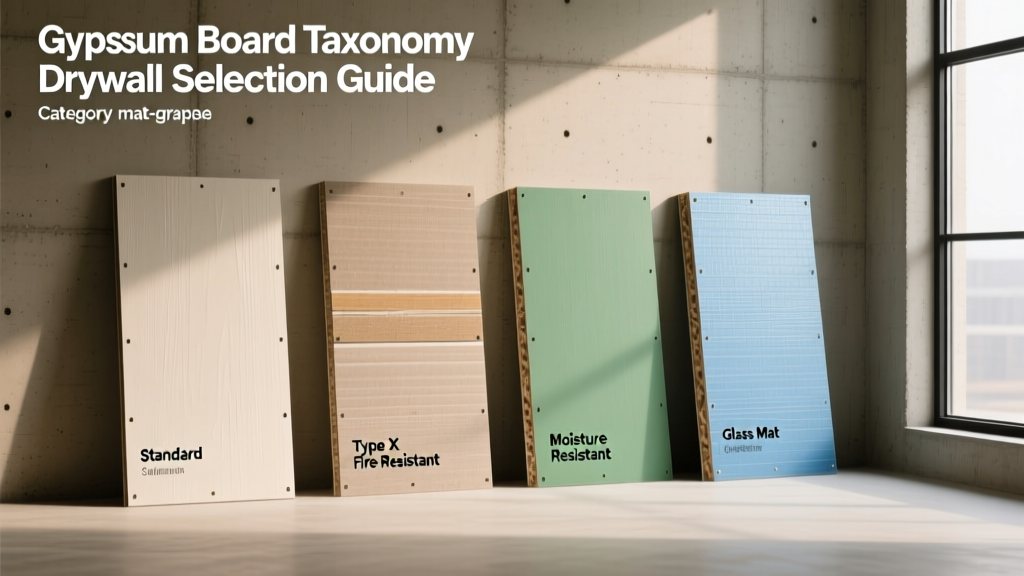
The Core Gypsum Board Taxonomy Matrix
Selecting the correct gypsum board requires navigating a complex taxonomy of core additives, face materials, and performance ratings. While all gypsum boards share a baseline of calcium sulfate dihydrate (CaSO4·2H2O) pressed between facers, modern manufacturing introduces specific chemical and structural modifications to meet stringent building codes. According to the Gypsum Association, the baseline specification for all panels is governed by ASTM C1396, but the functional divergence happens at the additive level.
| Board Classification | Core Additives | Face Material | Governing Standard | Primary Application |
|---|---|---|---|---|
| Standard (White Board) | Starch, foaming agents | Heavy paper | ASTM C1396 | Interior walls, ceilings (dry areas) |
| Type X (Fire-Rated) | >1% glass fibers by weight | Heavy paper | ASTM C1396 / E119 | 1-hour fire-rated assemblies, garages |
| Type C (Enhanced Fire) | Glass fibers + vermiculite | Heavy paper | ASTM C1396 / E119 | 2-hour+ assemblies, elevator shafts |
| MR (Green Board) | Silicone/wax water repellents | Green treated paper | ASTM C1396 / C473 | Residential bathroom walls (splash zones) |
| Mold/Moisture (Purple) | Fungicides + water repellents | Purple treated paper | ASTM D3273 | High-humidity areas, basements |
| Glass Mat (e.g., DensArmor) | None (inherently inorganic) | Fiberglass mat | ASTM C1177 | Exterior sheathing, tile backing, wet areas |
Decoding Fire-Rated Gypsum: Type X vs. Type C
Fire resistance in gypsum board is not achieved by making the core 'harder,' but by managing how the calcined gypsum core behaves when exposed to extreme heat. When gypsum is exposed to fire, it undergoes calcination, releasing its chemically combined water (roughly 21% of its weight) as steam. This endothermic reaction keeps the backside temperature of the board below 212°F (100°C) until all free and chemically bound water is driven off.
The Role of Glass Fibers and Vermiculite
Once the water is gone, the standard gypsum core shrinks, cracks, and falls off the framing, exposing the structure to fire. This is where the taxonomy splits:
- Type X Gypsum: Contains a minimum of 1% glass fibers by weight. These fibers act as a micro-rebar, holding the calcined core together after the water has evaporated, typically achieving a 1-hour fire rating in standard 5/8-inch thickness.
- Type C Gypsum: Contains higher concentrations of glass fibers plus vermiculite (an expanding silicate mineral). When heated, vermiculite expands, compensating for the natural shrinkage of the calcined gypsum core. This allows Type C boards (like USG Firecode C or CertainTeed Firestop) to maintain structural integrity in 2-hour and 3-hour rated assemblies, often allowing for thinner 1/2-inch panels in multi-family shaft walls.
Gypsum board itself does not have a '1-hour rating.' The rating belongs to the entire assembly (board, stud type, stud spacing, fastener spacing, and insulation). Installing Type X gypsum on 24-inch on-center wood studs without the required 1-1/4 inch coarse-thread drywall screws spaced at 12 inches on-center will void the UL Design rating and fail inspection.
Moisture and Mold Resistance Selection Framework
Moisture management is the most common failure point in gypsum selection. The EPA's mold guidelines emphasize that controlling indoor moisture is the only viable way to prevent mold growth, making the choice of gypsum facer and core treatment critical.
Green Board (MR) vs. Purple Board vs. Glass Mat
Do not conflate water resistance with mold resistance. The decision framework below dictates the correct material based on the environment's moisture profile:
- Green Board (Moisture-Resistant): Features a water-repellent core and green face paper. It resists liquid water absorption (ASTM C473 limits absorption to <5% compared to >10% for standard board). However, the paper face still contains cellulose, which is a food source for mold if exposed to chronic high humidity. Use only for residential bathroom walls outside the direct shower enclosure.
- Purple Board (Mold/Moisture-Resistant): Incorporates both water repellents and embedded fungicides in the core and paper. Products like CertainTeed M2Tech score a 10 on the ASTM D3273 mold resistance test. Ideal for basements, commercial kitchens, and high-humidity corridors.
- Glass Mat Gypsum: Completely eliminates the paper face, replacing it with an inorganic fiberglass mat. Because there is zero cellulose, there is no food source for mold. Products like Georgia-Pacific DensArmor Plus are mandatory for exterior sheathing, commercial tile-backing in wet areas, and any space prone to chronic dampness.
Never use Green, Purple, or even Glass Mat gypsum board as the primary substrate inside a continuous-use steam shower or commercial sauna. These environments generate vapor pressure that drives moisture through the facer into the core. For continuous vapor environments, you must use cement board (ASTM C1325) or specialized extruded polystyrene foam boards (like Wedi or Schluter-Kerdi-Board) with a bonded waterproof membrane.
Specialized Gypsum Boards: Acoustic and Abuse-Resistant
Beyond fire and moisture, commercial and high-end residential projects require specialized performance profiles that alter the physical density and structural composition of the board.
Acoustic Gypsum (Sound-Damping)
Standard gypsum blocks low-frequency sound poorly due to its relatively low mass and rigid coupling to framing. Acoustic boards, such as CertainTeed SilentFX or USG QuietRock, utilize a constrained-layer damping (CLD) technology. These panels feature a viscoelastic polymer layer sandwiched between two thin gypsum cores. When sound waves hit the board, the polymer layer shears, converting acoustic energy into trace amounts of heat. A single 5/8-inch layer of acoustic gypsum (STC 50+) performs equivalently to 8 layers of standard 1/2-inch drywall, saving crucial floor space in multi-family party walls.
Abuse and Impact-Resistant Gypsum
Used in commercial corridors, hospitals, and schools, abuse-resistant boards feature a high-density, fiber-reinforced core and a heavy-duty face paper or embedded fiberglass mesh. They are tested under ASTM C1629. While they resist surface abrasion and moderate impacts (like rolling carts), they are not bulletproof. For areas requiring extreme impact resistance (e.g., detention facilities or heavy equipment corridors), contractors must transition to fiberglass-reinforced panels (FRP) or cementitious boards.
Real-World Selection Scenarios and 2026 Pricing
Material costs fluctuate based on regional supply chains, but the following 2026 baseline pricing (per 4x8 sheet) provides a framework for budget estimation and material allocation.
Scenario A: Multi-Family Residential Bathroom (Walls & Ceiling)
- Requirement: Moisture resistance, basic sound isolation, cost-efficiency.
- Selection: 1/2-inch Purple Board (Mold/Moisture resistant) for walls; 5/8-inch Type X for the ceiling (required by code to separate dwelling units).
- Estimated Cost: Purple Board: $17/sheet. Type X Ceiling: $21/sheet.
Scenario B: Commercial Elevator Shaft Wall
- Requirement: 2-hour fire rating, high structural integrity, space constraints.
- Selection: 1-inch Type C Shaftliner panels (specifically designed for friction-fit into H-studs without screwing the field) or two layers of 1/2-inch Type C on standard steel studs.
- Estimated Cost: 1-inch Shaftliner: $42/sheet. 1/2-inch Type C: $24/sheet.
Scenario C: Home Theater / Bedroom Party Wall
- Requirement: Maximum STC rating within a standard 2x4 or 2x6 stud cavity.
- Selection: 5/8-inch Acoustic Gypsum (e.g., QuietRock 510) over resilient channel, paired with R-13 mineral wool insulation.
- Estimated Cost: Acoustic Board: $58/sheet. Mineral Wool: $1.15/sq ft.
Installation and Fastening Specifications
The highest-performing gypsum board will fail if fastening schedules violate manufacturer specifications or USG Drywall Systems guidelines. Adhere to these non-negotiable installation parameters:
- Fastener Type: Use only coarse-thread screws for wood framing (minimum 1-1/4 inch for 1/2-inch board) and fine-thread screws for steel framing (minimum 1 inch). Never use nails for fire-rated or acoustic assemblies.
- Screw Spacing (Ceilings): Maximum 12 inches on-center for all edges and field studs. For wall applications, 16 inches on-center in the field is permissible for non-rated assemblies, but 12 inches is mandatory for rated and acoustic assemblies.
- Edge Treatment: Tapered edges must be butted together. Never force boards into tight corners; leave a 1/8-inch expansion gap at floors and ceilings, which will be covered by baseboard and trim. Forcing boards causes edge-fracture, the most common cause of visible drywall seams post-painting.
- Acoustic Decoupling: When installing acoustic gypsum, the perimeter of the board must not touch the adjacent ceiling or floor. Apply a 1/4-inch bead of acoustic sealant at all perimeters before installing trim to prevent sound flanking through rigid structural connections.