What is the R-Value of 5/8 Gypsum Board? Specs & Assembly Guide
Discover the exact R-value of 5/8 gypsum board, ASHRAE thermal specs, and how to pair it with cavity insulation for code-compliant wall assemblies.
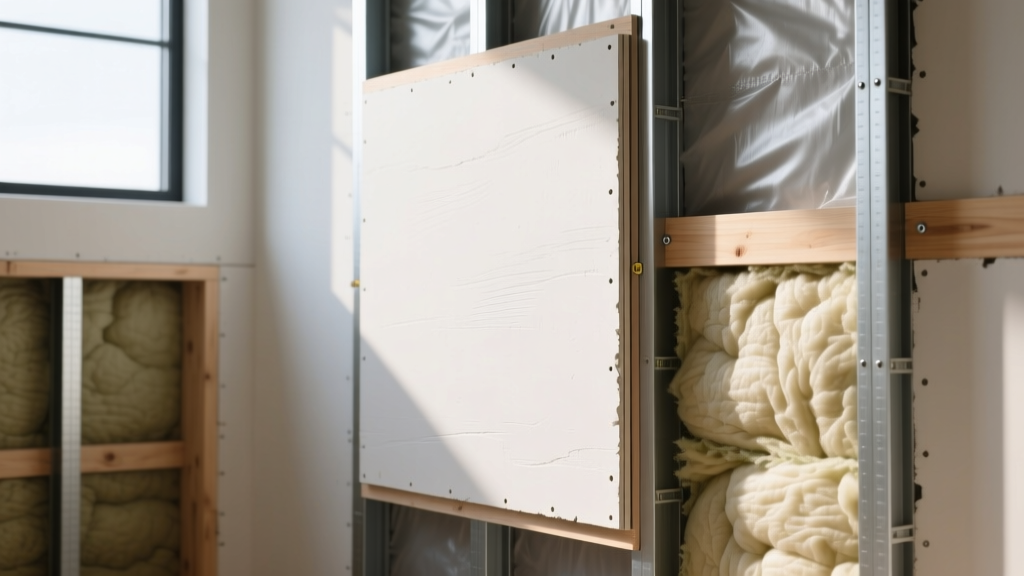
The Exact R-Value of 5/8 Gypsum Board: ASHRAE Standards
When calculating the thermal resistance of a wall or ceiling assembly, every material layer contributes to the overall U-factor. According to the ASHRAE Fundamentals Handbook and standard building physics data, the R-value of 5/8 gypsum board is 0.56 (often rounded to 0.5 or 0.6 in preliminary energy modeling).
This value is derived from the material's thermal conductivity (k-value), which typically sits around 1.11 Btu·in/(hr·ft²·°F) for standard-density gypsum cores. While 0.56 is a relatively low thermal resistance compared to dedicated insulation materials, it is a fixed constant that must be accounted for in whole-wall energy calculations, especially when designing to stringent IECC (International Energy Conservation Code) standards.
| Thickness | R-Value | Weight (Standard) | Weight (Type X) | Core Density |
|---|---|---|---|---|
| 1/4 in. (6.4 mm) | 0.22 | 1.2 lbs/sq ft | N/A | ~43 pcf |
| 3/8 in. (9.5 mm) | 0.33 | 1.6 lbs/sq ft | N/A | ~43 pcf |
| 1/2 in. (12.7 mm) | 0.45 | 1.7 lbs/sq ft | 2.0 lbs/sq ft | ~43-45 pcf |
| 5/8 in. (15.9 mm) | 0.56 | 2.2 lbs/sq ft | 2.6 lbs/sq ft | ~43-47 pcf |
The 'R-Value Trap': Thermal Resistance vs. Thermal Mass
A common mistake in residential and commercial energy modeling is evaluating gypsum board solely by its R-value. This ignores the material's high thermal mass (volumetric heat capacity). Gypsum contains crystalline water (calcium sulfate dihydrate). When exposed to heat, it absorbs and stores thermal energy, delaying the transfer of heat through the wall assembly.
In climates with high diurnal temperature swings (hot days, cold nights), the thermal mass of 5/8-inch drywall creates a 'time lag.' It absorbs solar heat gain during the afternoon and releases it slowly. While the R-value remains 0.56, the effective thermal performance in passive solar designs reduces peak HVAC cooling loads by up to 8-12% compared to lightweight, low-mass interior finishes.
Whole-Wall R-Value: Why 5/8-Inch Drywall Isn't Enough
If you install R-20 fiberglass batts in a 2x6 wood-framed wall and cover it with 5/8-inch gypsum board, your total clear-wall R-value is roughly R-20.56. However, the Department of Energy emphasizes that builders must calculate the whole-wall R-value, which accounts for thermal bridging through the framing.
- Wood Studs (2x6 at 16" O.C.): Wood has an R-value of ~1.25 per inch. A 5.5-inch stud acts as an R-6.87 thermal bridge, drastically dragging down the assembly's overall performance.
- Steel Studs: Light-gauge steel is highly conductive. A 2x6 steel-stud wall with R-20 cavity insulation can experience a thermal performance drop of 40% to 50% due to thermal short-circuiting.
- The 5/8" Board's Role: The R-0.56 interior membrane does nothing to stop thermal bridging. To meet modern IECC continuous insulation (ci) requirements, you must pair the interior 5/8" board with exterior rigid foam or mineral wool to break the thermal bridge.
Why Specify 5/8-Inch Over 1/2-Inch? (The Real Trade-Offs)
From a purely thermal standpoint, upgrading from 1/2-inch (R-0.45) to 5/8-inch (R-0.56) yields a negligible R-value increase of 0.11. The decision to specify 5/8-inch board is driven by structural, acoustic, and fire-resistance requirements, not insulation.
1. Fire-Resistance Ratings (Type X and Type C)
Standard 5/8-inch Type X gypsum board contains glass fibers and other additives that reinforce the core when the calcined gypsum dehydrates under extreme heat. According to the Gypsum Association, a single layer of 5/8-inch Type X on each side of a wood stud wall provides a 1-hour fire-resistance rating (UL Design U305). For 2-hour ratings, Type C or multiple layers are required. The 5/8-inch thickness is the industry baseline for commercial fire partitions and residential garage-to-living-space separations.
2. Ceiling Sag Resistance
When framing ceilings at 24 inches on center (O.C.), 1/2-inch drywall is prone to sagging over time due to gravity, humidity, and the weight of blown-in attic insulation. 5/8-inch gypsum board possesses significantly higher flexural strength, making it the mandatory specification for 24-inch O.C. ceiling joist spacing in both residential and commercial applications.
3. Acoustic STC Ratings
Sound Transmission Class (STC) ratings benefit from mass. The additional weight of 5/8-inch board (2.2 to 2.6 lbs/sq ft) improves the baseline STC of a partition wall by 1 to 2 points compared to 1/2-inch board. When paired with resilient channels and acoustic sealant, 5/8-inch board is critical for achieving STC 50+ in multi-family dwellings.
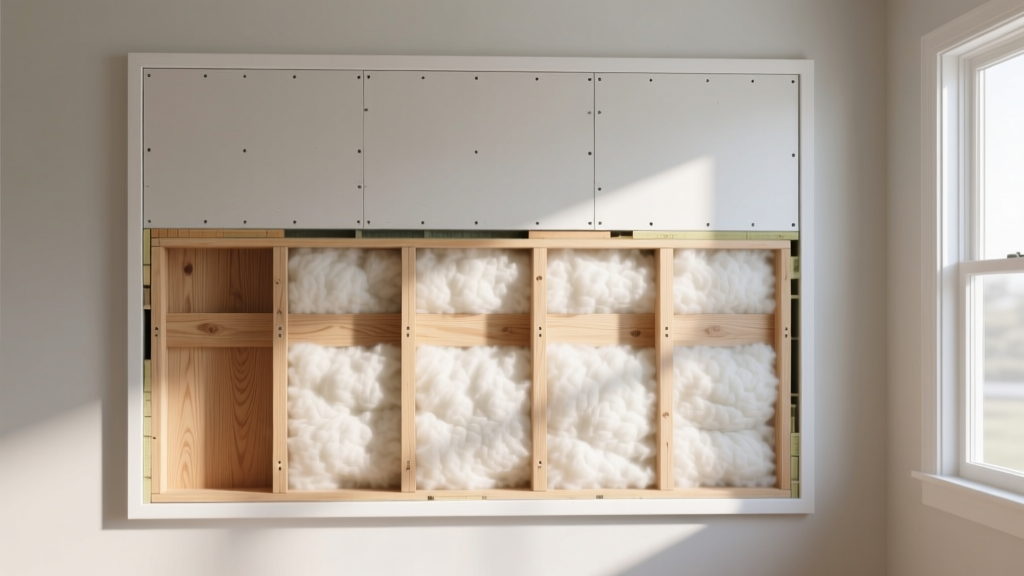
Optimizing the Interior Air Barrier
Beyond thermal resistance, 5/8-inch gypsum board serves as a primary component of the interior air barrier system. Because it is thicker and more rigid than 1/2-inch board, it is less susceptible to puncture and tearing during the installation of electrical boxes, plumbing penetrations, and HVAC registers.
Airtight Drywall Approach (ADA): To maximize the thermal efficiency of your wall assembly, seal the perimeter of the 5/8-inch gypsum board to the top and bottom plates using acoustical sealant or specialized gaskets. This prevents convective heat loss, which can bypass cavity insulation entirely and render the R-0.56 board's thermal mass ineffective.
Frequently Asked Questions
Does moisture-resistant (green board) 5/8-inch drywall have a different R-value?
No. The silicone-treated paper facing and moisture-resistant core additives do not significantly alter the thermal conductivity of the gypsum. The R-value remains 0.56.
Can I use 5/8-inch gypsum board as exterior sheathing for insulation?
Standard interior gypsum board will degrade if exposed to weather. However, specialized glass-mat gypsum sheathing (such as Securock or DensGlass) is used as exterior sheathing. While its R-value is similarly low (approx. 0.56 for 5/8-inch), it provides a fire-resistant, moisture-tolerant substrate for exterior continuous insulation (ci) layers.
How does the R-value of 5/8-inch drywall compare to plywood or OSB?
Plywood and OSB (oriented strand board) have slightly higher R-values per inch (approx. R-1.25 per inch). Therefore, a 5/8-inch plywood sheathing layer provides an R-value of ~0.78, which is marginally higher than the R-0.56 of 5/8-inch gypsum board. However, neither material provides sufficient thermal resistance to replace dedicated cavity or continuous insulation.
Written by
Sarah WhitfieldSarah Whitfield is a chartered quantity surveyor (MRICS) and construction cost analyst with 15 years of experience in material pricing, procurement strategy, and project budgeting. She earned her degree in Construction Management from the University of Reading (UK) and has worked on projects ranging from $2M custom homes to $180M mixed-use developments across North America and Europe. Sarah currently leads cost estimating for BuildMat Insight, maintaining a proprietary database of 4,000+ material price points updated quarterly. She is a frequent contributor to RSMeans cost data panels and has presented at the International Cost Engineering Council (ICEC) congress. Based in Denver, CO, Sarah is an avid trail runner and volunteer mentor for Women in Construction.
More from Sarah Whitfield
View all
Wood & Lumber
What Are the Different Types of Wood? A Builder's Guide
Compare structural softwoods, finish hardwoods, and engineered lumber. Analyze Janka ratings, MOE values, and 2026 pricing for construction.
Aug 4, 2026

Walls & Panels
Steel Framing vs Wood Framing: Corrosion and Moisture Defense
Compare steel framing vs wood framing for moisture resistance. Learn about galvanized coatings, condensation risks, and corrosion protection strategies.
Jul 21, 2026

Stone & Masonry
How to Cut Stone Veneer: Wet Saw vs Grinder Comparison
Compare the best tools for cutting stone veneer. We review wet saws, angle grinders, and chop saws to help you achieve clean, chip-free cuts.
Jul 21, 2026