Technical Specs and Performance Ratings for Sheetrock Screws
Master sheetrock screws specifications, ASTM C1002 ratings, thread types, and shear strength data to prevent fastener pops and ensure structural integrity.
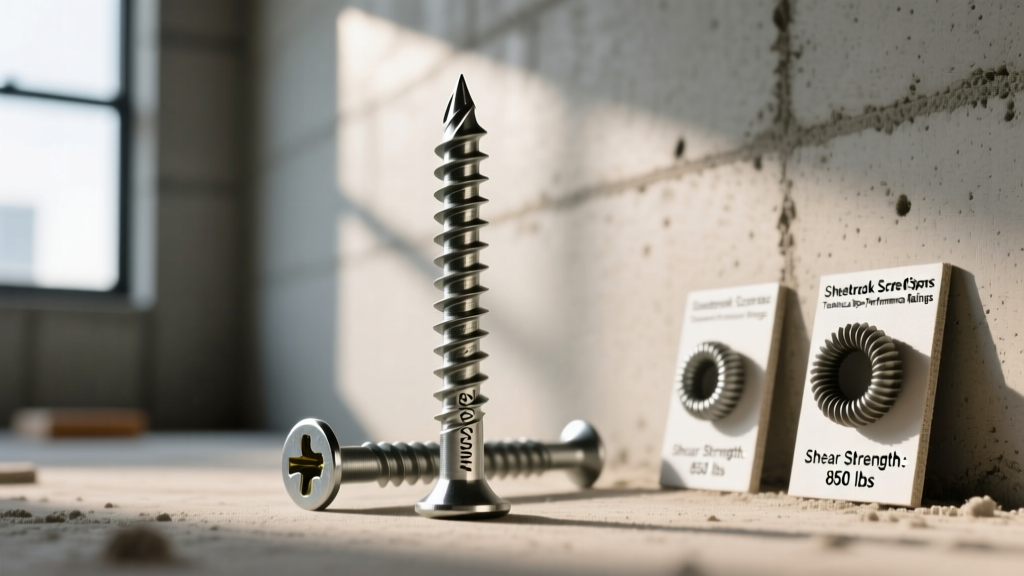
ASTM C1002: The Engineering Baseline for Sheetrock Screws
Sheetrock screws are not generic fasteners; they are precision-engineered components governed by strict metallurgical and geometric standards. The governing benchmark in North America is ASTM C1002 (Standard Specification for Steel Self-Piercing Tapping Screws for the Application of Gypsum Panel Products). This standard dictates the exact tensile strength, case hardness, and ductility required to prevent fastener failure during high-torque pneumatic or cordless driver installation.
• Minimum Tensile Strength: 45,000 psi for standard #6 gauge screws.
• Case Hardness: Rockwell C45 to C52. This specific hardness range ensures the screw can pierce steel studs without the tip blunting, while retaining enough core ductility to resist snapping under lateral sheer loads.
• Ductility Test: The screw shank must withstand a 10-degree bend without fracturing, preventing brittle failure during building settlement or seismic shifting.
Thread Geometry & Substrate Matching Matrix
Using the wrong thread pitch is the primary cause of stripped framing and reduced pull-out resistance. Sheetrock screws are categorized into three distinct thread profiles, each engineered for specific substrate densities and gauge thicknesses.
| Thread Type | Pitch (TPI) | Point Style | Target Substrate & Limits |
|---|---|---|---|
| S-Type (Fine) | 14-16 TPI | Needle / Sharp | Light-gauge steel studs (25 ga. to 20 ga.). The fine pitch cuts threads into thin steel without stripping the hole. |
| W-Type (Coarse) | 8-10 TPI | Needle / Sharp | Wood framing (SPF, Douglas Fir, LVL). The wide pitch aggressively clears sawdust and bites deep into wood fibers. |
| G-Type (Self-Drilling) | Fine with flute | Self-drilling Tek | Heavy-gauge structural steel (18 ga. to 12 ga.). Features a drill point and flute to evacuate steel shavings. |
Bugle Head Mechanics and Paper Tension
The defining visual characteristic of sheetrock screws is the bugle head. Unlike flat-head wood screws that sit flush with the surface, or pan-head screws that sit proud, the bugle head features a specific concave radius. According to installation guidelines published by the Gypsum Association, this radius is engineered to compress the gypsum core and dimple the face paper without breaking the paper's continuous tension.
Failure Modes Related to Head Profiles
- Overdriving (Breaking the Paper): If the driver clutch is set too deep, the bugle head cuts through the face paper. Once the paper is broken, the screw loses up to 75% of its holding power, as the gypsum core alone cannot support the shear load.
- Underdriving (Proud Screws): If the screw head sits above the panel surface, it will prevent the taping knife from laying flat, requiring excessive joint compound buildup that leads to ridging and visible seams under glancing light.
Coating Technologies & Corrosion Resistance
The black or grey finish on standard sheetrock screws is not paint; it is a chemical conversion coating. Understanding coating specifications is critical for moisture-prone environments.
1. Phosphate Coatings (Standard Interior)
Standard screws are treated with zinc or manganese phosphate. This creates a micro-porous surface that provides minimal corrosion resistance but acts as an excellent lubricant during driving, reducing friction heat and preventing the screw tip from burning out. These are strictly for interior, climate-controlled environments.
2. Zinc and Ceramic Coatings (High-Humidity / Exterior)
For moisture-resistant (green/purple board) installations in bathrooms, or exterior soffits utilizing glass-mat gypsum panels, standard phosphate screws will rust and bleed through the joint compound. You must specify screws with a minimum 5-micron zinc plating or a specialized ceramic coating (often rated for 500+ hours of salt-spray testing). These are typically color-coded silver, gold, or green.
Sizing, Penetration Rules, and Spacing
Fastener length and field spacing directly dictate the shear wall rating and structural rigidity of the gypsum assembly. The universal rule for sheetrock screw penetration is a minimum of 5/8 inch into the framing member.
| Panel Thickness | Minimum Screw Length | Maximum Field Spacing (Walls) | Maximum Field Spacing (Ceilings) |
|---|---|---|---|
| 1/4" (Curved walls) | 1" | 12" O.C. | 12" O.C. |
| 3/8" | 1" | 16" O.C. | 12" O.C. |
| 1/2" (Standard) | 1-1/4" | 16" O.C. | 12" O.C. |
| 5/8" (Type X Fire) | 1-3/8" or 1-5/8" | 12" O.C. | 12" O.C. |
Troubleshooting Fastener Failures: The Physics of Screw Pops
A "screw pop" occurs when the fastener head pushes outward, breaking the joint compound cover coat. This is rarely a defect in the sheetrock screw itself; it is a failure of environmental acclimation and substrate movement.
The Moisture Content Threshold
When hanging drywall on wood framing, the lumber's moisture content (MC) is the critical variable. If the framing lumber has an MC above 19% at the time of installation, it will inevitably shrink as it acclimates to the interior conditioned space (which typically rests at 8-12% MC). As the wood shrinks away from the gypsum panel, the screw remains anchored in the stud, but the panel pulls back. When the wall is bumped, the panel snaps back against the screw head, popping the compound.
Torsional Stress in Steel Studs
On commercial jobs using light-gauge steel, screw pops are usually caused by torsional twisting of the studs. When HVAC ducts or plumbing lines are forced through pre-punched knockouts, the stud twists. Over time, the stud attempts to untwist, pushing the screw head outward. The specification fix here is to use S-Type fine-thread screws with a slightly longer length (e.g., 1-5/8" instead of 1-1/4") to anchor deeper into the steel flange, combined with resilient channel isolation where applicable.