How to Choose Rebar Chairs for Slabs, Walls, and Heavy Footings
Match the right rebar chairs to your concrete pour. Compare steel, plastic, and concrete spacers for slabs, walls, and heavy footings with load data.
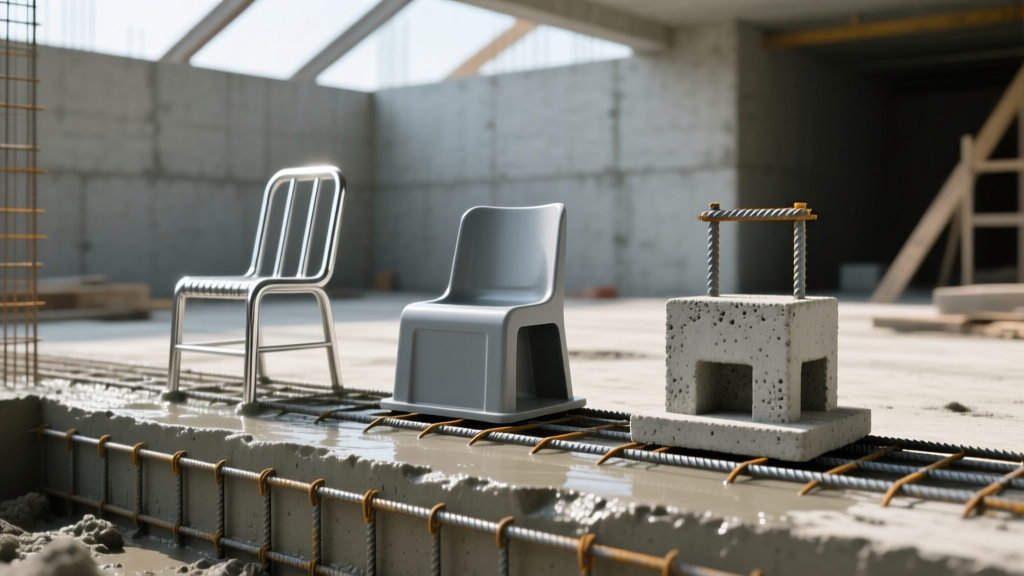
The Structural Stakes of Bar Support Selection
Rebar chairs are frequently treated as commodity consumables, yet they are the sole guarantee of structural concrete cover. When reinforcement steel drops below the specified cover depth during a pour, the structural lifespan of the element is compromised. Exposed or shallow-buried rebar invites moisture and chloride ingress, leading to oxidation. Rusting steel expands up to seven times its original volume, generating internal tensile stresses that cause concrete spalling and catastrophic structural degradation. Selecting the correct rebar chairs requires matching the spacer material, profile, and load capacity to the specific pour scenario, subgrade condition, and rebar weight.
Material Matrix: Steel vs. Plastic vs. Concrete Spacers
The Concrete Reinforcing Steel Institute (CRSI) categorizes bar supports by material and application. Choosing the wrong material for the environment is a primary cause of premature concrete failure. Below is a 2026 market comparison of the three primary rebar chair materials.
| Material | Ideal Scenario | Max Load Capacity | Corrosion / Bleed Risk | 2026 Avg. Cost (per unit/ft) |
|---|---|---|---|---|
| Plastic (Polypropylene) | Suspended slabs, architectural flatwork, corrosive environments | Medium (Up to #8 bar) | Zero (Non-corrosive) | $0.45 - $0.85 each |
| Steel (Galvanized/Epoxy) | Heavy mat foundations, precast, high-load decking | High (Handles #11 to #18 bar) | Low to Medium (If coating chips) | $1.60 - $3.20 per foot |
| Concrete (Pre-cast 'Dobies') | Grade beams, heavy footings, aggressive soil environments | Very High (Virtually crush-proof) | Zero (Matches slab CTE) | $1.10 - $2.50 each |
Scenario Matching: Selecting the Right Chair Profile
Material alone does not dictate success; the geometric profile of the rebar chair must match the formwork and pour dynamics. Here is how to match profiles to specific structural elements.
Suspended Slabs and Flatwork: High Chairs and Continuous Runners
For suspended slabs on grade or metal decking, plastic high chairs are the industry standard. They feature a multi-legged design that elevates the top mat of rebar while the bottom mat rests on standard low-profile chairs.
Vertical Walls and Columns: Wheel Spacers and Snap Ties
Standard flatwork chairs will tip over when placed against vertical formwork. For walls and columns, you must use wheel spacers (plastic wheels with a central tie wire) or bolsters with snap ties. Wheel spacers roll easily against the form face without scraping the form release agent, ensuring a clean architectural finish. For heavy retaining walls, steel-reinforced plastic wall chairs with heavy-gauge tie wires are required to prevent the rebar cage from bowing inward under the hydrostatic pressure of the wet concrete pour.
Heavy Mat Foundations and Grade Beams: Beam Bolsters and Concrete Bloks
When supporting massive rebar bundles (such as #11, #14, or #18 bars used in high-rise mat foundations), plastic chairs will shatter or deform. Steel beam bolsters (continuous U-shaped steel rails) or pre-cast concrete bar supports (dobies) are mandatory. Concrete dobies are particularly advantageous in below-grade environments because their coefficient of thermal expansion (CTE) perfectly matches the surrounding pour, eliminating micro-cracking around the spacer during temperature fluctuations.
Load Capacity and Spacing Calculations
Over-spacing rebar chairs is a common field error that results in sagging reinforcement cages. The National Ready Mixed Concrete Association (NRMCA) and ACI 318 guidelines emphasize maintaining strict cover tolerances (typically ±0.5 inches for formed surfaces). Use the following spacing framework based on rebar size and weight:
- Light Reinforcement (#3, #4, #5 bars): Space chairs at 3 to 4-foot intervals. Standard plastic high chairs or low-profile slab bolsters are sufficient.
- Medium Reinforcement (#6, #7, #8 bars): Reduce spacing to 2.5 to 3-foot intervals. Upgrade to heavy-duty (HD) plastic chairs with thicker gauge legs and wider bases.
- Heavy Reinforcement (#9, #10, #11+ bars): Space supports every 2 feet or less. Use continuous steel beam bolsters or concrete dobies. Point-load plastic chairs are strictly prohibited at these weights.
Real-World Failure Modes and Prevention
Understanding how rebar chairs fail in the field allows superintendents and engineers to preemptively adjust their detailing and procurement.
Failure Mode 1: Rust Bleeding in Architectural Concrete
The Cause: Using standard, uncoated steel wire chairs in exposed architectural concrete or tilt-up panels. The steel chair rusts, and the iron oxide bleeds through the concrete cover, creating unsightly streaks.
The Fix: Mandate 100% plastic bar supports, or specify steel chairs with a minimum 3-mil epoxy coating and plastic-dipped legs. Never allow bare metal chairs to touch the exterior form face.
Failure Mode 2: Kick-Over During Pumping
The Cause: The high-velocity discharge from a concrete pump hose strikes the rebar mat, snapping the brittle legs of cheap plastic chairs or kicking over steel bolsters.
The Fix: Use 'pump grade' heavy-duty plastic chairs with gusseted legs. Instruct pump operators to drop the hose below the top mat elevation or use an elephant trunk (drop tube) to dissipate the kinetic energy of the concrete flow before it hits the rebar grid.
Failure Mode 3: Cold Weather Shattering
The Cause: Standard polypropylene plastic chairs become highly brittle at temperatures below 32°F (0°C). Walking on the rebar mat in freezing conditions causes the legs to snap.
The Fix: For winter pours, source chairs manufactured from high-density polyethylene (HDPE) or specialized cold-weather polymer blends that retain ductility at sub-zero temperatures.
Procurement and Quality Assurance
When sourcing rebar chairs for a project, do not rely solely on the supplier's generic catalog descriptions. Request the manufacturer's load-deflection test data. A high-quality heavy-duty plastic high chair should support a minimum of 250 lbs of static point load without exceeding 1/8 inch of deflection. Furthermore, verify that plastic chairs feature UV inhibitors if they will be exposed to direct sunlight on large, multi-week staging sites, as UV degradation will severely compromise their structural integrity before the concrete is even poured. By matching the exact material, profile, and spacing to the specific structural scenario, you ensure the reinforcement performs exactly as the structural engineer intended.