Light Gauge Steel Framing Market: 2026 Grades & Pricing
Analyze the 2026 light gauge steel framing market. Compare 33 ksi vs 50 ksi grades, G60/G90 coatings, ASTM A1003 specs, and current wholesale pricing.
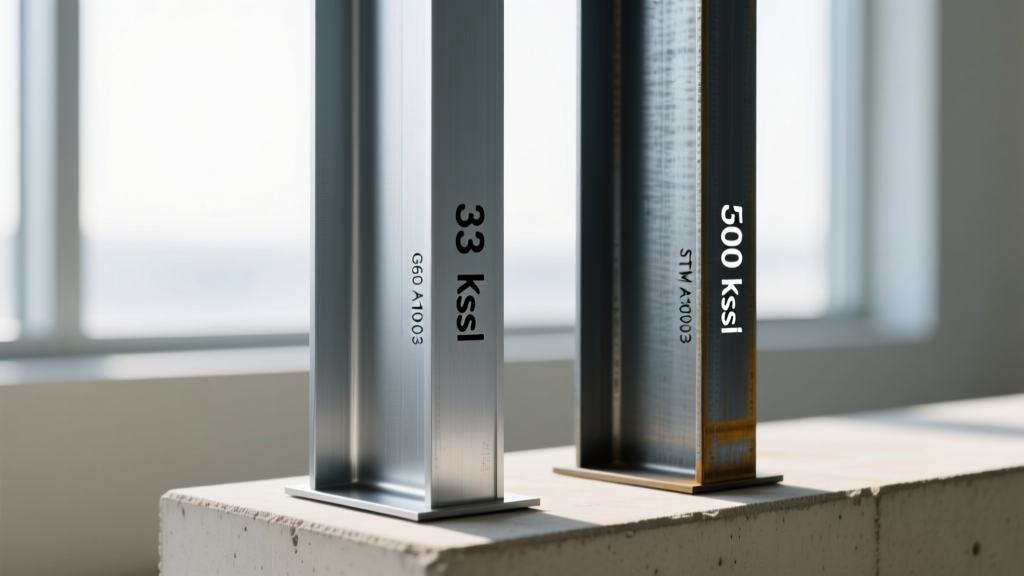
The 2026 Landscape of the Light Gauge Steel Framing Market
The light gauge steel framing market has undergone a significant metallurgical and structural shift heading into 2026. Driven by rising commercial insurance premiums for wood-frame structures and updated International Building Code (IBC) mandates for fire resistance, contractors are increasingly specifying cold-formed steel (CFS). However, navigating this market requires a precise understanding of steel grades, galvanization standards, and thickness tolerances. Specifying the wrong yield strength or zinc coating can result in structural deflection, premature corrosion, or massive budget overruns.
Decoding Steel Grades: 33 ksi vs. 50 ksi in Modern Construction
The foundation of the light gauge steel framing market relies on two primary yield strength categories, governed by the Steel Framing Industry Association (SFIA) and ASTM A1003 specifications. Understanding the mechanical properties of these grades is non-negotiable for structural integrity.
Grade 230 (33 ksi) - Non-Structural Applications
Often referred to as 33 ksi, this steel grade has a minimum yield strength of 33,000 psi. It is the undisputed standard for interior, non-load-bearing partition walls, ceiling grids, and furring channels. Because these walls do not support axial roof or floor loads, the lower yield strength is perfectly adequate, offering superior ductility for easy screw penetration and field modifications.
Grade 345 (50 ksi) - Structural & Load-Bearing Applications
With a minimum yield strength of 50,000 psi, 50 ksi steel is mandatory for exterior load-bearing walls, shear walls, and floor joist systems. The higher carbon equivalent and cold-rolling processes increase tensile strength but reduce ductility. In 2026, structural engineers are heavily favoring 50 ksi studs for exterior envelopes because the increased strength permits wider framing spacing without sacrificing wind-load resistance.
| Property | 33 ksi (Grade 230) | 50 ksi (Grade 345) |
|---|---|---|
| Minimum Yield Strength | 33,000 psi | 50,000 psi |
| Primary Application | Interior partitions, furring | Exterior walls, joists, trusses |
| Standard Spacing | 16" or 24" o.c. | 24" o.c. (optimizes material) |
| Ductility | High (easier to cut/drill) | Moderate (requires bi-metal bits) |
| Relative Cost Premium | Baseline | +12% to +18% |
Galvanization Standards Driving Market Demand
Corrosion resistance dictates the lifespan of cold-formed steel. The light gauge steel framing market adheres strictly to ASTM A653 for zinc coating weights. According to the American Galvanizers Association, the zinc acts as a sacrificial anode, corroding preferentially to protect the underlying steel substrate.
G60 vs. G90 Coatings
- G60 (0.60 oz/sq ft): The baseline coating for interior, climate-controlled environments. It provides adequate protection for standard commercial partition walls where moisture exposure is negligible.
- G90 (0.90 oz/sq ft): Contains 50% more zinc than G60. In 2026, G90 is practically mandatory for all exterior load-bearing walls, unconditioned spaces, and any construction within High-Velocity Hurricane Zones (HVHZ) or coastal salt-spray environments.
"Specifying G60 for exterior sheathing backing in humid climates is a leading cause of premature fastener pop and rust staining in modern CFS construction. Always default to G90 for any stud within 6 inches of the exterior sheathing."
ASTM A1003 Compliance and Thickness Tolerances
A critical point of confusion in the light gauge steel framing market is the nomenclature of 'gauge' versus 'mils'. The industry has largely moved away from gauge numbers in favor of 'design thickness' measured in mils (thousandths of an inch), as defined by the Cold-Formed Steel Engineers Institute (CFSEI). ASTM A1003 mandates that the actual minimum thickness must not fall below 95% of the design thickness.
Standard SFIA Thickness Matrix
- 33 mil (20 ga): Design: 0.0329" | Minimum: 0.0313" | Use: Non-load-bearing partitions.
- 43 mil (18 ga): Design: 0.0428" | Minimum: 0.0407" | Use: Heavy partitions, low-rise load-bearing.
- 54 mil (16 ga): Design: 0.0538" | Minimum: 0.0511" | Use: Standard exterior load-bearing walls.
- 68 mil (14 ga): Design: 0.0677" | Minimum: 0.0643" | Use: High-load shear walls, floor joists.
2026 Pricing Matrix: How Grades and Coatings Impact Cost
Wholesale pricing in the light gauge steel framing market fluctuates with global hot-rolled coil (HRC) indices and zinc commodity markets. Below is the current 2026 baseline pricing for standard 8-foot C-studs (1-5/8" flange, 1/2" return), excluding regional freight surcharges.
| Thickness / Grade | G60 Coating (per LF) | G90 Coating (per LF) | Primary Market Segment |
|---|---|---|---|
| 33 mil / 33 ksi | $2.85 | $3.20 | Interior Commercial |
| 43 mil / 50 ksi | $4.15 | $4.65 | Multi-Family Partitions |
| 54 mil / 50 ksi | $5.50 | $6.10 | Exterior Load-Bearing |
| 68 mil / 50 ksi | $7.25 | $8.05 | Structural Joists/Shear |
Strategic Procurement: Navigating Supply Chain Variables
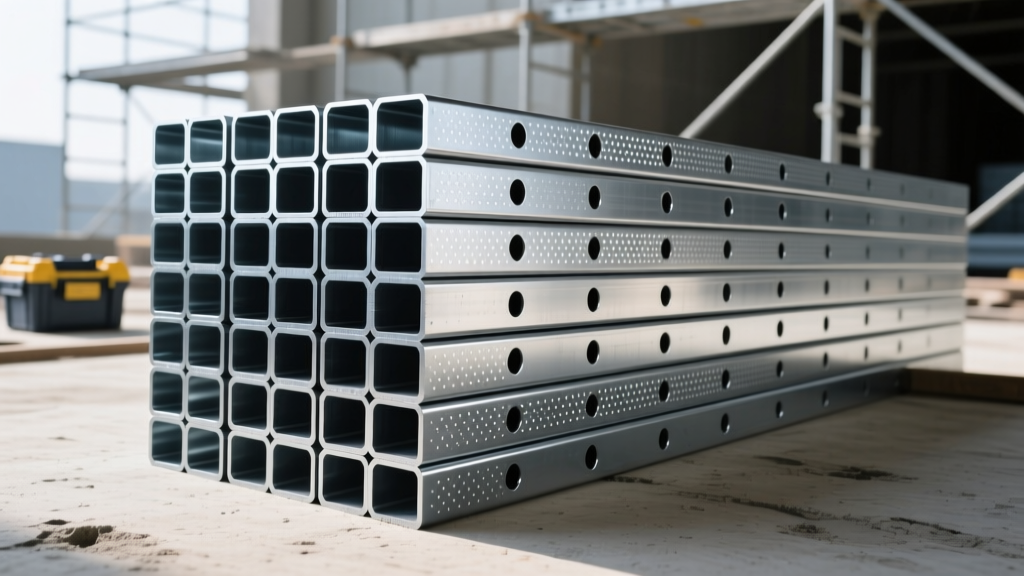
Procuring CFS in 2026 requires proactive supply chain management. Mills are increasingly consolidating production runs, meaning specialized profiles (like 8-inch deep structural studs with 2-inch flanges) may carry 6-to-8 week lead times compared to the 2-week turnaround for standard 6-inch, 1-5/8" flange studs.
Frequently Asked Questions
Can I use 50 ksi steel for non-load-bearing interior walls?
Yes, but it is generally not recommended. 50 ksi steel is harder and more brittle than 33 ksi. Drywall installers will experience higher screw-head stripping rates, and cutting 50 ksi studs with standard aviation snips causes excessive hand fatigue and tool wear. Stick to 33 ksi for interior partitions to optimize labor efficiency.
How does the light gauge steel framing market handle fire ratings?
Steel itself is non-combustible, but it loses structural integrity at high temperatures (yield strength drops significantly above 800°F). Fire ratings in the CFS market are achieved through the assembly, typically by specifying multiple layers of 5/8-inch Type X gypsum board. A standard 2-hour fire-rated assembly requires specific stud spacing (usually 16" o.c.) and specific screw patterns as tested by Underwriters Laboratories (UL).
What is the difference between EQ and standard mill steel?
EQ (Equivalent) studs are often roll-formed from recycled, lower-grade steel that does not strictly meet ASTM A1003 yield requirements. They are marketed as 'equivalent' to a certain gauge but are strictly for non-structural, non-load-bearing use. In 2026, building inspectors in strict jurisdictions are actively rejecting EQ studs for any application requiring a structural stamp. Always verify the mill test report (MTR) for critical assemblies.
Written by
Priya KapoorPriya Kapoor is a real estate market analyst and construction economics researcher with expertise in housing affordability, development feasibility, and infrastructure investment. She holds a Master of Regional Planning from Cornell University and previously worked as a senior analyst at CBRE's Investment Properties group, where she modeled returns for $4B in mixed-use development pipelines. Priya now runs an independent research practice advising developers, municipalities, and REITs on construction cost forecasting and market timing. She publishes the quarterly "BuildMat Market Pulse" report tracking material price indices across 12 commodity categories. Based in Austin, TX, Priya serves on the board of Habitat for Humanity Austin and is a marathon runner.
More from Priya Kapoor
View all
Construction Cost
Cost to Build a 1600 Sq Ft Home in 2026: Full Breakdown
Accurate 2026 cost to build a 1600 sq ft home—material, labor, and regional pricing breakdowns included. Plan your budget with real-time estimates.
Aug 11, 2026

Wood & Lumber
Name the Types of Wood for Pressure Treatment and Preservation
Learn how to name the types of wood best suited for pressure treatment. Compare species treatability, chemical retention levels, and 2026 preservation costs.
Aug 4, 2026

Stone & Masonry
Stone Veneer Suppliers Lindenhurst: 2026 Cost Analysis
Analyze 2026 stone veneer costs in Lindenhurst, NY. Compare local supplier pricing, delivery fees, and Suffolk County installation labor rates.
Aug 4, 2026