What Type of Wood Are Baseball Bats Made Of? A Species Guide
Discover what type of wood baseball bats are made of. Compare maple, ash, and birch based on Janka hardness, grain structure, and MLB rules.
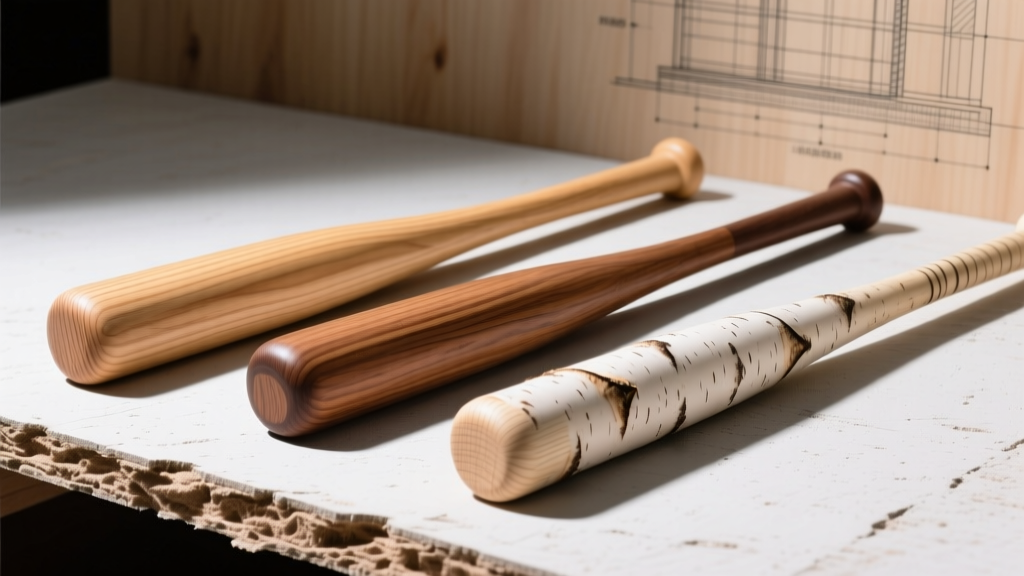
The Core Question: What Type of Wood Are Baseball Bats Made Of?
When evaluating lumber for high-impact sports equipment, the selection criteria shift dramatically from standard construction framing. If you are asking what type of wood baseball bats are made of, the modern professional and amateur markets are dominated by three primary North American hardwoods: Hard Maple, Northern White Ash, and Yellow Birch. Each species offers a distinct cellular anatomy, specific gravity, and failure mode that directly influences a batter's swing weight, trampoline effect, and safety.
Historically, hickory was the standard, but the modern game demands a higher strength-to-weight ratio. Today, bat manufacturers grade billets not just by species, but by microscopic grain alignment and moisture content. Below is a complete species guide detailing the material science behind baseball bat lumber.
The Big Three: Species Comparison Matrix
Understanding the mechanical properties of bat woods requires looking at Janka hardness, specific gravity (which dictates swing weight), and cellular structure. The following matrix breaks down the primary species used in professional and collegiate leagues.
| Species | Scientific Name | Janka Hardness (lbf) | Specific Gravity (Basic) | Grain Anatomy | Primary Failure Mode |
|---|---|---|---|---|---|
| Hard (Sugar) Maple | Acer saccharum | 1,450 | 0.63 | Diffuse-porous | Shatters / Splinters sharply |
| Northern White Ash | Fraxinus americana | 1,320 | 0.55 | Ring-porous | Flakes / Hinges / Dents |
| Yellow Birch | Betula alleghaniensis | 1,260 | 0.56 | Diffuse-porous | Compresses / Cracks |
| Hickory (Historical) | Carya ovata | 1,820 | 0.73 | Ring-porous | Snaps / Heavy denting |
Hard Maple (Sugar Maple)
Hard maple is currently the most popular wood in Major League Baseball, accounting for roughly 70% to 80% of all professional bats. According to The Wood Database, its diffuse-porous structure means the pores are relatively uniform in size and distributed evenly throughout the growth ring. This creates an incredibly dense, stiff surface that does not compress easily upon ball impact. The result is a highly efficient energy transfer (trampoline effect) and exceptional durability against denting. However, because it is so stiff, maple lacks the flexibility of ash. When a maple bat fails, especially on an inside pitch hit near the handle, it tends to shatter into sharp, dangerous projectiles.
Northern White Ash
Before the maple revolution of the early 2000s, white ash was the undisputed king of baseball lumber. Ash is a ring-porous wood, meaning it has large earlywood pores and dense latewood bands. This anatomy gives ash a natural flexibility and a pronounced 'whip' or 'trampoline' effect upon contact. When ash fails, it typically flakes, splinters, or bends (hinges) rather than exploding. Many traditionalists prefer ash for its forgiving nature on mishits and its slightly lighter swing weight compared to maple.
Yellow Birch
Yellow birch serves as the hybrid compromise between maple and ash. It possesses a diffuse-porous structure like maple, providing good surface hardness, but it has a lower Janka rating and slightly more flex. Birch requires a mandatory 'break-in' period. The initial impacts compress the wood fibers on the barrel, hardening the surface over time. If a batter uses a birch bat without breaking it in, the barrel will dent prematurely.
Wood Physics: Why Grain Structure Dictates Performance
The species of wood is only half the equation; the orientation of the grain within the billet determines whether the bat will survive a 95-mph fastball. Wood is an anisotropic material, meaning its strength varies depending on the direction of the applied force.
The Slope of Grain Rule
For a baseball bat to withstand high-velocity impacts, the grain lines must run as parallel to the longitudinal axis of the bat as possible. A slope of grain deviation greater than 1:33 (approximately 3 degrees) reduces the bending strength of the wood by up to 50%. Manufacturers must carefully split or quarter-saw billets to ensure the grain runs perfectly straight from the knob to the barrel.
Edge Grain vs. Face Grain Striking
In diffuse-porous woods like maple and birch, the bat must strike the ball on the edge grain (the quarter-sawn face, where the growth rings appear as tight, straight lines). Striking on the face grain (flat-sawn) in maple will cause immediate catastrophic failure. Conversely, ring-porous ash is traditionally struck on the face grain, as the dense latewood bands provide the necessary structural backing to prevent the large earlywood pores from crushing.
MLB Ink Dot Test and Moisture Regulations
To combat the dangerous shattering associated with maple bats, Major League Baseball instituted strict material testing protocols. According to MLB Official Rules, all maple and birch bats must pass the 'Ink Dot Test'.
- The Application: A drop of ink is placed on the tangential face (the face grain) of the bat handle.
- The Bleed: The ink bleeds along the wood's medullary rays.
- The Measurement: Manufacturers measure the angle of the ink bleed relative to the bat's centerline. If the slope exceeds 3 degrees, the bat is destroyed and rejected.
Furthermore, the USDA Forest Service Wood Handbook notes that wood strength is heavily dependent on moisture content (MC). Professional bat billets are kiln-dried to an exact MC of 8% to 10%. If the wood is too wet (above 12%), it becomes spongy, losing its stiffness and denting easily. If it is too dry (below 6%), it becomes overly brittle and prone to snapping.
The Bone-Rubbing Tradition in Ash Bats
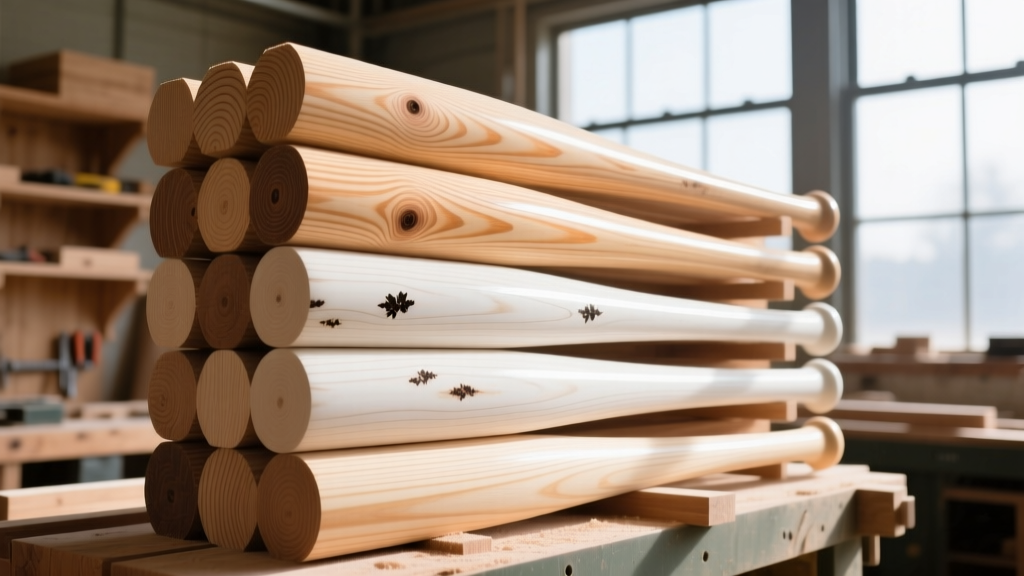
If you purchase a Northern White Ash bat, you will notice a distinct manufacturing step that is omitted for maple and birch: bone rubbing. Because ash is ring-porous, the surface is riddled with open earlywood vessels. Bat makers use a smooth piece of bone, porcelain, or hardened steel to aggressively burnish the barrel of the ash bat. This mechanical compression forces the open pores shut, hardening the surface and preventing the ball from denting the wood upon impact. Maple's naturally tight, diffuse-porous structure makes bone rubbing entirely unnecessary.
Niche and Historical Bat Woods
While the Big Three dominate the market, other species offer unique material properties for specific applications or historical interest.
- Hickory (Carya ovata): The heaviest and hardest wood used in baseball history. Babe Ruth famously swung hickory bats weighing upwards of 48 ounces. Today, hickory is virtually extinct in professional play because its high specific gravity (0.73) makes it impossible to generate the bat speed required to hit modern high-velocity pitches.
- European Beech (Fagus sylvatica): Occasionally used in European baseball and cricket overlaps. It shares a diffuse-porous structure with maple but is slightly more prone to moisture fluctuation. It provides a stiff, heavy feel similar to maple but lacks the same sheer impact resistance.
- Pecan (Carya illinoinensis): A close relative of hickory, sometimes used in amateur or youth bats in the Southern United States. It offers high shock resistance but is generally too heavy for optimized adult swing mechanics.
Sourcing Premium Bat Billets: A Buyer's Guide
For woodworkers, custom bat makers, or facilities sourcing raw lumber, buying standard hardwood boards from a local distributor will yield unacceptable results. Bat billets require specialized harvesting and milling techniques.
Split vs. Sawn Billets
Premium bat billets are riven (split) rather than sawn. Splitting the log along its natural grain lines guarantees that the medullary rays and growth rings remain perfectly parallel to the billet's edges. Sawn billets, cut with a bandsaw or circular saw, frequently cut across the grain, introducing hidden slope-of-grain deviations that will cause the bat to shatter under load.
Geographic Sourcing
The best baseball ash and maple are harvested from the 'Northern Tier' of the United States and Southern Canada (primarily New York, Pennsylvania, and Quebec). Trees grown in these colder climates experience shorter growing seasons, resulting in tighter, denser growth rings. A premium 3-inch diameter maple billet (roughly 37 inches long) typically costs between $12 and $18 wholesale, whereas lower-grade, wide-rung southern maple may sell for under $6 but will fail professional grading standards.
Visual Grading Criteria
When inspecting raw billets, reject any wood exhibiting:
- Mineral Streaks: Dark discolorations indicate mineral deposits that create brittle micro-fractures in the wood.
- Barley Twists: A spiraling grain pattern that indicates severe slope of grain.
- Knot Clusters: Even pin knots disrupt the local grain flow and create stress concentrations that will initiate cracks during a swing.
Selecting the correct wood species for a baseball bat is a precise exercise in material science. Whether optimizing for the stiff energy transfer of sugar maple, the flexible whip of white ash, or the transitional compression of yellow birch, understanding the cellular anatomy and grading standards of these hardwoods is essential for producing high-performance sports equipment.
Written by
Priya KapoorPriya Kapoor is a real estate market analyst and construction economics researcher with expertise in housing affordability, development feasibility, and infrastructure investment. She holds a Master of Regional Planning from Cornell University and previously worked as a senior analyst at CBRE's Investment Properties group, where she modeled returns for $4B in mixed-use development pipelines. Priya now runs an independent research practice advising developers, municipalities, and REITs on construction cost forecasting and market timing. She publishes the quarterly "BuildMat Market Pulse" report tracking material price indices across 12 commodity categories. Based in Austin, TX, Priya serves on the board of Habitat for Humanity Austin and is a marathon runner.
More from Priya Kapoor
View all
Construction Cost
Cost to Build a 1600 Sq Ft Home in 2026: Full Breakdown
Accurate 2026 cost to build a 1600 sq ft home—material, labor, and regional pricing breakdowns included. Plan your budget with real-time estimates.
Aug 11, 2026

Wood & Lumber
Name the Types of Wood for Pressure Treatment and Preservation
Learn how to name the types of wood best suited for pressure treatment. Compare species treatability, chemical retention levels, and 2026 preservation costs.
Aug 4, 2026

Stone & Masonry
Stone Veneer Suppliers Lindenhurst: 2026 Cost Analysis
Analyze 2026 stone veneer costs in Lindenhurst, NY. Compare local supplier pricing, delivery fees, and Suffolk County installation labor rates.
Aug 4, 2026