Technical Specs and Performance Ratings for Types of Cedar Siding
Compare types of cedar siding by performance ratings, fire resistance, and grading specs to select the optimal profile for your climate and structural needs.
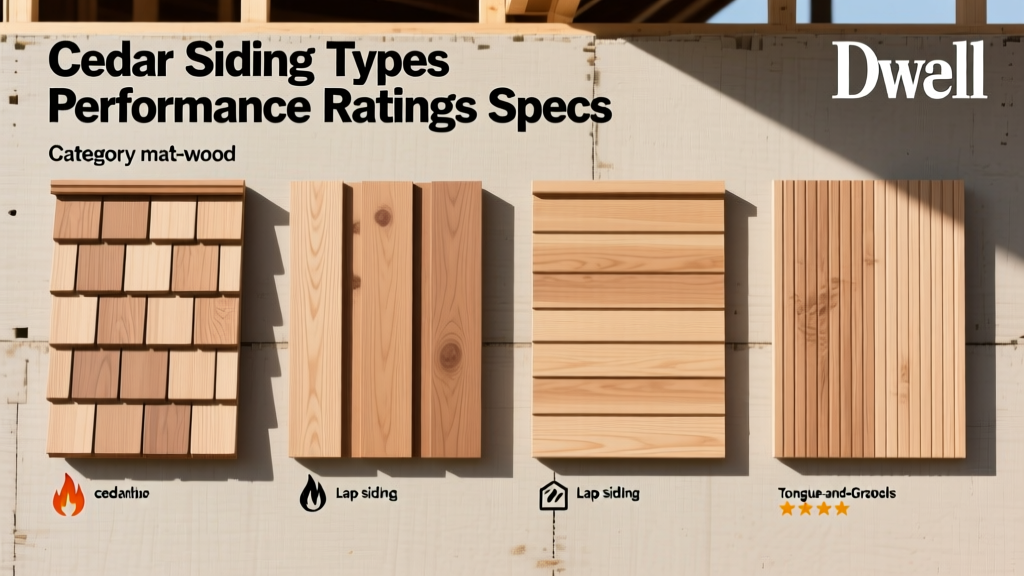
Core Performance Metrics: Western Red vs. Alaskan Yellow Cedar
When evaluating the different types of cedar siding for high-performance exterior envelopes, architects and builders must look beyond aesthetics to the underlying cellular structure and mechanical properties. The two primary species used in North American construction are Western Red Cedar (Thuja plicata) and Alaskan Yellow Cedar (Callitropsis nootkatensis). Their performance profiles differ significantly in density, dimensional stability, and natural decay resistance.
Western Red Cedar (WRC): Density of 23 lbs/ft³ (oven-dry). Janka hardness of 350 lbf. Radial shrinkage: 3.9%; Tangential shrinkage: 6.0%.
Alaskan Yellow Cedar (AYC): Density of 28 lbs/ft³ (oven-dry). Janka hardness of 580 lbf. Radial shrinkage: 4.6%; Tangential shrinkage: 6.8%.
According to the USDA Forest Products Laboratory Wood Handbook, WRC exhibits superior dimensional stability due to its lower shrinkage coefficients, making it the preferred choice for regions with extreme seasonal humidity swings. AYC, while slightly more prone to movement, offers 65% greater surface hardness, providing better resistance to physical impact and denting in high-traffic or hail-prone zones. Both species feature heartwood rated as Class 1 (highly resistant to decay) due to the presence of natural extractives like thujaplicins, though the sapwood of both species remains susceptible to fungal attack and requires careful detailing to avoid ground contact.
Siding Profiles and Dimensional Specifications
The structural performance and weather-shedding capabilities of cedar siding are heavily dictated by the milled profile. Selecting the correct profile requires balancing wind-driven rain resistance, material waste factors, and structural spanning capabilities.
| Profile Type | Nominal Dimensions | Max Exposure | Lap / Joint Spec | Waste Factor |
|---|---|---|---|---|
| Bevel (Clapboard) | 1/2" x 6" to 1/2" x 10" | 5.5" (for 8" board) | Min 1" overlap | 10-15% |
| Tongue & Groove (T&G) | 1x4 to 1x6 | Full face width | 3/8" tongue depth | 15-20% |
| Board & Batten | 1x10 board, 1x3 batten | N/A (Vertical) | Min 1" batten overlap | 5-10% |
| Shingles (Perfection) | 18" length, 5/2" butt | 5.5" to 7.5" | 1.5" side lap offset | 20-25% |
Grading Standards and Moisture Content Tolerances
Performance failures in cedar siding are most frequently traced back to improper moisture content (MC) at the time of installation or misinterpretation of grade stamps. The Western Red Cedar Lumber Association (WRCLA) establishes strict grading rules that directly correlate to structural integrity and surface finish longevity.
- Clear A (Edge Grain): 100% heartwood, vertical grain, zero knots. Highest dimensional stability and fastest moisture dissipation. Required for high-end architectural applications where minimal cupping is acceptable.
- Clear B: Allows small, tight knots (max 1/2 inch diameter). Suitable for most premium residential applications.
- Select Knotty: Tight, structurally sound knots of any size. Prone to localized resin bleeding and differential shrinkage around knot perimeters.
- Quality Knotty: Permits loose knots and minor defects. Strictly limited to rustic applications; not recommended for painted finishes due to knot fallout and tannin bleed.
Kiln-dried (KD) cedar siding must be delivered at 12-15% MC. If installed in a humid climate without a 3-to-5-day on-site acclimation period under protective tarps, the wood will absorb ambient moisture, leading to severe compressive buckling when fastened. Conversely, green or air-dried siding installed at >19% MC will experience radial checking and fastener pull-through as it drops to equilibrium moisture content (EMC).
Fire Ratings and Code Compliance for Cedar Siding
Untreated cedar siding carries a Class C flame spread rating (ASTM E84), which renders it non-compliant in many Wildland-Urban Interface (WUI) zones governed by the International Wildland-Urban Interface Code (IWUIC) or California Building Code Chapter 7A. To specify cedar in these high-risk fire zones, builders must utilize Pressure-Impregnated Fire Retardant (PIFR) treatments.
Pressure-Impregnated Fire Retardant (PIFR) Specifications
PIFR cedar achieves a Class A flame spread rating (0-25 index) and a smoke developed index of <450. The treatment process involves forcing water-soluble borate or phenolic resins into the wood cellular structure under vacuum pressure, followed by kiln drying to lock the chemicals in place. Unlike surface-applied intumescent coatings, PIFR treatment does not degrade under UV exposure or rain washing. However, PIFR cedar is highly hygroscopic; it must be sealed with a vapor-permeable, water-repellent preservative (WRP) to prevent accelerated moisture uptake, which can compromise the fire-retardant salts over decades of exposure.
"In WUI jurisdictions, the use of untreated wood siding is strictly prohibited within 30 feet of the primary structure. Specifiers must verify that the PIFR cedar carries a valid ICC-ES Evaluation Report confirming compliance with ASTM E84 and NFPA 285 assembly testing."
Thermal and Acoustic Performance Data
While cedar siding is not a primary insulation layer, its cellular structure provides measurable thermal and acoustic benefits compared to fiber cement or vinyl alternatives. Cedar has an R-value of approximately 1.35 per inch of thickness. A standard 1/2" bevel siding profile contributes an R-value of 0.67 to the wall assembly. While marginal for thermal resistance, this mass and cellular air-trapping significantly reduce thermal bridging at the cladding layer.
Acoustically, a 1/2" cedar bevel siding assembly installed over 1/2" OSB sheathing and standard stud framing yields a Sound Transmission Class (STC) rating improvement of 2 to 4 points over rigid claddings like fiber cement, due to cedar's natural dampening coefficient which absorbs high-frequency exterior noise (e.g., traffic, wind-driven rain impact).
Real-World Failure Modes and Mitigation Strategies
Even premium-grade cedar siding will fail prematurely if installation specifications ignore the material's biological and chemical realities. Below are the most common field failures and their engineered mitigations.
1. Extractive Bleeding and Finish Delamination
The Failure: Water-soluble tannins and extractives migrate through water-based acrylic primers, causing brown staining and breaking the chemical bond of topcoats, leading to peeling within 18 months.
The Fix: Mandate a heavy-bodied, alkyd-based stain-blocking primer (e.g., Zinsser Cover Stain or Benjamin Moore Fresh Start Exterior Alkyd) applied at 1.5 mils dry film thickness. Acrylic primers lack the solvent penetration required to encapsulate cedar tannins.
2. Fastener Corrosion and Iron-Tannin Staining
The Failure: Electro-galvanized or standard steel nails react with cedar's natural acids, causing black streaks and premature fastener corrosion, leading to wind-load failure.
The Fix: Specify 304 stainless steel ring-shank nails for standard applications. For coastal projects within 1 mile of saltwater, mandate 316 stainless steel. If using hot-dipped galvanized (ASTM A153 Class D), ensure the zinc coating is a minimum of 1.0 oz/ft², though stainless remains the superior performance choice.
3. Differential Cupping in Bevel Profiles
The Failure: The exposed face of the siding dries and shrinks faster than the back face, which is trapped against the weather-resistive barrier (WRB), causing the bottom edge to curl outward.
The Fix: Implement a back-priming protocol on-site using the same alkyd primer as the face. Additionally, ensure a minimum 3/8" drainage gap behind the siding via furring strips or a thick, textured WRB to equalize the drying rate on both faces of the board.
Summary of Specification Best Practices
Specifying the correct types of cedar siding requires a holistic approach that aligns the species, profile, grade, and fastener chemistry with the specific microclimate and building code requirements of the project. By adhering to strict moisture content tolerances, utilizing appropriate stain-blocking chemistries, and ensuring proper WUI fire compliance where necessary, builders can deliver cedar exterior envelopes that easily exceed a 40-year service life with standard maintenance cycles.