Types of Faux Wood Blinds: A Room-by-Room Selection Framework
Navigate the types of faux wood blinds with our selection framework. Compare PVC vs. composite, slat sizes, and structural limits for every room.
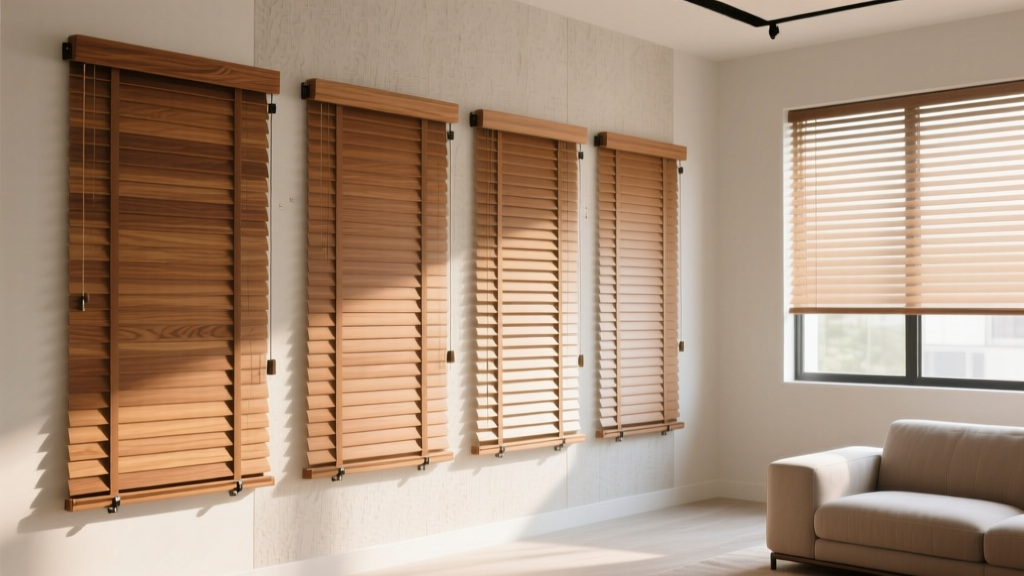
Faux wood blinds dominate the residential and commercial window treatment market, accounting for over 40% of all hard blind sales due to their moisture resistance and cost-effectiveness. However, the umbrella term 'faux wood' masks critical structural and material differences. Treating all faux wood blinds as identical leads to warped slats, failing headrails, and excessive light bleed. This selection framework breaks down the exact material compositions, mechanical limits, and sizing parameters required to specify the correct blind for any architectural environment.
The Core Dilemma: 100% PVC vs. Composite Blends
The primary decision in selecting faux wood blinds is identifying the core material. Manufacturers generally produce these window coverings using one of two distinct extrusion processes, each with specific failure thresholds.
| Feature | 100% PVC (Solid Vinyl) | Composite (Wood-Pulp/PVC Blend) |
|---|---|---|
| Core Composition | Extruded polyvinyl chloride with UV inhibitors | MDF (medium-density fiberboard) core wrapped in PVC, or co-extruded wood-pulp/vinyl blend |
| Weight | Lighter (approx. 2.2 lbs per sq. ft.) | Heavier (approx. 3.5 lbs per sq. ft.) |
| Max Unsupported Span | 48 inches (wider spans require center support) | 42 inches (highly prone to bowing under its own weight) |
| Moisture Resistance | Impervious; ideal for wet zones | High, but exposed cut ends can absorb ambient humidity over time |
| Thermal Warping | Prone to warping in direct, unfiltered south-facing sunlight | More dimensionally stable under high heat due to wood-pulp density |
Slat Sizing, Stack Height, and Routing Mechanics
Faux wood slats are significantly thicker than aluminum or real wood alternatives, typically measuring 2.5mm to 3mm in thickness. This dimension drastically impacts both the visual aesthetic and the mechanical stack height when the blind is fully raised.
Standard Slat Dimensions
- 2-Inch Slats: The standard for shallow window casings (minimum 1.5-inch depth required). Provides a traditional, denser louver look.
- 2.5-Inch Slats: The modern industry standard. Offers optimal balance between light control and outward visibility when tilted open.
- 3-Inch Slats: Plantation style. Requires deep window frames (minimum 3.25-inch depth) to prevent the slats from protruding past the casing when fully tilted.
The Stack Height Penalty
Because faux wood slats are thick, the 'stack height' (the space the blind occupies when fully raised) is substantial. A standard 2.5-inch faux wood blind on a 60-inch tall window will stack approximately 14 to 16 inches high. For windows with low headroom or transom windows directly above, this stack will obscure up to 25% of the glass even when fully open.
Routeless vs. Routed Slat Design
Traditional routed blinds feature a small hole punched through the center of every slat for the lift cord to pass through. Routeless blinds eliminate this hole, relying on the ladder string to hold the slats in place. Routeless options reduce light bleed by 15% to 20% and provide a cleaner aesthetic, though they typically carry a 10% to 15% price premium and require slightly more careful handling during cleaning to avoid dislodging the slats from the ladder tape.
The Room-by-Room Selection Framework
Applying the material and sizing data above, use this decision matrix to specify the correct blind type for specific architectural zones.
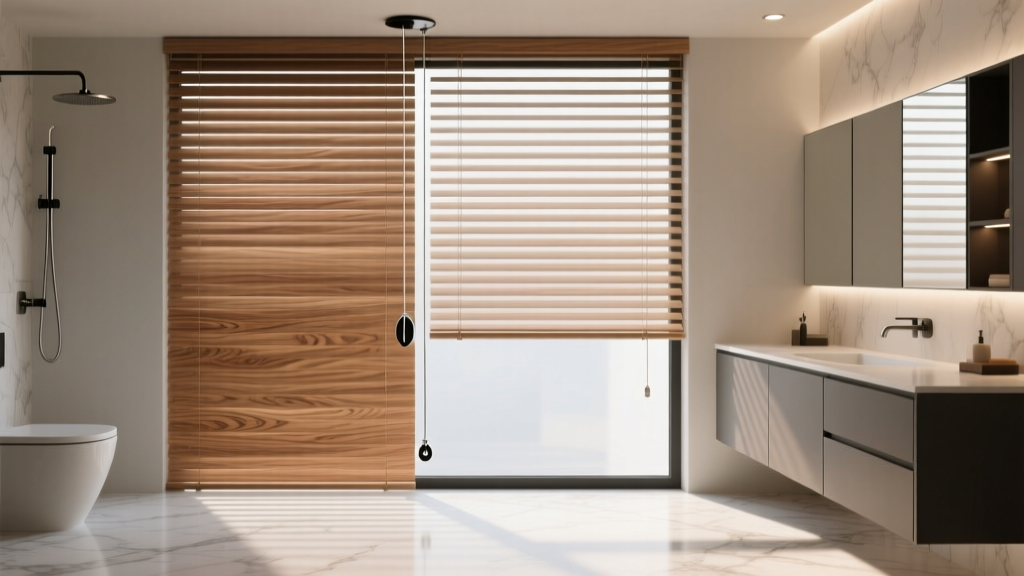
High-Humidity Zones (Bathrooms, Saunas, Indoor Pools)
Specification: 100% PVC, 2-inch routed slats, standard cordless lift.
Rationale: Pure vinyl will not absorb moisture, preventing the swelling and delamination that can occur with composite blinds when exposed to constant steam. The 2-inch slat is necessary because bathroom windows often feature shallow, vinyl-wrapped casings that cannot accommodate deeper 2.5-inch or 3-inch profiles.
Large Expanses (Living Rooms, Sunrooms)
Specification: Composite blend, 2.5-inch or 3-inch routeless slats, motorized headrail.
Rationale: Composite materials mimic the deep, varied grain of real wood much better than extruded PVC, which often looks flat and repetitive. Because a 72-inch wide faux wood blind can weigh over 20 pounds, manual cordless operation becomes physically difficult and accelerates internal spring wear. Motorization (using a lithium-ion tube motor) is highly recommended for spans over 48 inches.
French Doors and Tilt-and-Turn Windows
Specification: 100% PVC, 1-inch or 2-inch slats, shallow-profile headrail, hold-down brackets.
Rationale: French doors require minimal clearance to allow the door handle to operate and the door to swing fully. Shallow-profile headrails (under 1.25 inches deep) paired with 1-inch mini faux wood slats ensure the blind sits flush against the glass. Hold-down brackets at the bottom rail are mandatory to prevent the blind from swinging violently when the door is opened or closed.
Structural Load and Hardware Requirements
The most common installation failure with faux wood blinds is headrail detachment. Because these blinds are heavy, relying on standard drywall anchors is a critical error.
According to the U.S. Department of Energy, properly fitted window coverings can significantly reduce thermal transfer. However, to maximize the insulating R-value of faux wood blinds, the headrail must be mounted as close to the ceiling or crown molding as possible, and side channels or wide overlapping trim should be utilized to trap the layer of dead air between the glass and the blind.
Safety Standards and Motorization in 2026
The regulatory landscape for window coverings has shifted dramatically to eliminate strangulation hazards. Under the U.S. Consumer Product Safety Commission (CPSC) guidelines and the mandatory 16 CFR Part 1260 standard, virtually all stock and custom faux wood blinds sold in the United States must be cordless or feature inaccessible cords.
When selecting a lift system, you are now choosing between three primary mechanisms:
- Standard Cordless (Spring Motor): Operated by pushing or pulling the bottom rail. Best for windows under 60 inches in height. The internal spring mechanism has a finite lifecycle (typically 5,000 to 8,000 cycles) before requiring replacement.
- Continuous Loop Cord (Clutch System): Features a cord loop anchored to the wall via a tension device. While technically a 'cord', it is code-compliant when the tensioner is securely screwed into the window casing, keeping the loop taut and out of reach of children. This system is superior for very tall or heavy blinds where a spring motor would fail.
- Motorized (RF or Wi-Fi): Powered by a concealed battery wand or hardwired low-voltage transformer. The Window Covering Manufacturers Association (WCMA) notes that motorization is the fastest-growing segment in the industry, as it inherently solves child-safety concerns while solving the ergonomic issue of lifting 20-pound composite blinds.
Quick-Reference Cost Matrix
Pricing for faux wood blinds varies based on material blend, routing, and lift mechanism. The following table outlines average market costs for a standard 36-inch by 60-inch window (excluding professional installation labor, which typically adds $25 to $45 per window).
| Configuration | Material | Lift Type | Estimated Unit Cost |
|---|---|---|---|
| Entry-Level Standard | 100% PVC, Routed | Cordless Spring | $35 - $50 |
| Mid-Tier Premium | Composite, Routeless | Cordless Spring | $65 - $95 |
| High-End Custom | Composite, Routeless, Decorative Tape | Motorized (Battery) | $180 - $260 |
By aligning the specific material properties of PVC and composite blends with the mechanical realities of slat thickness and structural weight limits, you can specify faux wood blinds that deliver long-term durability, precise light control, and code-compliant safety across any architectural application.
Written by
Elena RodriguezElena Rodriguez is a civil engineer and technical writer specializing in concrete technology, masonry systems, and ASTM/ACI compliance. She earned her B.S. in Civil Engineering from Texas A&M University and spent a decade at a materials testing laboratory, performing over 2,000 concrete compressive strength tests and masonry prism evaluations. Elena is an ACI-certified Field Testing Technician (Grade I) and a member of ASTM Committee C12 on Natural Building Stone. She currently consults on forensic engineering cases involving concrete failures and moisture intrusion. Based in San Antonio, TX, Elena is a proud member of the Society of Women Engineers (SWE) and coaches her daughter's FIRST Robotics team.
More from Elena Rodriguez
View all
Walls & Panels
Cost Analysis: Light Gauge Steel Framing Advantages and Disadvantages
Evaluate light gauge steel framing advantages and disadvantages through a strict cost analysis lens, comparing material, labor, and lifecycle expenses.
Aug 4, 2026

Walls & Panels
Gypsum Board Types: Exact Specifications, Thickness & Dimensions
Compare standard, Type X, and moisture-resistant gypsum board types. Get exact specifications, thicknesses, dimensions, and ASTM standards for your project.
Aug 4, 2026

Fire Resistance
Best Fire-Resistant Outdoor Decking Materials: 2026 Buyer Guide
Discover the best fire-resistant outdoor decking materials for 2026. Compare Class A PVC, aluminum, and hardwood options for WUI compliance and safety.
Aug 4, 2026