Ipe Wood Decking: Material Taxonomy, Grades, and Selection Guide
Explore the material taxonomy of ipe wood decking. Compare grades, analyze FSC sourcing, and use our selection matrix to choose the right hardwood.
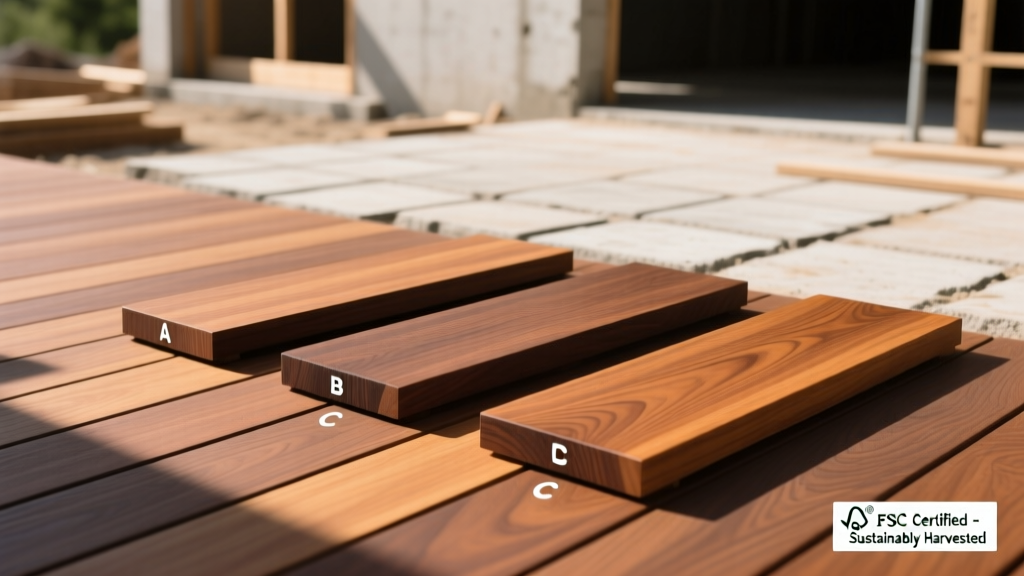
The Botanical and Commercial Taxonomy of Ipe
In the premium exterior lumber market, 'ipe' functions as a commercial umbrella term rather than a single botanical species. Historically classified under the Tabebuia genus, modern botanical taxonomy has reclassified the primary species used for decking into the Handroanthus genus. When sourcing ipe wood decking, you are typically procuring Handroanthus serratifolia (yellow poui), Handroanthus impetiginosus (pink ipe), or Handroanthus chrysotrichus.
Understanding this taxonomy is critical for material selection because different species within the ipe group exhibit slight variations in color, interlocked grain patterns, and silica content. According to The Wood Database, true ipe possesses a Janka hardness rating of 3,680 lbf and a specific gravity of 0.90 to 1.10, making it one of the densest and most rot-resistant timbers commercially available.
Lumber Grading Standards for Hardwood Decking
Unlike softwood dimensional lumber (which uses SPIB grading rules like #2 Grade), ipe wood decking is graded using modified National Hardwood Lumber Association (NHLA) standards, adapted specifically for exterior applications. Selecting the correct grade dictates both the structural integrity and the visual uniformity of your deck.
FAS (Firsts and Seconds) / Premium Clear
FAS is the highest grade available. Boards must yield a minimum of 83.3% clear-face cuttings. In the context of ipe decking, FAS means the boards are virtually free of knots, sapwood, and mineral streaks. This grade is mandatory for high-visibility commercial projects, luxury residential builds, and applications where a uniform, dark olive-brown aesthetic is required.
Select and Better (SEL/BTR)
This is the most common grade for premium residential ipe wood decking. SEL/BTR allows for minor visual imperfections, such as small, tight pin knots (under 1/2 inch), slight color variations between heartwood and sapwood, and minimal wane on the edges. It offers 90% of the visual appeal of FAS at a 15% to 20% lower cost.
#1 Common / Commercial Grade
#1 Common permits larger knots, significant color variegation, and up to 15% sapwood. While structurally sound and equally resistant to decay, the wild grain patterns and lighter sapwood patches make it less desirable for primary decking surfaces. It is best utilized for structural sub-framing, privacy screens, or hidden joist components.
Material Selection Matrix: Ipe vs. Alternative Hardwoods
When specifying exterior timber, architects and builders must weigh density, dimensional stability, and cost. The following matrix compares ipe to its closest South American competitors.
| Species | Janka Hardness (lbf) | Specific Gravity | Tangential Shrinkage | Best Application |
|---|---|---|---|---|
| Ipe (Handroanthus spp.) | 3,680 | 0.90 - 1.10 | 6.6% | Heavy-traffic commercial, boardwalks, luxury residential |
| Cumaru (Dipteryx odorata) | 3,330 | 0.80 - 0.95 | 7.9% | Cost-effective ipe alternative, residential decking |
| Massaranduba (Manilkara bidentata) | 3,190 | 0.85 - 0.95 | 9.2% | Ground-contact landscaping, retaining walls |
| Tigerwood (Astronium fraxinifolium) | 2,160 | 0.70 - 0.80 | 7.5% | Interior flooring, covered porch ceilings, accent trim |
Fastener and Hardware Selection for High-Density Timber
The extreme density and natural oils of ipe wood decking dictate strict hardware requirements. Standard galvanized or polymer-coated screws will react with the wood's tannins, causing unsightly black halos (galvanic corrosion) and eventual fastener failure.
'When face-screwing ipe, pre-drilling is not optional. The silica content in the wood will dull standard high-speed steel (HSS) bits in a matter of minutes. Always use carbide-tipped drill bits and countersink bits designed for composite or hardwoods.'
Hidden Fastener Systems vs. Face Screwing
- Hidden Fasteners (Recommended): Systems like the Tiger Claw TC-3S or Eb-Ty utilize biscuit-style clips that slot into pre-routed grooves on the edges of the ipe boards. This method eliminates top-down water penetration points and accommodates the wood's natural tangential shrinkage and expansion. Ensure the clips are manufactured from 304 or 316 stainless steel.
- Face Screwing: If face fastening is required by local building codes or structural engineering specs, use 305-grade or 316-grade stainless steel trim-head screws. 316 stainless is mandatory for projects located within 10 miles of a saltwater coastline to prevent pitting corrosion.
Sourcing, FSC Certification, and Lacey Act Compliance
Because ipe is harvested primarily from the Amazon basin, specifying this material requires rigorous supply chain documentation. Under the USDA APHIS Lacey Act, it is a federal offense to import or trade illegally logged timber. Builders and architects must demand a clear chain-of-custody document from their supplier.
For commercial projects pursuing LEED v4.1 certification, or for municipalities with strict green procurement policies, you must specify FSC (Forest Stewardship Council) 100% Certified ipe. According to FSC US, this certification ensures the timber was harvested from managed concessions that maintain biodiversity, protect indigenous land rights, and enforce selective logging rather than clear-cutting. Note that FSC-certified ipe typically carries a 10% to 15% price premium over non-certified stock due to the costs of third-party auditing.
Cost Breakdown and ROI Analysis (2026 Market Data)
Ipe wood decking is a capital-intensive investment, but its lifecycle cost often undercuts composite alternatives when factoring in replacement cycles. A premium composite deck may require replacement after 20-25 years, whereas properly maintained ipe can easily exceed 50 years of structural service life.
Material and Installation Pricing Matrix
| Cost Component | Estimated Range (per sq. ft.) | Specifications & Notes |
|---|---|---|
| Ipe Decking Boards (5/4x6) | $14.00 - $22.00 | SEL/BTR Grade. Prices fluctuate based on FSC certification and length requirements (long-lengths >10ft cost more). |
| Substructure (PT Pine) | $6.00 - $9.00 | Pressure-treated #1 Southern Yellow Pine. Must include butyl joist tape (e.g., Trex Protect) to prevent rot. |
| Hardware & Fasteners | $2.50 - $4.50 | 304 SS hidden fasteners, carbide bits, and stainless steel structural connectors. |
| Professional Labor | $18.00 - $28.00 | Hardwood installation requires specialized labor, pre-drilling, and precise cutting, driving up labor rates. |
| Total Installed Cost | $40.50 - $63.50 | Varies by regional labor rates, site access, and substructure complexity (e.g., multi-level decks). |
Maintenance and UV Protection
Structurally, ipe requires zero maintenance to survive decades of weather exposure. However, without UV protection, the ultraviolet rays will break down the surface lignin, causing the wood to weather to a silvery-gray patina within 6 to 12 months. If the rich, dark brown color is desired, the deck must be oiled annually using a penetrating hardwood finish specifically formulated for dense timbers, such as Penofin Hardwood Formula or Messmer's UV Plus. Film-forming finishes (like polyurethane) will peel and fail rapidly due to the wood's density and inability to absorb deep moisture barriers.
Frequently Asked Questions
Can I use standard pressure-treated joists with ipe decking?
Yes, but you must isolate the two materials. Ipe holds moisture differently than pressure-treated pine. Apply a high-quality butyl rubber joist tape (like Trex Protect or DeckWise WiseWrap) to the top of every joist before laying the ipe boards. This prevents moisture trapping, which can accelerate joist decay, and provides a cushion that reduces squeaking.
Does ipe wood decking require end-grain sealing?
Absolutely. Whenever you cut an ipe board on-site, the exposed end-grain acts like a bundle of microscopic straws, rapidly absorbing moisture and leading to end-checking (splitting). You must immediately coat all cut ends with a commercial anchor seal or wax-based end-grain sealer to lock out moisture.
Is ipe fire resistant?
Yes. Due to its extreme density, ipe holds a Class A fire rating—the same rating as concrete and steel. This makes it an exceptional choice for buildings in Wildland-Urban Interface (WUI) zones where strict fire codes dictate exterior building materials.