MDF Wood Performance Specs: Density, Moisture, and Emission Ratings
Technical guide to MDF wood performance specs, covering density grades, moisture resistance, formaldehyde emissions, and structural fastener limits.
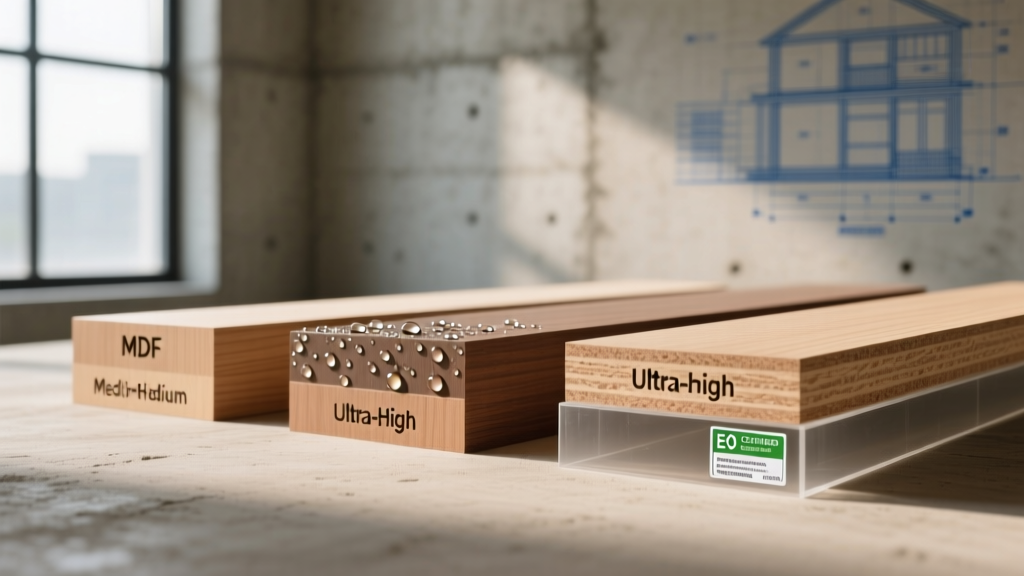
Core Physical Properties: Density and Thickness Tolerances
When specifying MDF wood for architectural millwork, cabinetry, or structural substrate applications, understanding the exact density profile is critical. Medium Density Fiberboard is manufactured by breaking down hardwood or softwood residuals into wood fibers, combining them with wax and a synthetic resin binder, and forming panels under high temperature and pressure. The resulting performance is strictly governed by its density class, which directly dictates machining quality, weight, and fastener withdrawal strength.
- Lightweight MDF (LDF): 25–37 pcf (400–590 kg/m³). Used for exhibition booths, caravan interiors, and non-structural wall paneling where weight reduction is paramount.
- Standard MDF: 37–50 pcf (590–800 kg/m³). The baseline for interior cabinetry, painted furniture, and CNC-machined door fronts.
- High-Density MDF (HDF): 50–65 pcf (800–1040 kg/m³). Specified for heavy-duty flooring substrates, deep-embossed door skins, and high-wear retail fixtures.
Thickness tolerance is another vital specification. For sanded MDF wood panels, the Composite Panel Association (CPA) and ANSI A208.2 standards mandate a thickness tolerance of ±0.008 inches (±0.2 mm). Unsanded panels allow for ±0.015 inches. When designing automated CNC nesting programs or precise cabinet box joinery, assuming a nominal 3/4-inch (19mm) panel is exactly 19.0mm will cause cumulative errors; always program toolpaths based on the manufacturer's specific caliper data, which typically ranges from 18.8mm to 19.2mm for metric-stock panels.
Moisture Resistance Classifications: Standard vs. MR vs. HMR
Standard MDF wood is highly susceptible to hydroscopic expansion. When exposed to liquid water or sustained relative humidity above 65%, the wood fibers absorb moisture, causing irreversible thickness swell (TS) and edge degradation. To mitigate this, manufacturers produce Moisture Resistant (MR) and High Moisture Resistant (HMR) variants.
A common industry misconception is that the green dye often added to MR-MDF provides the moisture resistance. The dye is purely an identifier. The actual performance comes from the resin chemistry and wax emulsions. Standard MDF uses Urea-Formaldehyde (UF) resin. MR-MDF utilizes Melamine-Urea-Formaldehyde (MUF) or polymeric Methylene Diphenyl Diisocyanate (pMDI) resins, combined with higher concentrations of paraffin wax emulsion during the felting process.
| MDF Classification | Primary Resin System | 24-Hour Thickness Swell (TS) | Approved Application Environments |
|---|---|---|---|
| Standard Interior | Urea-Formaldehyde (UF) | 15% – 25% | Conditioned interior spaces (30-50% RH) |
| Moisture Resistant (MR) | MUF or pMDI + Wax | 8% – 12% | Kitchens, bathrooms, high-humidity interiors |
| High Moisture Resistant (HMR) | 100% pMDI + Heavy Wax | < 5% | Exterior-protected soffits, covered patios, wet-area substrates |
Edge Case: Machining and Finishing MR-MDF
While MR-MDF resists bulk water absorption, the machining process exposes untreated core fibers at the cut edges. If you are routing profiles into MR-MDF wood for painted cabinet doors, the exposed edges must be sealed immediately. Use a high-solids polyurethane or acrylic-based edge sealer before applying primer. Failure to seal routed edges allows ambient moisture to bypass the panel's wax emulsion, leading to localized fiber raising and a compromised paint finish.
Formaldehyde Emission Standards and Indoor Air Quality
Because traditional MDF wood relies on formaldehyde-based resins for curing, off-gassing is a primary concern for indoor air quality (IAQ). Specifiers must ensure compliance with regional and international emission standards, particularly for healthcare, education, and high-density residential projects.
- CARB Phase 2 & TSCA Title VI: The baseline legal requirement in North America. Limits formaldehyde emissions from MDF to 0.11 parts per million (ppm). Verified via ASTM E1333 large-chamber testing.
- ULEF (Ultra-Low Emitting Formaldehyde): Limits emissions to 0.05 ppm. Achieved using advanced UF resin scavengers or modified MUF systems.
- NAF (No Added Formaldehyde): Exempt from testing limits (typically tests at <0.05 ppm naturally from the wood itself). NAF MDF wood is manufactured using pMDI resins, which contain zero formaldehyde. According to the California Air Resources Board (CARB), NAF panels are mandatory for projects targeting strict green building certifications like LEED v4.1 or WELL Building Standard.
Structural Limitations: Bending Strength and Fastener Withdrawal
MDF wood is an engineered substrate designed for dimensional stability and surface smoothness, not for structural load-bearing. Its Modulus of Rupture (MOR)—the maximum stress before breaking—typically ranges from 3,500 to 4,500 psi for standard 3/4-inch panels. Its Modulus of Elasticity (MOE), which measures stiffness, is roughly 400,000 to 500,000 psi. Compared to 3/4-inch Baltic Birch plywood (MOR ~7,500 psi), MDF will sag significantly under heavy, distributed loads over spans exceeding 24 inches.
Fastener Withdrawal and Edge Splitting
The most frequent point of failure in MDF wood cabinetry is fastener withdrawal from the panel edge. MDF lacks the cross-banded grain structure of plywood, meaning screws driven into the edge rely solely on the internal bond of the compressed fibers, which can easily pulverize under torque.
To achieve reliable edge joinery, specify fasteners designed explicitly for composite materials:
- Confirmat Screws: Features a thick shank and wide, blunt threads (e.g., 6.3mm x 50mm). Requires a specialized stepped drill bit (5mm shank hole, 3mm thread hole) to relieve internal pressure.
- Euro Screws (System Screws): Coarse, widely spaced threads designed to cut into fiber without displacing excessive material.
- Knock-down Fittings (Minifix/Rafix): Utilizes a steel dowel inserted into a face-drilled hole, transferring the withdrawal load to the stronger face-plane of the MDF rather than the weak edge-plane.
Fire Performance Ratings for Commercial Fit-Outs
For commercial corridors, elevator lobbies, and egress routes, building codes often mandate a Class A (ASTM E84) or Class 1 fire rating for wall and ceiling finishes. Standard MDF wood typically achieves a Class C rating (Flame Spread Index 76-200). To meet Class A requirements (Flame Spread Index 0-25), specifiers must use Fire Retardant (FR) MDF.
FR-MDF is impregnated with ammonium phosphate, borate, or intumescent chemical treatments during the fiber blending stage. While effective for fire suppression, these chemical salts are inherently hygroscopic. In environments with fluctuating humidity, FR-MDF can absorb atmospheric moisture, leading to surface weeping or 'blooming' of salts, which ruins clear coatings and causes paint adhesion failure. Always specify factory-applied, moisture-sealing primers for FR-MDF wood, and consult the Architectural Woodwork Institute (AWI) guidelines for finishing fire-rated composite substrates.
Specification Decision Matrix
Use the following framework to select the correct MDF wood specification based on project parameters, ensuring performance aligns with environmental and structural demands.
| Application Scenario | Required Density | Moisture Rating | Emission Standard | Fastening Strategy |
|---|---|---|---|---|
| Painted Kitchen Cabinet Doors | Standard (45 pcf) | MR-MDF (MUF Resin) | ULEF or NAF | Hinge boring (face); Avoid edge screws |
| CNC-Routed Retail Display Fixtures | HDF (55+ pcf) | Standard | CARB Phase 2 | Confirmat screws; Stepped pilot holes |
| Hospital Wall Paneling & Nurse Stations | Standard (40 pcf) | Standard or MR | NAF (pMDI Resin) | Adhesive bonding to substrate; Blind cleats |
| Commercial Egress Corridor Wainscoting | Standard (40 pcf) | Standard | CARB Phase 2 + Class A Fire Rating | Z-clips; French cleats (face-mounted) |
By prioritizing exact density metrics, resin chemistries, and fastener mechanics over generic material labels, architects and millworkers can eliminate field failures, ensure IAQ compliance, and maximize the lifespan of MDF wood installations.