Oriented Strand Board OSB Durability: Lifespan and Failure Modes
Analyze the durability and lifespan of oriented strand board OSB. Discover moisture failure modes, grade differences, and treatments.
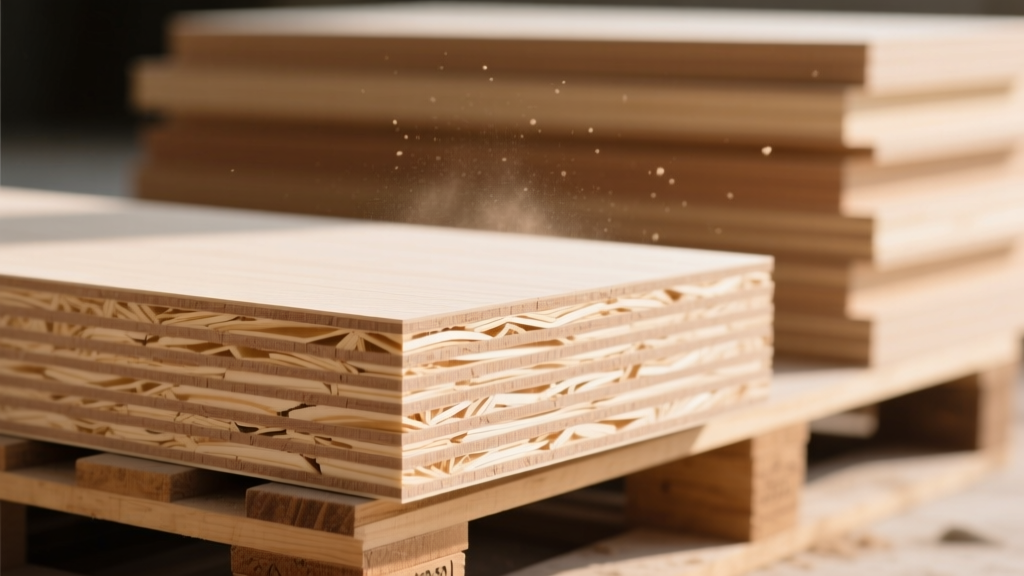
The Anatomy of OSB Durability: Resin, Wax, and Strand Orientation
Oriented strand board (OSB) dominates the North American structural panel market, accounting for over 70% of sheathing applications in residential construction. Its baseline durability stems from a highly engineered manufacturing process: rectangular wood strands are sliced from fast-growing, small-diameter logs (primarily southern yellow pine, aspen, and poplar) and arranged in cross-directional layers. A typical 15/32-inch panel contains up to 50 distinct layers of strands, with surface layers oriented parallel to the panel's long axis and core layers oriented perpendicularly. This cross-lamination mimics the structural mechanics of plywood, providing high shear strength and dimensional stability under dry conditions.
The true determinant of oriented strand board OSB lifespan, however, is the chemical binder. Standard panels utilize phenol-formaldehyde (PF) resins combined with a wax emulsion. PF resins provide excellent structural bonding and pass standard boil tests, but the wax emulsion—which provides temporary water repellency—degrades over time when exposed to liquid water. Premium panels upgrade this chemistry by incorporating polymeric methylene diphenyl diisocyanate (pMDI) resins. Unlike PF, which relies on mechanical interlocking and surface adhesion, pMDI reacts chemically with the hydroxyl groups in wood cellulose, creating a covalent bond that is virtually impervious to hydrolysis. This molecular distinction is the primary reason premium OSB panels achieve a 50-year structural lifespan even in high-humidity environments, whereas standard panels may experience bond degradation if chronically wetted.
Exposure Ratings Decoded: Why 'Exposure 1' is Not 'Waterproof'
A critical misunderstanding in construction is the conflation of 'Exposure 1' with 'Exterior' durability. According to the APA - The Engineered Wood Association, Exposure 1 rated OSB is designed to withstand the normal moisture exposure associated with construction delays. It can survive rain and snow during the framing phase, but it is not intended for permanent exposure to the elements.
While Exposure 1 OSB can technically survive months of weathering before being enclosed, repeated wetting and drying cycles will exhaust the panel's factory-applied wax emulsion. If an OSB roof deck is left exposed to weather for more than 90 days, edge swelling and surface checking become highly probable. Always enclose the building envelope or apply a weather-resistant barrier (WRB) within 30 to 60 days of panel installation.
True 'Exterior' rated panels (bonded with 100% waterproof adhesives and lacking core voids) are almost exclusively manufactured as plywood, not OSB. If your application requires permanent exterior exposure—such as unsealed siding, exterior soffits, or marine applications—oriented strand board is the incorrect material choice regardless of the manufacturer's claims.
Real-World Failure Modes and Edge Swelling Data
When oriented strand board OSB fails in the field, it rarely fails structurally under dry conditions; it fails cosmetically and functionally due to moisture-induced dimensional changes. The most prevalent failure mode is edge swelling, often referred to as 'ghosting' or 'ridge-ing' when it telegraphs through roofing shingles or vinyl flooring.
| Failure Mode | Mechanism of Degradation | Field Mitigation Strategy |
|---|---|---|
| Edge Swelling (Thickness Swell) | Water wicks into the unprotected, cut edges of the panel. Strands absorb moisture and expand. Standard OSB swells up to 15% after a 24-hour soak per PS 2-10 standards. | Seal all field cuts with a polyurethane edge sealer. Maintain a strict 1/8-inch expansion gap between all panel edges. |
| Surface Checking / Flaking | UV radiation and cyclic wetting/drying break down the surface wax, causing the top layer of strands to detach or warp. | Apply a synthetic underlayment immediately after roof sheathing is laid. Do not leave exposed to direct sunlight for >60 days. |
| Fungal Decay (Rot) | If panel moisture content exceeds 20% for prolonged periods, wood-decaying fungi (like brown rot) colonize the cellulose. | Ensure proper attic ventilation (1/150 net free area ratio) and fix roof/plumbing leaks immediately. OSB does not recover from rot. |
| Panel Buckling | Thermal and hygroscopic expansion causes panels to push against each other when installed tight, resulting in ridges at the joists. | Use a 10d nail as a spacer gauge when installing panels to guarantee the mandatory 1/8-inch gap at all ends and edges. |
Premium vs. Standard OSB: AdvanTech and ZIP System Lifespan Metrics
For builders operating in high-precipitation climates or those managing tight construction schedules where weather delays are inevitable, premium OSB products offer a quantifiable increase in durability. Data analyzed by the USDA Forest Products Laboratory and independent testing labs highlight significant performance gaps between commodity OSB and engineered premium panels.
Commodity OSB (Standard Exposure 1)
- Edge Swell Limit: Up to 15% thickness swell after 24-hour water immersion.
- Resin Type: Phenol-formaldehyde (PF) with standard wax emulsion.
- Sanding Requirement: Swollen edges often require mechanical sanding before laying hardwood or LVP flooring to prevent telegraphing.
- Cost Premium: Baseline pricing (e.g., $25 - $35 per 4x8 sheet in early 2026 markets).
Premium Moisture-Resistant OSB (e.g., Huber AdvanTech)
- Edge Swell Limit: Less than 3% thickness swell after extreme water immersion testing.
- Resin Type: Proprietary pMDI and advanced resin blends that bind at the cellular level.
- Sanding Requirement: Virtually eliminated; panels remain flat even after weeks of framing-stage rain exposure.
- Cost Premium: Approximately 40% to 60% higher than commodity OSB, offset by eliminated sanding labor and reduced callback risks.
Integrated WRB OSB (e.g., ZIP System)
Beyond the panel chemistry, integrated systems like the ZIP System apply a factory-laminated weather-resistant barrier to the OSB face. This eliminates the need for traditional housewrap, reducing bulk water exposure during the vulnerable framing phase and accelerating the drying-in process. According to Huber Engineered Woods, the integrated tape and panel system creates a continuous drainage plane that protects the structural OSB core from wind-driven rain, effectively extending the functional lifespan of the wall assembly by preventing chronic moisture trapping behind traditional vinyl or wood siding.
Structural Load Degradation Over a 50-Year Lifecycle
When kept dry, oriented strand board OSB exhibits exceptional long-term structural durability, easily meeting the 50-year design life required by the International Residential Code (IRC) for structural sheathing. However, engineers must account for 'creep'—the gradual, time-dependent deformation of a material under sustained load.
'Under sustained uniform loads, OSB exhibits slightly higher creep deflection than plywood. Design values for OSB roof sheathing already incorporate a creep factor, meaning the published allowable spans in the APA EWS Span Table are safe for the life of the structure, provided the panels remain at a moisture content below 16%.'
For roof sheathing spanning 24 inches on center (o.c.), the IRC mandates a minimum 15/32-inch thickness. Over a 50-year lifecycle, a properly ventilated and dry 15/32-inch OSB panel will maintain its stiffness (EI) and shear capacity without measurable degradation. However, if the attic space lacks adequate ventilation and the panel's moisture content chronically fluctuates between 12% and 20%, the repeated swelling and shrinking will mechanically fatigue the resin bonds, accelerating creep and potentially leading to a sagging roof deck decades before the end of its intended lifespan.
Field-Tested Best Practices for Maximizing OSB Lifespan
Achieving the maximum 50-year lifespan from oriented strand board OSB requires strict adherence to installation tolerances. The majority of field failures are not material defects, but installation errors that invite moisture and mechanical stress.
- Maintain the 1/8-Inch Expansion Gap: OSB expands and contracts with changes in humidity. Installing panels tight against one another guarantees buckling when the wood absorbs ambient moisture. Use a 10d common nail as a physical spacer between all panel edges and end joints.
- Seal All Field Cuts: The factory-sealed edges of OSB are highly water-resistant. When you rip a panel on a table saw, you expose the porous, unsealed core strands. Immediately coat all field cuts with a dedicated edge sealer (such as ZIP System Liquid Flash or a high-quality polyurethane sealant) before installation.
- Optimize Fastener Selection: For roof sheathing, use 8d ring-shank nails (minimum 0.113-inch diameter, 2-3/8-inch length) rather than smooth-shank nails or staples. Ring-shank nails provide up to 40% greater withdrawal resistance, which is critical for preventing panel uplift during high-wind events over the panel's multi-decade lifespan.
- Install H-Clips on 24-Inch O.C. Rafters: When roof rafters are spaced 24 inches on center, install H-shaped metal clips between the unsupported panel edges. This distributes the point load of a worker's weight or heavy snow loads across two panels, preventing edge crushing and localized deflection over time.
- Store Panels Flat and Elevated: Before installation, store OSB bundles flat on raised dunnage (at least 4 inches off the ground) and cover them with a breathable tarp. Storing panels on edge or directly on damp soil will wick moisture into the panel edges, triggering irreversible thickness swell before the panels are even nailed to the framing.