Types of Wooden Materials Compared: Structural vs. Finish Lumber
Compare the top types of wooden materials for 2026 construction. Expert analysis of dimensional lumber, LVL, OSB, and plywood with pricing and load data.
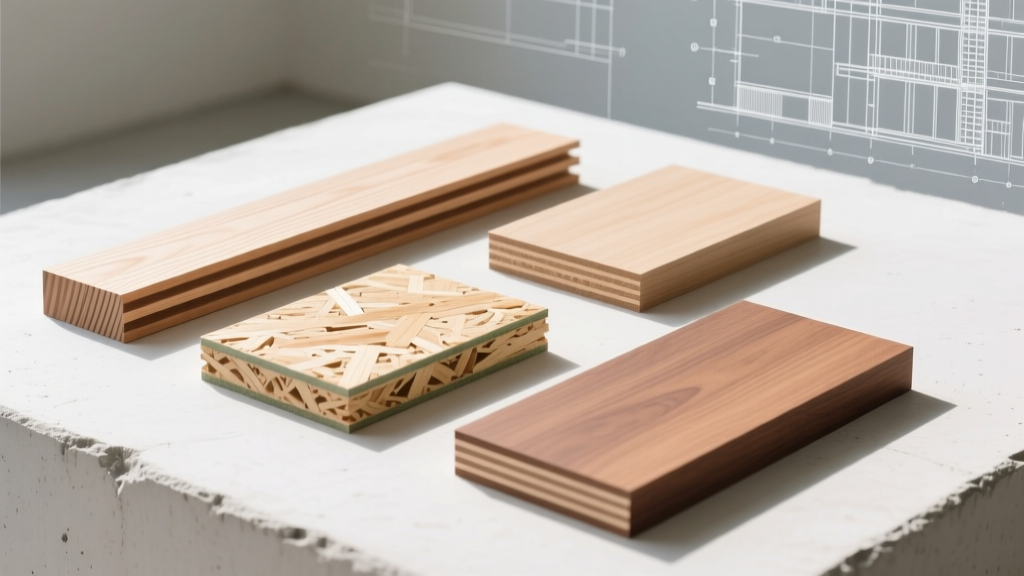
The Core Divide: Solid Sawn vs. Engineered Wood Materials
When evaluating the various types of wooden materials for modern construction, the fundamental split lies between solid-sawn lumber and engineered wood products (EWP). Solid-sawn lumber is milled directly from a single log, retaining the natural anisotropic properties of the tree, including knots, slope of grain, and natural checking. Engineered wood products, conversely, are manufactured by binding wood strands, fibers, or veneers with structural adhesives. This manufacturing process redistributes natural defects, resulting in predictable, highly consistent structural performance that allows EWPs to span longer distances and carry heavier loads than traditional dimensional lumber.
Selecting the correct material requires looking beyond basic species identification. Builders and architects must evaluate Modulus of Elasticity (E), allowable bending stress (Fb), moisture tolerance, and fastener-holding capacities. Below is a comprehensive technical comparison of the primary wood-based building products dominating the 2026 market.
Dimensional Lumber Showdown: SPF vs. SYP vs. Douglas Fir
Dimensional lumber remains the backbone of light-frame residential and commercial construction. However, not all species groups offer the same structural resistance. The three primary species groups available at commercial lumberyards are Spruce-Pine-Fir (SPF), Southern Yellow Pine (SYP), and Douglas Fir-Larch (DF-L). The American Wood Council (AWC Span Tables) publishes specific design values for each, which directly dictate joist and rafter spacing limits.
| Species Group | Common Grade | Modulus of Elasticity (E) | 2026 Avg. Cost (per board foot) | Best Application |
|---|---|---|---|---|
| SPF (Spruce-Pine-Fir) | #2 | 1.3 x 10^6 psi | $3.50 - $4.20 | Interior wall framing, low-load ceiling joists |
| SYP (Southern Yellow Pine) | #2 | 1.7 x 10^6 psi | $4.10 - $5.30 | Floor joists, pressure-treated deck framing |
| DF-L (Douglas Fir-Larch) | #2 | 1.9 x 10^6 psi | $5.00 - $6.50 | Structural beams, heavy snow-load roof rafters |
Southern Yellow Pine is exceptionally dense and takes pressure treatment (like MCA or ACQ) better than SPF, making it the mandatory choice for ground-contact or exterior exposed framing. Douglas Fir-Larch commands a premium due to its high Fb values and superior fastener withdrawal resistance, making it ideal for shear walls and high-stress roof systems in seismic or heavy snow zones.
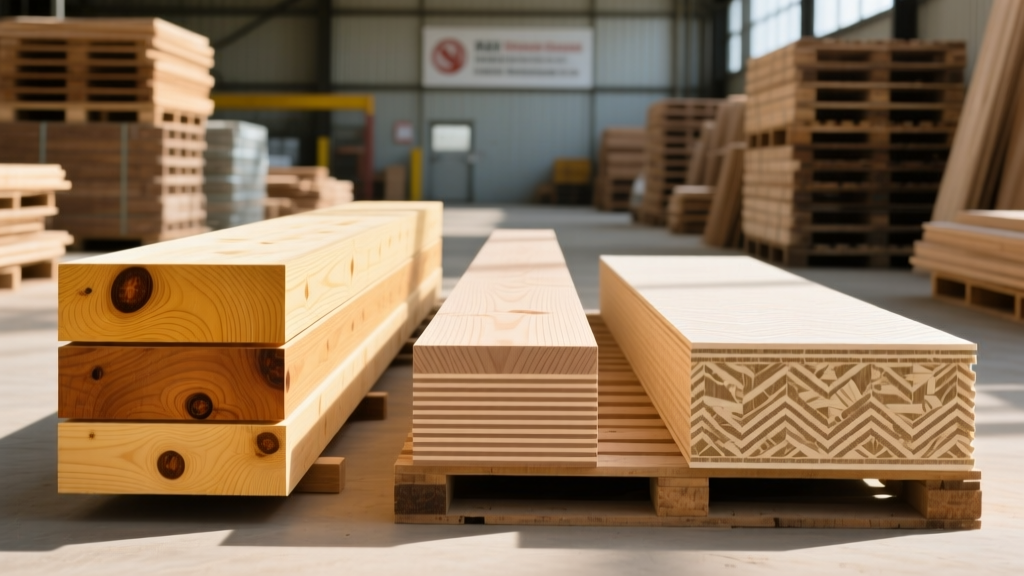
Engineered Wood Products (EWP): LVL, Glulam, and CLT
When spans exceed 20 feet or point loads surpass the capacity of solid sawn timber, EWPs become structurally necessary. The USDA Forest Products Laboratory (FPL) notes that engineered products can be manufactured to specific stress grades, eliminating the variability inherent in natural timber.
LVL (Laminated Veneer Lumber)
LVLs are created by peeling logs into thin veneers, drying them, and laminating them with parallel grain orientation. They are primarily used for headers, rim boards, and concealed structural beams. A standard 1.75 in. x 14 in. LVL beam costs approximately $4.50 to $5.80 per linear foot in 2026. They offer exceptional dimensional stability and will not shrink, cup, or twist, which prevents drywall cracking above window and door headers.
Glulam (Glued Laminated Timber)
Unlike LVL, Glulam is manufactured from thicker dimensional lumber laminations (typically 1.5 in. thick). It is frequently used in exposed architectural applications, commercial roofs, and heavy timber construction. Glulam can be cambered during manufacturing to counteract dead-load deflection. Western species Glulam (like Rosboro T24) is highly prized for its aesthetic finish and structural capacity in long-span applications like gymnasiums and churches.
CLT (Cross-Laminated Timber)
CLT represents the frontier of mass timber construction. By alternating the grain direction of stacked lumber panels (typically in 3, 5, or 7 plies), CLT achieves two-way structural action, functioning as both floor slabs and shear walls in mid-rise and high-rise buildings. While currently priced at a premium ($12 to $18 per square foot for 5-ply panels), CLT drastically reduces on-site labor and carbon footprint.
Structural Panels: CDX Plywood vs. OSB
The subfloor, roof sheathing, and wall bracing debate almost always centers on CDX (C-D Exposure 1) Plywood versus OSB (Oriented Strand Board). APA - The Engineered Wood Association (APA) rates both under the same performance standards (PS 1 for plywood, PS 2 for OSB), meaning a 5/8 in. OSB panel and a 5/8 in. plywood panel with the same span rating will support identical structural loads. However, their failure modes differ drastically in the field.
While OSB and plywood share the same structural span ratings, OSB is highly susceptible to edge swelling when exposed to liquid water during construction delays. Plywood, conversely, may delaminate but generally maintains its edge thickness and fastener-holding integrity when wet.
- OSB (Oriented Strand Board): More cost-effective (typically 20% to 30% cheaper than plywood). However, standard OSB has a thickness swelling limit of 15% when exposed to water. If OSB gets rained on before the roof is dried in, the swollen edges will telegraph through vinyl or hardwood flooring, requiring costly sanding or replacement.
- CDX Plywood: Cross-laminated veneers provide superior impact resistance and fastener withdrawal strength. It dries out faster and more completely than OSB. For high-end custom homes where subfloor flatness is critical, 3/4 in. T&G CDX plywood remains the gold standard.
- Advanced OSB (e.g., AdvanTech): Premium OSB panels utilize advanced resin systems that offer 500-day no-sand warranties against moisture swelling. These panels cost roughly 15% more than standard OSB but bridge the performance gap with plywood in wet conditions.
Field-Tested Decision Framework: Matching Material to Application
To eliminate guesswork, use this conditional framework when specifying types of wooden materials for your next project:
- If spanning 18+ feet with heavy point loads (e.g., kitchen islands, stone countertops): Do not use dimensional lumber. Specify a 2.4E LVL or a flitch beam (wood sandwiching a steel plate) to limit deflection to L/480 or better, preventing tile cracking.
- If framing exterior decks or ground-contact sill plates: Specify #2 SYP pressure-treated to 0.40 pcf (AWPA UC4A) for ground contact. Never use SPF for treated applications, as its low density prevents deep chemical penetration.
- If sheathing a roof in a high-wind/hurricane zone: Use 5/8 in. CDX plywood rather than OSB. Plywood offers superior panel shear and staple-holding capacity under cyclic wind uplift loads.
- If building interior non-load-bearing partition walls: Use standard SPF #3 or Stud grade. The structural E-value is irrelevant here; prioritize straightness and cost-efficiency.
Moisture, Treatment, and Fastener Compatibility Gotchas
A critical, often overlooked aspect of material selection is the chemical interaction between treated wood and metal fasteners. Modern wood preservatives, such as Alkaline Copper Quaternary (ACQ) and Micronized Copper Azole (MCA), are highly corrosive to standard zinc and aluminum.
When fastening into ACQ-treated SYP or exterior-rated Glulam, you must use hot-dipped galvanized fasteners meeting ASTM A153 standards (minimum 1.0 oz/sq ft zinc coating) or Type 304/316 stainless steel. Using standard electroplated galvanized nails or screws in treated wood will result in severe galvanic corrosion, leading to fastener failure and structural compromise within 3 to 5 years. Always verify the preservative retention level (pcf) of your lumber and match it to the fastener manufacturer's approved corrosion-resistance matrix.
Written by
Elena RodriguezElena Rodriguez is a civil engineer and technical writer specializing in concrete technology, masonry systems, and ASTM/ACI compliance. She earned her B.S. in Civil Engineering from Texas A&M University and spent a decade at a materials testing laboratory, performing over 2,000 concrete compressive strength tests and masonry prism evaluations. Elena is an ACI-certified Field Testing Technician (Grade I) and a member of ASTM Committee C12 on Natural Building Stone. She currently consults on forensic engineering cases involving concrete failures and moisture intrusion. Based in San Antonio, TX, Elena is a proud member of the Society of Women Engineers (SWE) and coaches her daughter's FIRST Robotics team.
More from Elena Rodriguez
View all
Walls & Panels
Cost Analysis: Light Gauge Steel Framing Advantages and Disadvantages
Evaluate light gauge steel framing advantages and disadvantages through a strict cost analysis lens, comparing material, labor, and lifecycle expenses.
Aug 4, 2026

Walls & Panels
Gypsum Board Types: Exact Specifications, Thickness & Dimensions
Compare standard, Type X, and moisture-resistant gypsum board types. Get exact specifications, thicknesses, dimensions, and ASTM standards for your project.
Aug 4, 2026

Fire Resistance
Best Fire-Resistant Outdoor Decking Materials: 2026 Buyer Guide
Discover the best fire-resistant outdoor decking materials for 2026. Compare Class A PVC, aluminum, and hardwood options for WUI compliance and safety.
Aug 4, 2026