Vinyl Wood Flooring: Best Applications & Scenario Guide
Discover where vinyl wood flooring outperforms hardwood. Compare SPC vs WPC cores, moisture limits, and 2026 pricing for basements, commercial, and sunrooms.
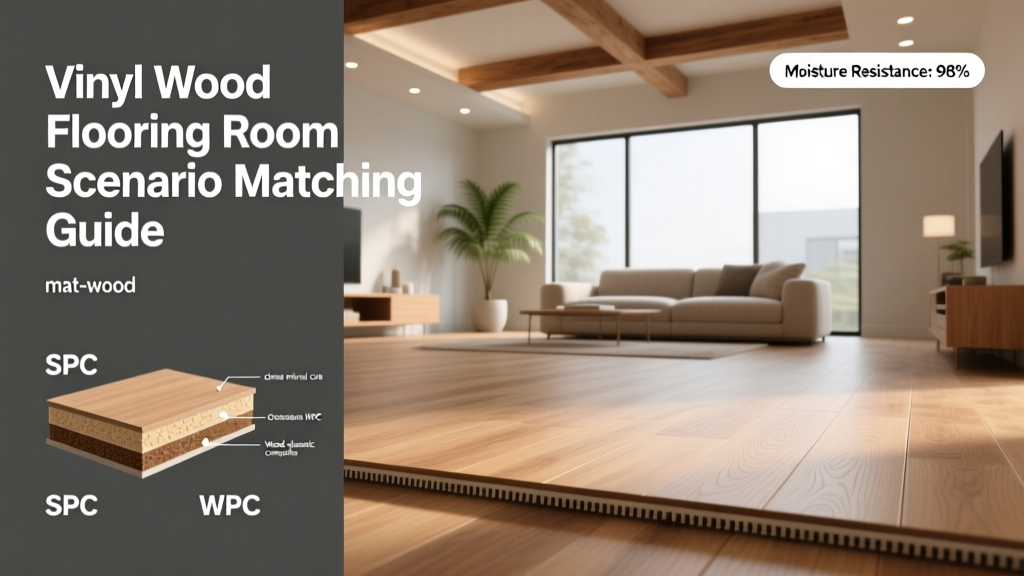
The Material Science of Vinyl Wood Flooring
Specifying flooring requires matching material properties to environmental stressors. While solid and engineered hardwood remain premium choices for stable, above-grade environments, vinyl wood flooring—specifically Luxury Vinyl Plank (LVP) and Luxury Vinyl Tile (LVT)—has become the mandatory specification for high-moisture, below-grade, and high-impact scenarios. Modern vinyl wood flooring utilizes photorealistic 3D-printed wear layers and rigid polymer cores to replicate the visual depth of white oak or hickory while eliminating the hygroscopic expansion and contraction inherent to natural timber.
According to the Resilient Floor Covering Institute (RFCI), the market has shifted heavily toward rigid core technologies. However, specifying the wrong core type (SPC vs. WPC) or inadequate wear layer for a specific application remains the leading cause of premature flooring failure. This guide maps exact vinyl wood flooring specifications to their optimal architectural scenarios.
Scenario Decision Matrix: When to Specify Vinyl Over Hardwood
| Application Scenario | Primary Stressor | Recommended Material | Critical Specification |
|---|---|---|---|
| Below-Grade Basements | Hydrostatic pressure, concrete alkalinity | SPC Vinyl Wood Flooring | Minimum 6-mil poly vapor barrier if RH > 75% |
| Multi-Family / Condos | Impact noise transmission (IIC/STC) | WPC Vinyl Wood Flooring | Attached IXPE pad (minimum 1.5mm) for IIC > 50 |
| Commercial / Heavy Pets | Point-load indentation, micro-scratching | SPC with Ceramic Bead | 22-mil wear layer with aluminum oxide/ceramic bead |
| Sunrooms / Solariums | UV degradation, thermal expansion | SPC Vinyl Wood Flooring | UV-cured urethane topcoat, 1/2" perimeter expansion gap |
| Whole-Home (Above Grade) | Underfoot comfort, acoustic resonance | WPC Vinyl Wood Flooring | Foamed core for thermal insulation and sound dampening |
Scenario 1: Below-Grade Basements and Concrete Slabs
Natural wood flooring is strictly prohibited by the National Wood Flooring Association (NWFA) for below-grade installations due to the inevitable moisture vapor transmission from concrete. Vinyl wood flooring solves this, but it is not invincible to hydrostatic pressure.
Moisture Testing and Subfloor Preparation
Before installing rigid core vinyl over a concrete slab, contractors must perform quantitative moisture testing. The industry standard is the ASTM F2170 relative humidity (RH) test using in-situ probes. If the concrete RH exceeds 75%, or if a calcium chloride test (ASTM F1869) shows moisture vapor emission rates (MVER) greater than 5 lbs per 1,000 square feet per 24 hours, a secondary vapor barrier is mandatory.
While the vinyl wood flooring plank itself is 100% waterproof, the installation system is not. If hydrostatic pressure pushes moisture through the concrete, it will become trapped beneath the floating floor. This leads to mold growth on the subfloor, alkalinity degradation of the click-lock mechanisms, and trapped odors. Always use a 6-mil polyethylene film over high-moisture slabs before laying the planks.
Scenario 2: Multi-Family, HOAs, and Acoustic Requirements
In condominiums and multi-story residential builds, the primary constraint is acoustic transmission. Homeowner Associations (HOAs) typically mandate an Impact Insulation Class (IIC) and Sound Transmission Class (STC) rating of 50 or higher. This is where Wood Plastic Composite (WPC) core vinyl wood flooring outperforms Stone Plastic Composite (SPC).
Core Breakdown: SPC vs. WPC
| Feature | SPC (Stone Plastic Composite) | WPC (Wood Plastic Composite) |
|---|---|---|
| Core Composition | Limestone powder + PVC stabilizers | PVC + foaming agents + wood-like flour |
| Density & Weight | High density, heavy, rigid | Lower density, lighter, aerated |
| Indentation Resistance | Exceptional (resists heavy furniture) | Moderate (susceptible to point-load dents) |
| Acoustic Performance | Poor (transmits impact noise without thick pads) | Excellent (aerated core absorbs impact sound) |
| Underfoot Comfort | Hard, cold feel similar to tile | Softer, warmer, more forgiving |
For multi-family scenarios, specify a WPC product with an attached cross-linked polyethylene (IXPE) underlayment. Avoid EVA foam attached pads, as they compress permanently under heavy furniture over 12 to 18 months, compromising the click-lock joint integrity and reducing the acoustic rating.
Scenario 3: Sunrooms, Solariums, and Radiant Heat
South-facing rooms with expansive glazing introduce two severe stressors: concentrated UV radiation and extreme thermal fluctuations. Natural wood will photo-oxidize (fade or darken) and cup under these conditions. Vinyl wood flooring is highly resilient, provided the correct chemical topcoat is specified.
Thermal Expansion and Radiant Heat Limits
SPC vinyl wood flooring exhibits superior dimensional stability compared to WPC, expanding and contracting at roughly half the rate when exposed to temperature swings. When installing over hydronic or electric radiant heat systems, the maximum surface temperature must never exceed 85°F (29.4°C). Exceeding this threshold softens the PVC binder, leading to edge-curling and joint separation. Always require the flooring manufacturer's specific radiant heat warranty in writing; generic warranties are frequently voided if temperature logs are not maintained.
For sunrooms, specify vinyl wood flooring with a UV-cured urethane topcoat fortified with ceramic beads. Standard acrylic or basic urethane topcoats will yellow and degrade under direct, unfiltered sunlight within 24 to 36 months. Furthermore, maintain a strict 1/2-inch expansion gap around the entire perimeter, hidden by baseboards, to allow for thermal expansion without buckling.
2026 Procurement & Installation Cost Analysis
When budgeting for vinyl wood flooring, material costs represent only a fraction of the total project expense. Subfloor remediation and specialized transitions often inflate the final invoice. Below is the current 2026 pricing landscape for commercial and residential specifications.
- Entry-Level Residential (12-mil wear layer, WPC core): $2.80 – $3.90 per sq. ft. (Material only)
- Mid-Tier Residential/Light Commercial (20-mil wear layer, SPC core): $4.20 – $5.80 per sq. ft.
- Premium Commercial (22+ mil, SPC with attached IXPE): $6.50 – $8.50 per sq. ft.
- Professional Installation (Floating Click-Lock): $1.75 – $3.25 per sq. ft. (Includes basic prep and standard transitions)
- Subfloor Leveling (Self-Leveling Underlayment): $1.50 – $3.00 per sq. ft. (Mandatory if slab variance exceeds 3/16" over 10 feet)
Specification Checklist for Architects and Procurement
To ensure the specified vinyl wood flooring meets environmental and health standards, verify the following data points on the manufacturer's technical data sheet (TDS) before approving submittals:
- Indoor Air Quality: Verify FloorScore or GREENGUARD Gold certification. The EPA notes that stringent VOC limits are critical for enclosed spaces, ensuring formaldehyde and phthalate emissions remain well below 0.05 ppm.
- Wear Layer Thickness: Confirm the wear layer is measured in "mils" (thousandths of an inch), not millimeters. A 20-mil wear layer is the absolute minimum for commercial or heavy-dog households.
- Core Rigidity (SPC): Look for a core density specification. High-quality SPC should have a density exceeding 1,900 kg/m³ to prevent telegraphing of subfloor imperfections.
- Locking Mechanism: Specify patented, high-shear locking systems (e.g., Valinge 5G or Uniclic) which can withstand up to 1,200 lbs of horizontal shear force without snapping.
- Fire Rating: For commercial corridors and egress paths, ensure the product holds an ASTM E648 Class I critical radiant flux rating (minimum 0.45 W/cm²).
By aligning the core chemistry, wear layer thickness, and underlayment specifications with the exact environmental stressors of the room, you eliminate the primary failure modes associated with resilient flooring and guarantee long-term performance.