Total Weight of 18 Sheets 4x8 Plywood: Specs & Load Limits
Calculate the exact weight of 18 sheets 4x8 plywood by thickness and species. Includes structural specs, payload limits, and jobsite handling data.
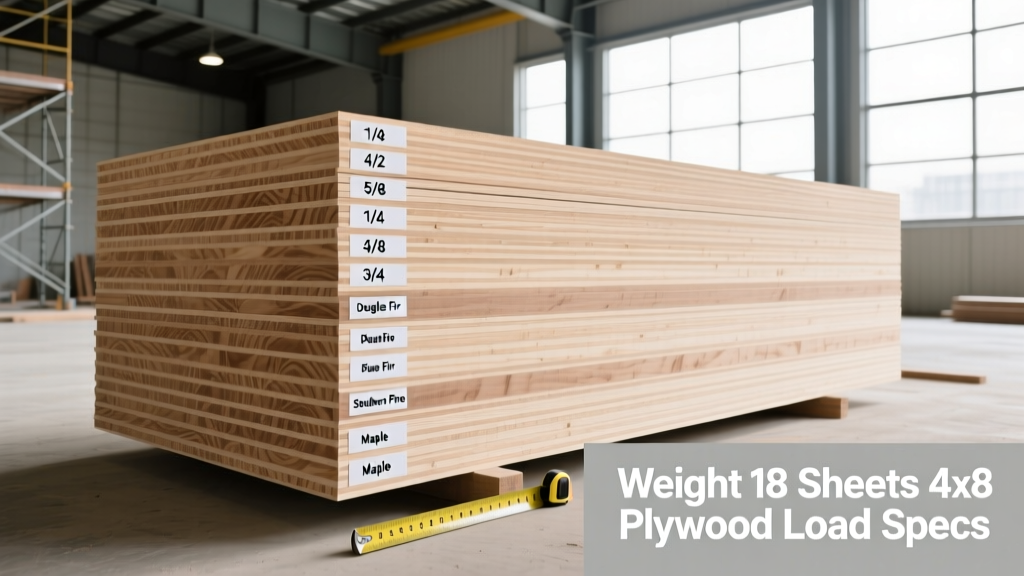
The Baseline: Calculating the Weight of 18 Sheets 4x8 Plywood
Determining the exact weight of 18 sheets 4x8 plywood is a critical logistical calculation for jobsite staging, structural load planning, and transportation. A standard 4x8 panel covers 32 square feet, meaning an 18-sheet bundle covers 576 square feet. However, the total mass of this bundle fluctuates significantly based on panel thickness, wood species core density, and ambient moisture content.
For general contractors and structural engineers, treating all plywood as having a uniform weight is a critical error that can lead to overloaded light-duty trucks, compromised roof trusses during material staging, or inaccurate structural shear calculations. The data below establishes the baseline weights for standard structural and sheathing panels manufactured to APA (The Engineered Wood Association) specifications.
A standard bundle of eighteen 3/4-inch CDX (Southern Pine) plywood sheets weighs between 1,080 and 1,170 pounds. This assumes a kiln-dried moisture content of roughly 8-12% and standard mill tolerances.
Weight Specifications by Panel Thickness
The following matrix breaks down the expected weight of 18 sheets 4x8 plywood across the most common structural and underlayment thicknesses. These figures assume a standard softwood core (Southern Yellow Pine or Douglas Fir) with a C-D grade face and back.
| Nominal Thickness | Actual Thickness | Single Sheet Weight (Avg) | 18-Sheet Bundle Weight |
|---|---|---|---|
| 1/4 inch | 1/4 inch | 22 - 26 lbs | 396 - 468 lbs |
| 3/8 inch | 11/32 inch | 30 - 34 lbs | 540 - 612 lbs |
| 1/2 inch | 15/32 inch | 40 - 46 lbs | 720 - 828 lbs |
| 5/8 inch | 19/32 inch | 50 - 56 lbs | 900 - 1,008 lbs |
| 3/4 inch | 23/32 inch | 60 - 65 lbs | 1,080 - 1,170 lbs |
| 1 inch | 3/4 inch (sized) | 75 - 85 lbs | 1,350 - 1,530 lbs |
Variables That Shift the Scale: Species and Moisture
The baseline weights above assume standard construction-grade softwood. However, performance-rated panels and specialty architectural plywoods introduce significant weight variances that must be accounted for in structural and logistical planning.
Softwood vs. Hardwood Core Density
According to data published by the USDA Forest Products Laboratory, the specific gravity (SG) of the wood species directly dictates panel mass. Southern Yellow Pine (SYP), the most common core for CDX and structural sheathing, has an average SG of 0.55. Douglas Fir is slightly lighter (SG 0.50). If you order 18 sheets of 4x8 plywood with a hardwood core—such as Baltic Birch or marine-grade Okoume—the weight shifts dramatically. Baltic Birch (SG ~0.65) 3/4-inch panels weigh closer to 75 pounds per sheet, pushing the 18-sheet bundle weight to 1,350 pounds, nearly 200 pounds heavier than a standard SYP bundle.
The Moisture Content (MC) Multiplier
Plywood is hygroscopic. The APA - The Engineered Wood Association specifies that structural panels must be manufactured to a moisture content that matches the equilibrium of their intended environment, typically around 8% to 12% for interior applications. However, Exposure 1 panels stored in open lumberyards can absorb ambient humidity or rain, pushing MC up to 19% (the maximum allowed for Exposure 1 classification).
Water weighs roughly 8.34 pounds per gallon. When a 3/4-inch plywood sheet absorbs moisture from 8% MC to 19% MC, its weight can increase by up to 12%. For a bundle of 18 sheets, this means a standard 1,100-pound bundle can easily scale to 1,230 pounds after sitting in a damp staging area. Always calculate maximum wet weights when planning crane lifts or roof staging.
Never stage a full 18-sheet bundle of 3/4-inch plywood (1,100+ lbs) on a single roof truss bay without engineering approval. Standard residential roof trusses are designed for distributed live/dead loads (typically 20-40 psf), not concentrated point loads exceeding 1,000 pounds. Distribute the 18 sheets across multiple truss nodes or stage them directly over load-bearing partition walls below.
Logistical Specifications: Transport and Payload Limits
Understanding the weight of 18 sheets 4x8 plywood is equally vital for fleet logistics and material delivery. Exceeding the Gross Vehicle Weight Rating (GVWR) or payload capacity of transport vehicles results in safety hazards and severe mechanical wear.
- Half-Ton Pickups (e.g., Ford F-150, Chevy Silverado 1500): Modern half-ton trucks feature maximum payload capacities ranging from 1,600 to 2,200 pounds. A single 18-sheet bundle of 3/4-inch plywood (1,170 lbs max) is well within safe limits, leaving ample capacity for the driver, tools, and fuel. However, stacking two bundles (2,340 lbs) will exceed the payload rating of almost all standard half-ton configurations.
- Three-Quarter-Ton Pickups (e.g., F-250, Silverado 2500): With payload capacities between 3,000 and 4,000 pounds, these vehicles can easily handle two 18-sheet bundles of 3/4-inch material, or a single bundle of 1-inch thick heavy-duty underlayment.
- Flatbed Trailers and Forklifts: Standard lumberyard forklifts are rated for 5,000 to 8,000 pounds. An 18-sheet bundle represents less than 20% of standard forklift capacity, making it a highly efficient, single-lift unit for yard loading and jobsite offloading.
Structural Performance: How Weight Correlates to Rating
In engineered wood products, weight is often a proxy for density, which directly influences structural performance ratings. Heavier plywood sheets generally possess a higher specific gravity, which translates to superior mechanical properties.
"The withdrawal strength of a nail or screw driven into the face or edge of a plywood panel is directly proportional to the specific gravity of the wood veneers. Denser, heavier panels provide significantly higher resistance to fastener pull-through under uplift and shear loads."
— Adapted from structural design principles, APA Engineered Wood Design Guide
When specifying the weight of 18 sheets 4x8 plywood for shear walls or diaphragms, engineers look at the panel's span rating and shear capacity. A heavier Southern Pine 3/4-inch panel will yield higher nail withdrawal values (often exceeding 150 lbs per inch of penetration for a 10d common nail) compared to a lighter mixed-species panel. If your structural drawings specify high-shear shear walls in seismic or high-wind zones, verifying that your supplier is delivering high-density (and consequently heavier) SYP or Douglas Fir panels is a critical quality control step.
Quick Specs FAQ for Jobsite Planning
How much does an 18-sheet bundle of 1/2-inch CDX weigh?
An 18-sheet bundle of 1/2-inch (15/32 actual) CDX plywood weighs between 720 and 828 pounds. This is the standard weight for roof sheathing bundles and is generally safe to hoist via standard residential material lifts without exceeding the 1,000-pound single-line limit of most portable winches.
Does the glue type affect the weight of the plywood bundle?
The adhesive used (typically phenol-formaldehyde for exterior/exposure panels or urea-formaldehyde for interior) accounts for less than 2% of the total panel mass. The variance in weight between an Interior and Exterior rated bundle of the same thickness and species is negligible and does not impact logistical or structural calculations.
Why did my 18-sheet bundle weigh 150 lbs more than the spec sheet?
Mill tolerances and moisture content are the primary culprits. APA standards allow for slight thickness overages to ensure panels meet minimum structural thickness requirements after sanding. Additionally, if the bundle was stored outdoors under a tarp where condensation accumulated, the core veneers may have absorbed enough moisture to add 10-15% to the total bundle weight. Always weigh a sample sheet on a jobsite scale upon delivery if precise dead-load calculations are required.