Maximizing Wood Fence Gate Durability: Lifespan & Species Guide
Analyze wood fence gate durability by species, hardware, and framing. Discover exact lifespans, shrinkage rates, and anti-sag structural designs.
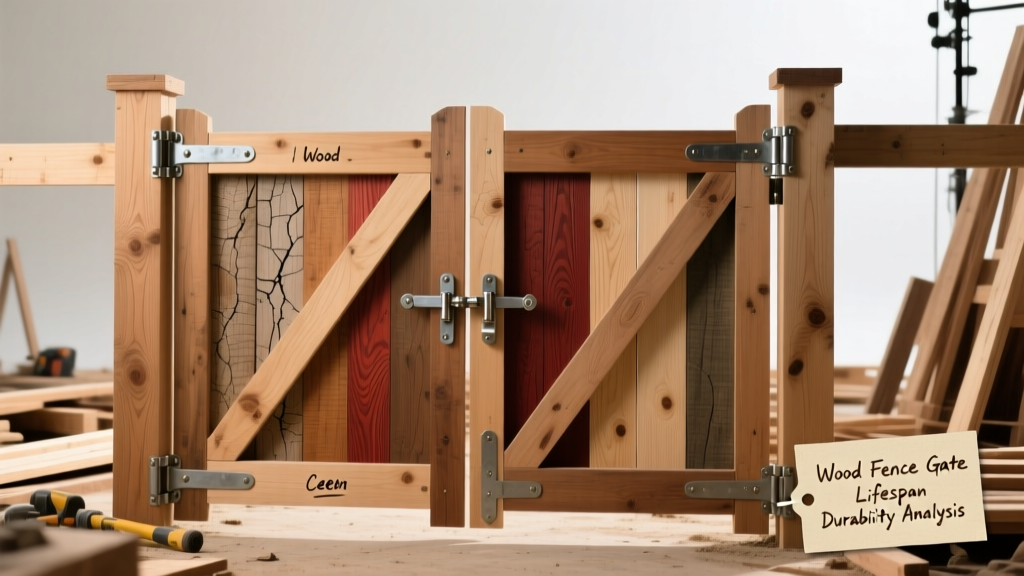
The Physics of Gate Failure: Why Wood Fence Gates Sag
A wood fence gate is the most mechanically stressed component of any perimeter enclosure. Unlike static fence panels, a gate operates as a cantilevered beam subjected to dynamic loads, cyclical wood movement, and gravitational shear. Gate sag—the primary failure mode—is rarely caused by the wood itself rotting; it is almost always a cascading failure originating from three specific variables: hinge post deflection, fastener withdrawal due to tangential wood shrinkage, and hardware deformation.
To engineer a wood fence gate that survives 20+ years without structural intervention, builders must address the moment of inertia at the hinge post and select materials based on dimensional stability rather than just surface aesthetics. The US Forest Products Laboratory emphasizes that wood durability in exterior applications is a function of both natural decay resistance and the material's ability to resist moisture-induced dimensional changes.
Wood Species Lifespan Matrix: Decay Resistance & Dimensional Stability
Choosing the correct lumber species dictates the gate's baseline lifespan and its tolerance for hardware stress. High-density woods hold screws better but are heavier, increasing the load on hinges. Low-density woods are lighter but suffer from fastener pull-out as they swell and shrink.
| Wood Species | Janka Hardness (lbf) | Tangential Shrinkage | Natural Decay Resistance | Expected Lifespan |
|---|---|---|---|---|
| Western Red Cedar | 350 | 5.0% | High (Heartwood) | 15–20 Years |
| PT Southern Yellow Pine | 690 | 7.2% | High (Chemical) | 15–25 Years |
| Ipe (Tabebuia spp.) | 3,680 | 6.6% | Very High | 40+ Years |
| Accoya (Acetylated Pine) | 450 | ~3.0% | Very High | 50 Years |
Shrinkage Rates & Movement Tolerances
Pressure-treated Southern Yellow Pine (PT SYP) is the most common gate material due to cost, but its 7.2% tangential shrinkage is a major liability. As PT SYP dries from its treated state (often installed at >19% moisture content), a 6-inch wide stile can shrink nearly 3/8 of an inch. This movement breaks the friction grip of standard screws, leading to joint loosening and eventual rack (the gate shifting from a square to a parallelogram).
Conversely, Accoya wood undergoes an acetylation process that permanently alters the wood's cell structure, reducing swelling and shrinkage by up to 50% compared to untreated pine. For high-end gates where precise hardware alignment and zero-sag performance are required over decades, Accoya or Ipe provide superior dimensional stability, though Ipe requires specialized carbide tooling and pre-drilling for all fasteners due to its 3,680 lbf Janka hardness.
Structural Framing: Tension vs. Compression Diagonal Bracing
The internal frame of a wood fence gate determines its structural lifespan. A standard rectangular frame will inevitably rack under its own weight. A diagonal brace is mandatory, but the orientation of that brace dictates whether the gate fails in 3 years or 20 years.
The Compression Brace Rule: The diagonal brace must always run from the bottom hinge corner to the top latch corner. Gravity pushes down on the top latch corner, transferring the load down the diagonal brace directly into the bottom hinge. This places the wood brace in compression. Wood is exceptionally strong in compression parallel to the grain, and this configuration ensures that even if the mechanical fasteners loosen due to wood shrinkage, the physical geometry of the brace continues to support the gate's weight.
- Joinery: Use half-lap joints or mortise-and-tenon connections at the brace intersections, secured with structural timber screws (e.g., GRK RSS or Simpson Strong-Tie SDWS), not standard deck screws.
- Clearance: Maintain a 1/2-inch clearance at the latch side and 1/4-inch at the hinge side to account for seasonal tangential expansion without binding the frame against the posts.
Hardware Selection & Galvanic Corrosion Risks
Hardware failure accelerates wood degradation. When steel hinges rust, the expanding iron oxide (rust jacking) splits the surrounding wood fibers, destroying the mounting points.
If you are building a gate with modern pressure-treated lumber (treated with Micronized Copper Azole [MCA] or Alkaline Copper Quaternary [ACQ]), the high copper content acts as a severe galvanic corrosive to standard steel and aluminum. The American Galvanizers Association notes that direct contact between copper-based preservatives and uncoated or electro-galvanized steel leads to rapid deterioration.
Hardware Specification Matrix
- Hinges: Use heavy-duty strap hinges rather than T-hinges. Strap hinges distribute the shear load across a wider surface area of the wood stile, reducing localized crushing. For a standard 4x6 foot cedar gate weighing ~85 lbs, select hinges rated for a minimum of 150 lbs to provide a safety factor for dynamic wind loads.
- Fasteners: Reject 304 stainless steel for treated lumber applications; it is susceptible to crevice corrosion in the presence of copper preservatives. Specify 316 marine-grade stainless steel or hot-dipped galvanized (HDG) fasteners meeting ASTM A153 standards.
- Latches: Gravity latches with a 2-inch throw accommodate seasonal wood movement better than rigid deadbolts, which will bind when the gate swells during high-humidity months.
Post Anchoring & Moisture Mitigation Strategies
The hinge post absorbs the entirety of the gate's cantilevered weight. A standard 4x4 line post set in concrete is insufficient for a gate hinge post; the lateral deflection will cause the concrete collar to crack and the post to lean.
According to guidelines supported by the Western Red Cedar Lumber Association, keeping the wood envelope dry is the primary defense against fungal decay. For gate posts, this means mitigating ground-contact moisture.
- Post Sizing: Upgrade the hinge post to a minimum 6x6 dimension. The increased cross-sectional area provides a higher moment of inertia, resisting the twisting force (torque) applied by the gate's weight.
- Subsurface Drainage: Set the post 36 inches deep (or below the local frost line) on a 6-inch bed of crushed gravel. Do not encase the bottom of the post in a concrete 'boot' that traps water; instead, pour concrete around the sides and slope the top surface away from the wood at a 45-degree angle to shed precipitation.
- Steel Alternatives: For maximum lifespan, use a structural steel post (e.g., 3x3 1/4-inch wall thickness square tubing) set in concrete, and bolt the wood fence panels and gate hinges directly to the steel using structural lag bolts. This entirely eliminates subsurface wood rot at the most critical stress point.
Maintenance Intervals & Total Cost of Ownership (TCO)
Durability is ultimately a financial calculation. A cheaper wood species requires more frequent chemical treatments, sealants, and eventual replacement. Analyzing the 30-year Total Cost of Ownership (TCO) reveals that premium species often cost less over the lifecycle of the enclosure.
| Material | Initial Build Cost (per 4x6 gate) | Maintenance Interval | 30-Year Maintenance Cost | Replacement Required in 30 Yrs? | Estimated 30-Yr TCO |
|---|---|---|---|---|---|
| PT Southern Yellow Pine | $250 | Every 2 Years (Sealant) | $450 | Yes (at Year 20) | $950 |
| Western Red Cedar | $400 | Every 3-4 Years (Oil/Stain) | $350 | No | $750 |
| Accoya (Acetylated) | $850 | Every 5+ Years (Coating) | $200 | No | $1,050 |
While Pressure-Treated Pine presents the lowest initial barrier to entry, its high shrinkage rate necessitates hardware adjustments, and its susceptibility to surface checking requires biennial sealing to prevent moisture ingress. Western Red Cedar offers the optimal balance of initial cost, low tangential shrinkage, and natural decay resistance, yielding the lowest 30-year TCO for standard residential applications. For commercial or high-moisture coastal environments, the dimensional stability of Accoya or the sheer density of Ipe justifies the premium initial investment by eliminating mid-lifecycle replacement costs entirely.