Wood Framing vs CHB: Analyzing the Cost to Build House Philippines
Compare wood framing and concrete hollow block (CHB) to understand the true cost to build house Philippines. Explore lumber prices, durability, and ROI.
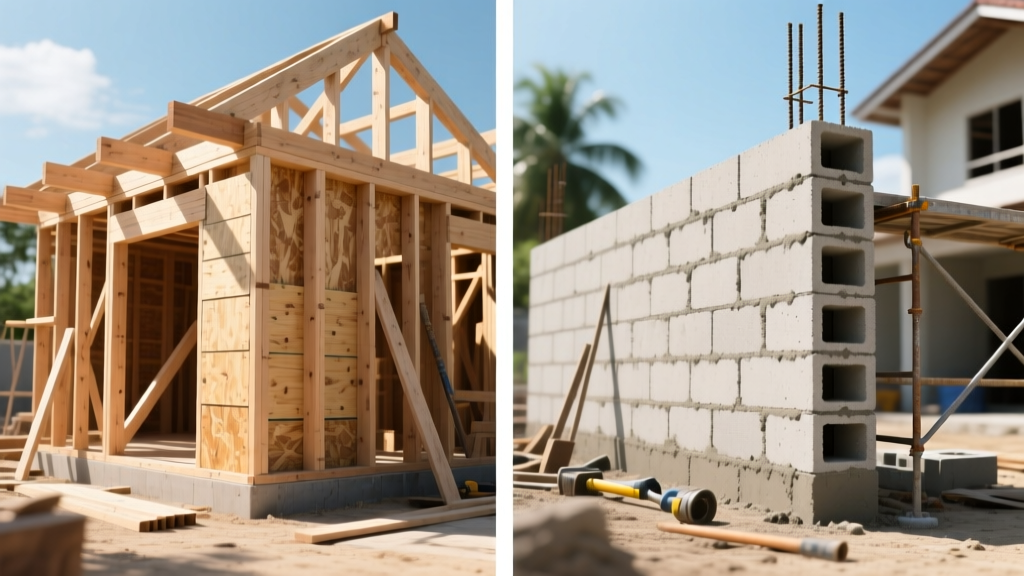
The Philippine Construction Landscape: Why Framing Dictates Your Budget
When calculating the cost to build house Philippines, most homeowners and contractors default to Concrete Hollow Block (CHB) masonry. It is the cultural and structural norm. However, light wood framing—utilizing locally sourced coconut lumber (coco lumber) or imported engineered wood—is rapidly gaining market share due to seismic resilience and accelerated build times. Evaluating these two structural systems requires looking beyond the raw material price per board foot or per block; it demands a comprehensive analysis of labor rates, site logistics, and long-term maintenance in a tropical, typhoon-prone environment.
Direct Material & Labor Cost Comparison Matrix
To accurately forecast your budget, we must break down the wall assembly costs per square meter (sqm). The following matrix compares a standard 4-inch CHB reinforced wall against a 2x4 coco lumber framed wall with fiber cement board cladding, and an engineered wood/steel hybrid system.
| System Type | Material Cost (PHP/sqm) | Labor Cost (PHP/sqm) | Total Assembly Cost | Build Speed |
|---|---|---|---|---|
| 4" CHB Masonry (Standard) | ₱1,800 - ₱2,200 | ₱1,200 - ₱1,500 | ₱3,000 - ₱3,700 | Slow (curing time) |
| Coco Lumber Framing (2x4 w/ Fiber Cement) | ₱2,400 - ₱2,900 | ₱800 - ₱1,100 | ₱3,200 - ₱4,000 | Fast (dry build) |
| Engineered Wood Trusses (Roofing only) | ₱1,500 - ₱1,900 | ₱400 - ₱600 | ₱1,900 - ₱2,500 | Very Fast (pre-fab) |
Note: Costs exclude interior finishing (paint, drywall taping) and exterior weatherproofing. PHP prices reflect Q1 2026 averages in urban and peri-urban Philippine regions.
Deep Dive: Philippine Lumber Species for Structural Framing
If you opt for wood framing to optimize the cost to build house Philippines, selecting the correct timber species is non-negotiable. The National Structural Code of the Philippines (NSCP), maintained by the Association of Structural Engineers of the Philippines (ASEP), dictates specific stress grades for load-bearing wood. Hardwoods like Yakal and Narra are heavily restricted and economically unfeasible for whole-house framing. Instead, the market relies on three primary alternatives:
1. Coconut Lumber (Coco Lumber)
Coco lumber is the most accessible local timber, but it is highly variable in density. The Philippine Coconut Authority (PCA) classifies coco lumber into four grades based on specific gravity (SG).
- Grade 1 (SG > 0.50): Sourced from the lower 3 meters of the trunk. Hard, dense, and suitable for structural posts, trusses, and load-bearing studs. Priced at ₱35 - ₱45 per board foot.
- Grade 2 & 3 (SG 0.35 - 0.50): Mid-trunk timber. Acceptable for non-load-bearing partitions, purlins, and ceiling joists. Priced at ₱20 - ₱30 per board foot.
- Grade 4 (SG < 0.35): Top of the trunk. Too soft for construction; used only for temporary scaffolding or formwork.
2. Philippine Mahogany (Lauan / Tangile)
While true mahogany is rare, plantation-grown Lauan and Tangile (often marketed collectively as Philippine Mahogany) are widely used. They offer more consistent grain and density than coco lumber, making them easier to machine and nail without splitting. However, they are highly susceptible to powder-post beetles (bukbok) and require mandatory, deep-penetration chemical treatment before installation. Expect to pay ₱55 - ₱75 per board foot for structurally graded, treated plantation mahogany.
3. Engineered Wood Products (LVL and Glulam)
For high-end residential builds or areas with severe typhoon exposure (e.g., Eastern Visayas, Bicol), Laminated Veneer Lumber (LVL) and Glued Laminated Timber (Glulam) imported from Malaysia or New Zealand are superior. They eliminate the natural defects of solid wood (knots, warping) and offer predictable engineering values. While the material cost is 40-60% higher than local solid wood, the reduction in material waste and the elimination of on-site culling often balances the overall framing budget.
Hidden Costs and Long-Term ROI in Tropical Climates
When comparing the cost to build house Philippines, the initial invoice is only half the equation. Wood framing introduces specific environmental liabilities in the Philippines that must be budgeted for upfront.
Termite and Moisture Management
Concrete hollow blocks are immune to biological degradation. Wood is not. If you choose wood framing, you must allocate budget for the following non-negotiable treatments:
- Pre-construction Soil Poisoning: Applying a chemical termiticide barrier (e.g., Fipronil or Imidacloprid-based solutions) to the soil beneath the foundation slab. Cost: ₱150 - ₱250 per sqm of footprint.
- Pressure Treatment: All structural lumber must be Chromated Copper Arsenate (CCA) or Copper Azole (CA) pressure-treated. Surface brushing is entirely ineffective against subterranean termites.
- Capillary Breaks: Installing a 1.5mm high-density polyethylene (HDPE) sill sealer between the concrete foundation and the bottom wood sill plate to prevent moisture wicking.
Seismic and Typhoon Resilience
The Philippines sits on the Pacific Ring of Fire and the typhoon belt. CHB walls, if poorly reinforced (a common issue with unlicensed local contractors), are brittle and prone to catastrophic shear failure during a magnitude 6.0+ earthquake. Wood framing, when properly sheathed with structural plywood or fiber cement boards and tied down with galvanized steel hurricane straps, exhibits high ductility. It flexes under seismic loads and sheds wind pressure, significantly reducing the risk of total structural collapse. This resilience can lower home insurance premiums by 5-10% annually in high-risk zones.
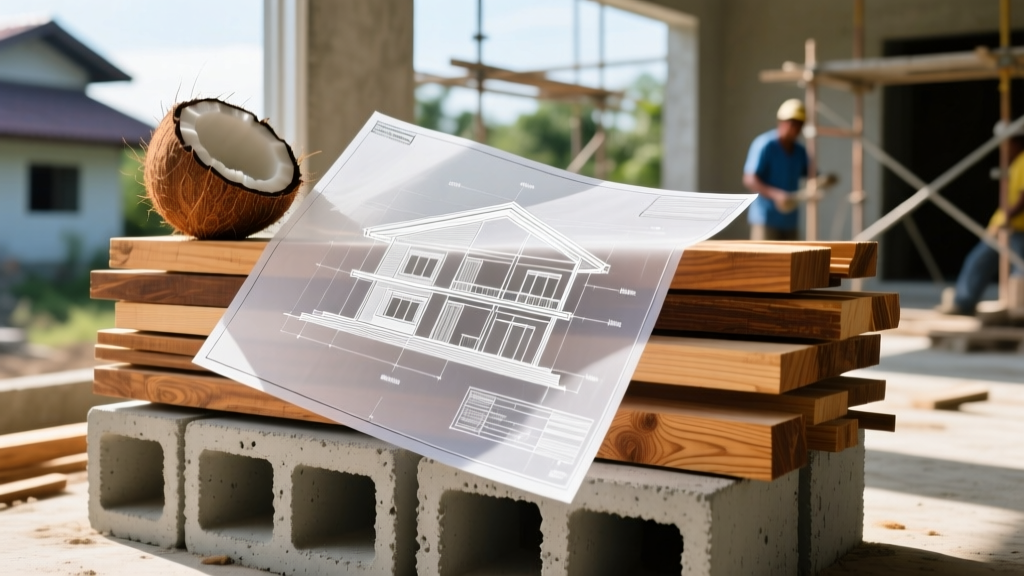
Verdict: Which Method Optimizes Your Build Cost?
There is no universal 'cheapest' option; the optimal choice depends on your site location, labor access, and timeline.
- Choose CHB Masonry if: You are building in a highly urbanized area where skilled carpenters are scarce, your lot is prone to prolonged flooding (where wood sill plates would remain submerged), or you prioritize high thermal mass for passive cooling.
- Choose Wood Framing if: You are building on difficult terrain (e.g., steep slopes in Baguio or Antipolo) where hauling heavy concrete and water is logistically expensive, you need to complete the build rapidly before the monsoon season, or you are designing a complex architectural style with multiple cantilevers and non-standard angles.
- The Hybrid Approach: The most cost-effective strategy for a two-story Philippine home in 2026 is often a hybrid: a reinforced concrete ground floor (for security, flood resistance, and thermal mass) paired with a coco lumber or light-gauge steel framed second story. This reduces the overall structural load, allowing for smaller, less expensive concrete footings.
Frequently Asked Questions (FAQ)
Does wood framing pass local barangay building permits?
Yes, provided the structural plans are signed and sealed by a licensed Civil or Structural Engineer and comply with the NSCP. However, some rural barangay officials are unfamiliar with light wood framing codes. It is highly recommended to have your engineer present the structural calculations to the local Office of the Building Official (OBO) during the permit application phase to prevent arbitrary rejections.
How does the fire rating of wood framing compare to CHB?
A standard 4-inch CHB wall provides a 2-hour fire rating. A wood-framed wall clad with 12mm fire-rated fiber cement board (such as HardieFlex) and insulated with rockwool can achieve a 1-hour to 2-hour fire rating, meeting the requirements for most residential property line setbacks under the Philippine Fire Code.
Is coco lumber sustainable for large-scale housing?
The Philippines replants millions of coconut trees annually. Harvesting coco lumber utilizes senile trees (over 60 years old) that have stopped producing fruit, making it a highly sustainable, carbon-sequestering building material compared to the high embodied energy required to manufacture Portland cement for CHB.
Written by
Elena RodriguezElena Rodriguez is a civil engineer and technical writer specializing in concrete technology, masonry systems, and ASTM/ACI compliance. She earned her B.S. in Civil Engineering from Texas A&M University and spent a decade at a materials testing laboratory, performing over 2,000 concrete compressive strength tests and masonry prism evaluations. Elena is an ACI-certified Field Testing Technician (Grade I) and a member of ASTM Committee C12 on Natural Building Stone. She currently consults on forensic engineering cases involving concrete failures and moisture intrusion. Based in San Antonio, TX, Elena is a proud member of the Society of Women Engineers (SWE) and coaches her daughter's FIRST Robotics team.
More from Elena Rodriguez
View all
Walls & Panels
Cost Analysis: Light Gauge Steel Framing Advantages and Disadvantages
Evaluate light gauge steel framing advantages and disadvantages through a strict cost analysis lens, comparing material, labor, and lifecycle expenses.
Aug 4, 2026

Walls & Panels
Gypsum Board Types: Exact Specifications, Thickness & Dimensions
Compare standard, Type X, and moisture-resistant gypsum board types. Get exact specifications, thicknesses, dimensions, and ASTM standards for your project.
Aug 4, 2026

Fire Resistance
Best Fire-Resistant Outdoor Decking Materials: 2026 Buyer Guide
Discover the best fire-resistant outdoor decking materials for 2026. Compare Class A PVC, aluminum, and hardwood options for WUI compliance and safety.
Aug 4, 2026