Asphalt vs Concrete Driveway Cost Calculator: 2026 Guide
Master the asphalt vs concrete driveway cost calculator for 2026. Compare hidden prep costs, 30-year lifecycle ROI, and climate-specific material choices.
The True Cost Equation: Beyond Basic Square Footage
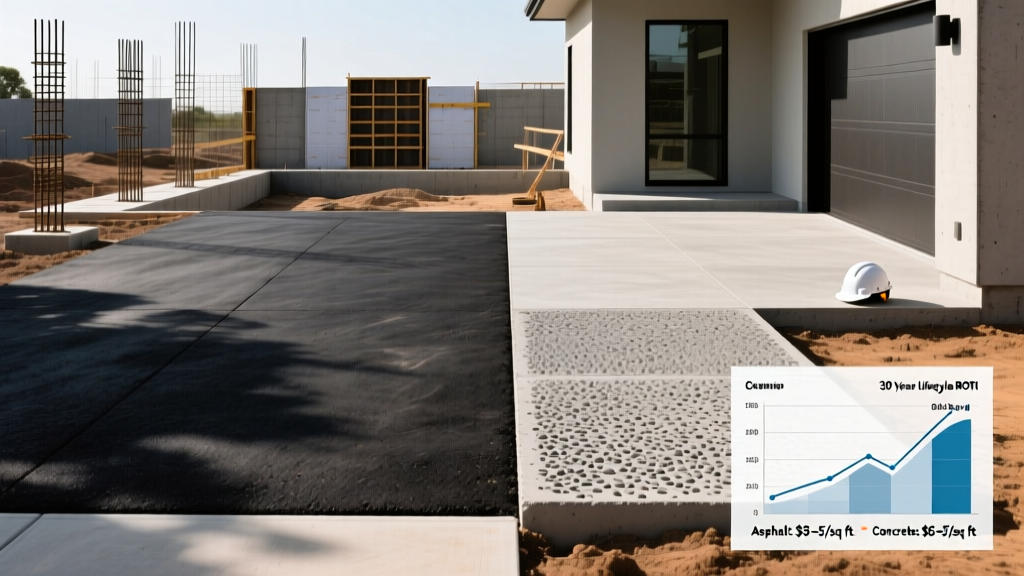
If you have ever typed 'asphalt vs concrete driveway cost calculator' into a search engine, you have likely been met with simplistic tools that only ask for your driveway's length and width. These basic calculators are fundamentally flawed because they only account for surface material and superficial labor. In 2026, surface materials account for barely 40% of the total project cost. The remaining 60% is dictated by site preparation, soil remediation, subbase engineering, and long-term lifecycle maintenance.
To make a financially sound decision, homeowners and contractors must build a comprehensive cost model that factors in regional aggregate prices, specific mix designs, and 30-year lifecycle cost analysis (LCCA). This guide provides the exact data points, material specifications, and hidden variables you need to build an accurate, real-world cost calculator for your specific property.
Asphalt vs Concrete Driveway Cost Calculator: The Core Variables
When building your custom calculator, start with the foundational costs per square foot. The prices below reflect 2026 national averages for a standard residential driveway (4-inch concrete slab or 2-inch asphalt surface over a 3-inch binder course) on a moderately prepared site.
| Cost Component | Concrete (Per Sq. Ft.) | Asphalt (Per Sq. Ft.) | Variables & Notes |
|---|---|---|---|
| Demolition & Haul-Away | $2.00 - $4.50 | $2.00 - $4.50 | Higher if removing reinforced concrete or deep tree roots. |
| Grading & Excavation | $1.50 - $3.00 | $1.50 - $3.00 | Depends on slope; steep grades require retaining walls. |
| Subbase (Aggregate) | $1.50 - $2.50 | $1.50 - $2.50 | Requires 4-6 inches of compacted crushed stone (ASTM D2940). |
| Material & Pouring/Paving | $6.00 - $10.00 | $3.50 - $6.50 | Concrete requires 4,000 PSI mix; Asphalt requires PG 64-22 binder. |
| Finishing & Curing | $1.50 - $4.00 | $0.50 - $1.00 | Broom finish is standard; stamped or exposed aggregate adds $6-$12/sq ft. |
| Total Base Cost | $12.50 - $24.00 | $9.00 - $17.50 | Excludes decorative upgrades and complex drainage solutions. |
Hidden Cost Multipliers Most Calculators Ignore
Basic online calculators fail to prompt users for site-specific anomalies. If your property features any of the following, you must add these multipliers to your final estimate:
- Expansive Clay Soils: Clay expands when wet and shrinks when dry, causing severe slab heaving. Remediation requires over-excavating 12 inches and replacing it with a non-expansive engineered fill, adding $3.00 to $5.00 per square foot.
- Heavy Tree Root Networks: Removing large root systems near the driveway edge requires specialized stump grinding and soil compaction, typically adding a flat fee of $800 to $2,500.
- Drainage Regrading: If your driveway slopes toward your garage or foundation, contractors must install trench drains or French drains. A standard 10-foot trench drain system adds $1,200 to $1,800 to the project.
- HOA and Municipal Permits: Many municipalities now require permeable subbases or specific curb-cut permits, adding $300 to $800 in administrative and material fees.
Lifecycle Cost Analysis (LCCA): 30-Year Projection
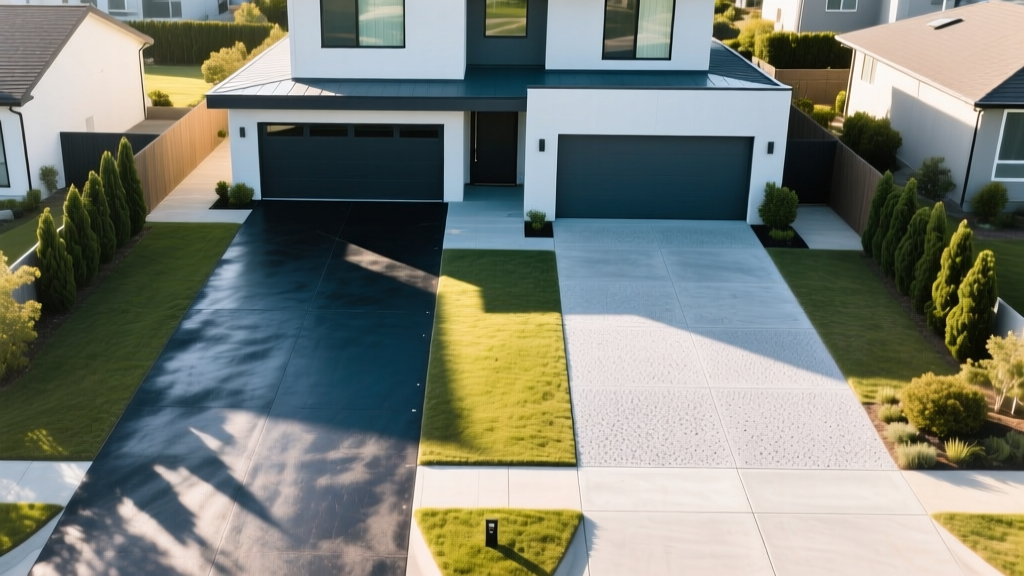
The initial installation cost is only the entry fee. To truly compare asphalt and concrete, you must calculate the 30-year lifecycle cost. According to principles outlined by the National Asphalt Pavement Association, asphalt requires more frequent surface maintenance, while concrete demands higher upfront capital but lower ongoing upkeep.
30-Year Cost Projection (600 Sq. Ft. Driveway)
Concrete Driveway:
- Initial Installation: $9,000
- Sealing (Every 5 years, 6 applications @ $250): $1,500
- Joint Resealing & Minor Crack Repair: $600
- 30-Year Total: $11,100 (Lifespan: 30-50 years)
Asphalt Driveway:
- Initial Installation: $5,400
- Sealcoating (Every 3 years, 10 applications @ $200): $2,000
- Crack Filling & Patching (Bi-annual): $900
- Mill and Overlay (Year 15): $3,600
- 30-Year Total: $11,900 (Lifespan: 15-20 years before full reconstruction)
While asphalt wins on day-one pricing, concrete often achieves cost parity by year 18 due to the necessity of an asphalt mill-and-overlay and frequent sealcoating.
Climate and Soil Matrix: Which Material Wins Where?
Material failure is the ultimate hidden cost. Choosing the wrong material for your microclimate will result in premature structural failure, voiding your calculator's ROI projections.
Freeze-Thaw Regions (Northern US, Canada)
In regions with severe winter cycles, water penetrates micro-cracks, freezes, and expands. Concrete wins here, provided it is specified correctly. You must mandate a 4,000 PSI air-entrained mix (5% to 7% air content) with a 3/4-inch aggregate. The microscopic air bubbles give expanding water room to freeze without spalling the surface. Asphalt in these regions becomes brittle in extreme cold, leading to transverse cracking.
Extreme Heat Regions (Southwest, Southern US)
In high-heat environments, asphalt binder softens, leading to rutting and tracking under heavy vehicle loads. Concrete is vastly superior here. Furthermore, the Environmental Protection Agency (EPA) notes that dark asphalt absorbs significantly more solar radiation, contributing to the urban heat island effect and raising localized cooling costs. Concrete's higher albedo (reflectivity) keeps the surface and surrounding air cooler.
Coastal and De-Icing Salt Environments
If you live near the ocean or in a municipality that heavily salts roads, asphalt is the safer choice. Chlorides and magnesium chloride de-icers chemically attack the calcium silicate hydrate in concrete, causing surface scaling and rebar corrosion. Asphalt is entirely immune to salt-induced chemical degradation.
Maintenance and Repair Cost Breakdown
When your driveway inevitably sustains damage, the repair methodologies and costs differ drastically between the two materials.
| Repair Type | Concrete Repair Method & Cost | Asphalt Repair Method & Cost |
|---|---|---|
| Surface Cracking | Epoxy injection or polyurethane foam ($8 - $15 per linear foot). | Hot pour rubberized crack sealing ($2 - $4 per linear foot). |
| Settling / Sunken Areas | Polyjacking / Slab jacking ($5 - $9 per square foot). | Infrared thermal patching or full-depth removal ($4 - $7 per square foot). |
| Oil / Chemical Stains | Requires professional power washing and chemical poultice ($150 - $300 flat). | Oil dissolves the binder; requires saw-cutting and patching ($250 - $500). |
Step-by-Step: How to Build Your Own Custom Calculator
Do not rely on generic web tools. Follow this exact sequence to generate a highly accurate budget for your specific property before calling contractors.
- Calculate True Square Footage: Measure length and width, but add 10% for curve flares, aprons, and sidewalk tie-ins. A standard 2-car driveway is typically 500 to 600 square feet.
- Assess the Subgrade: Dig a 1-foot test hole. If you hit solid rock, add $2.00/sq ft for rock excavation. If you hit high water table or muck, add $4.00/sq ft for geogrid reinforcement and engineered fill.
- Select the Mix Design: For concrete, specify a 4,000 PSI mix with fiber mesh reinforcement and #4 rebar on 2-foot centers. For asphalt, specify a 3-inch binder course (larger aggregate) topped with a 1.5-inch surface course (finer aggregate).
- Factor in Accessibility: If concrete mixer trucks or asphalt pavers cannot easily access the site (e.g., narrow alleys, steep hills, overhead wires), contractors will charge a 15% to 25% 'difficult access' premium due to the need for concrete pumps or smaller bobcat equipment.
- Request Itemized Bids: As noted by the American Concrete Institute, proper installation relies on strict adherence to material standards. Force contractors to break down their bids into Demolition, Subbase Prep, Material, and Finishing. This prevents them from hiding subbase shortcuts in a lump-sum price.
Contractor Negotiation Tip: Never ask a contractor 'How much for a concrete driveway?' Instead, ask, 'What is your price per square foot for a 4-inch slab of 4,000 PSI air-entrained concrete, placed over 4 inches of compacted ASTM D2940 aggregate, with control joints cut every 10 feet?' This signals that you understand the engineering requirements and prevents them from bidding on a substandard 3-inch slab with a weak 2,500 PSI mix.
By inputting these specific, localized variables into your own spreadsheet, you transform a generic asphalt vs concrete driveway cost calculator into a precision financial modeling tool. This ensures you select the material that offers the highest structural integrity and the best long-term ROI for your exact geographic and soil conditions.
Written by
James ThorntonJames Thornton is a construction industry veteran with 25 years of hands-on experience in wood framing, lumber grading, and residential building codes. He started as a framing carpenter in rural Oregon, earned his ICC Residential Building Inspector certification, and eventually became a senior plan reviewer for the City of Portland Bureau of Development Services. James holds a B.S. in Wood Science & Technology from Oregon State University and is a certified lumber grader through the West Coast Lumber Inspection Bureau (WCLIB). He has inspected over 3,000 residential construction sites and authored the city's internal guide on advanced framing techniques (2x6 at 24" O.C.). James lives in Bend, OR, where he builds custom timber-frame cabins and competes in lumberjack sports.
More from James Thornton
View all
Insulation
Best Home Insulation Materials: Complete 2026 Guide
Compare top home insulation materials for 2026. Find R-values, installed costs per square foot, and best uses for fiberglass, spray foam, and mineral wool.
Aug 4, 2026

Sustainable Building
Certify Your Green Building Material for LEED and WELL
Step-by-step guide to certifying a green building material for LEED v5 and WELL v2. Master EPDs, HPDs, and VOC limits for 2026 project specifications.
Aug 4, 2026

Stone & Masonry
Veneer Stacked Stone Panels: Interior Design & Style Showcase
Discover how veneer stacked stone panels transform interiors. Explore modern design profiles, material pairings, and technical installation specs.
Aug 4, 2026