Advanced Concrete Volume Calculator: Performance & Yield Specs
Master the concrete volume calculator by integrating performance specs, air entrainment yield adjustments, and HPC density factors for precise ordering.
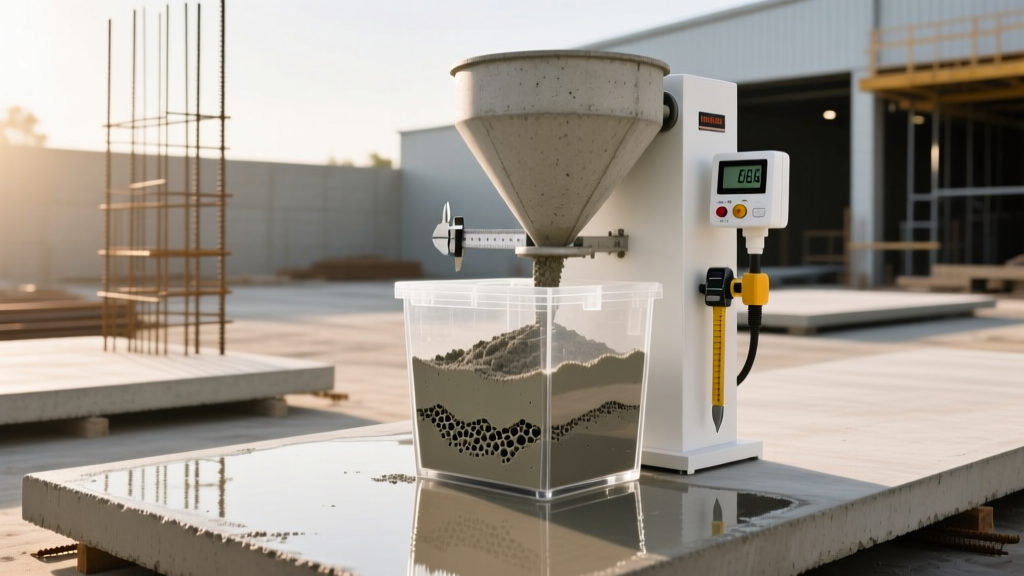
Beyond Geometry: Why Standard Concrete Volume Calculators Fail
Most basic concrete volume calculators operate on a purely geometric premise: Length × Width × Depth = Total Volume. While this provides a baseline cubic yardage for simple slabs, it completely ignores the material science and performance specifications that dictate actual batch yield. In professional construction, ordering concrete based solely on geometric volume leads to chronic short loads, compromised structural integrity, and inflated costs due to emergency short-load fees.
To use a concrete volume calculator effectively, engineers and project managers must transition from geometric calculators to performance-specified yield calculators. This means adjusting the base geometric volume for air entrainment, unit weight variations, subgrade tolerances, and the specific rheological properties of high-performance mixes. According to guidelines from the National Ready Mixed Concrete Association (NRMCA), failing to account for mix-specific yield adjustments can result in volume discrepancies of 5% to 12% on large pours.
Integrating Performance Specifications into Volume Calculations
A professional-grade concrete volume calculator must ingest specific mix design parameters to output an accurate order quantity. The two most critical performance variables that alter physical yield are air content and unit weight.
Air Entrainment and Yield Adjustments (ASTM C231)
Air-entrained concrete is mandatory for exterior flatwork in freeze-thaw climates, typically specified at 4% to 8% air content per ACI 318. However, air occupies physical space within the matrix. For every 1% of entrained air, the absolute yield of the batch decreases by approximately 1%. If your geometric calculator dictates 100 cubic yards for a parking structure, and the specification calls for 6% air entrainment, the batch plant must proportion the mix to account for this void space. Failing to apply a 1.06 yield adjustment factor to your calculator's output will leave you exactly 6 cubic yards short at the end of the pour.
Unit Weight and Payload Constraints (ASTM C138)
Standard normal-weight concrete has a unit weight of 145 to 150 pounds per cubic foot (pcf). However, high-strength performance mixes (6,000+ PSI) often utilize denser aggregates like basalt or trap rock, pushing the unit weight to 155–165 pcf. While this does not change the volumetric space the concrete fills, it drastically impacts the payload capacity of the transit mixer. Department of Transportation (DOT) bridge laws restrict gross vehicle weights. A standard truck carrying 150 pcf concrete might legally haul 10 cubic yards. That same truck, loaded with 160 pcf high-performance concrete, may be legally restricted to 8.5 cubic yards. An advanced calculator must factor in truck payload limits to calculate the required number of loads and staggered dispatch timing.
Performance Mix Specifications & Volume Adjustment Factors
| Mix Design Classification | Target Compressive Strength | Specified Air Content | Avg. Unit Weight (pcf) | Calculator Yield Multiplier |
|---|---|---|---|---|
| Standard Flatwork (Interior) | 3,000 - 4,000 PSI | 1.5% - 2.0% | 145 - 148 | 1.02 |
| Exterior Flatwork (Freeze-Thaw) | 4,000 - 5,000 PSI | 5.0% - 7.0% | 140 - 145 | 1.05 - 1.07 |
| High-Performance Structural | 8,000 - 10,000+ PSI | 1.0% - 2.0% | 150 - 160 | 1.02 (Check Truck Payload) |
| Self-Consolidating (SCC) | 5,000 - 8,000 PSI | 1.0% - 3.0% | 145 - 150 | 1.03 - 1.04 (Form Deflection) |
The Professional's Concrete Volume Calculator Framework
To achieve precision ordering, follow this sequential framework when inputting data into your volume calculation software or spreadsheet:
- Calculate Gross Geometric Volume: Measure the exact formwork dimensions (L × W × H) to establish the baseline cubic yardage.
- Apply Subgrade Tolerance Factor: For slabs-on-grade, add 3% to 5% to account for minor subgrade undulations and over-excavation. For suspended decks, this factor is 0%.
- Apply Air Entrainment Yield Factor: Multiply the subgrade-adjusted volume by (1 + [Air % / 100]).
- Factor in Formwork Deflection: For wall pours or SCC applications, add 1% to 2% to account for the outward bowing of plywood or aluminum forms under hydrostatic pressure.
- Add Structural Waste Factor: Add 4% for simple slabs, 8% for complex footings, and 12% for heavily reinforced columns or shotcrete applications.
Do not artificially inflate your calculator output by an arbitrary 15% "just to be safe." Ready-mix suppliers charge severe short-load penalties (often $75–$125 per cubic yard) for trucks returning with unused material. Furthermore, over-ordering leads to the illegal dumping of excess concrete or the costly rental of concrete washout containers. Precision specification is always more cost-effective than blind over-ordering.
Calculating for Specialty High-Performance Concrete (HPC)
When your project specifications call for advanced materials, the standard volume calculator logic must be modified to account for unique material behaviors.
Self-Consolidating Concrete (SCC)
SCC flows under its own weight without vibration, requiring highly flowable mix designs with elevated powder contents and viscosity-modifying admixtures (VMAs). Because SCC exerts full hydrostatic pressure on formwork (as detailed by American Concrete Institute (ACI) guidelines), formwork systems often experience micro-deflections. A standard geometric calculator will underestimate the volume required to fill these slightly expanded forms. Always apply a minimum 1.03 multiplier for SCC wall and column pours to account for formwork bulge.
Fiber-Reinforced Concrete (FRC)
Macro-synthetic or steel fiber-reinforced concrete alters the volumetric calculation indirectly through waste and placement mechanics. The presence of fibers increases the mix's cohesiveness, which can lead to higher residual waste left inside the truck drum and chutes (up to 0.25 cubic yards per truck). When calculating FRC volumes for large mat foundations, increase your baseline waste factor from the standard 4% to 7% to compensate for drum retention.
Common Specification Errors That Skew Calculator Outputs
Even with an advanced concrete volume calculator, garbage input yields garbage output. Avoid these frequent specification errors:
- Ignoring Rebar Displacement: In heavily reinforced mat foundations or thick shear walls, the steel rebar cage can displace 2% to 4% of the total volume. While concrete is typically ordered by the gross form volume, high-density rebar zones require precise net-volume calculations to avoid massive overages.
- Miscalculating Sloped Slabs: Inputting the average depth of a sloped garage floor into a basic calculator often ignores the geometric reality of the wedge shape. Use the prismoidal formula or break the slope into discrete triangular and rectangular prisms for exact yardage.
- Overlooking Pump Line Priming: If the pour requires a concrete pump, the first 0.5 to 1.0 cubic yards of concrete (or a dedicated mortar slug) is used to prime the line and is not placed in the forms. This priming volume must be added to the final calculator output.
FAQ: Advanced Volume Calculation Queries
How do I calculate concrete volume for a cylindrical pier?
Use the formula V = π × r² × h. For a 24-inch diameter pier that is 10 feet deep, the radius is 1 foot. V = 3.1416 × (1)² × 10 = 31.416 cubic feet. Divide by 27 to get 1.16 cubic yards per pier. Apply a 10% over-excavation factor for soil variance, bringing the specified order to 1.28 cubic yards per pier.
Does the slump rating affect the volume calculator output?
Indirectly, yes. High-slump mixes (6+ inches) or mixes utilizing superplasticizers can experience slight bleeding and segregation if held in the truck too long, altering the effective yield. More importantly, high-slump mixes exert greater hydrostatic pressure, increasing the risk of formwork blowouts or deflection, which necessitates the form-deflection volume multiplier mentioned in the SCC section.
Where can I find the exact yield data for my specific mix design?
Request the certified mix design batch report from your ready-mix supplier. The Portland Cement Association (PCA) recommends reviewing the batch proportions and the specific gravity of the aggregates used. The supplier's quality control department can provide the exact theoretical yield per cubic yard based on the absolute volume of the cement, water, aggregates, and air specified in your contract.