Pouring Concrete: Curing Secrets for Maximum Slab Lifespan
Discover how pouring concrete with advanced curing techniques extends slab lifespan to 100 years. Expert analysis on mix designs, temperature, and sealing.
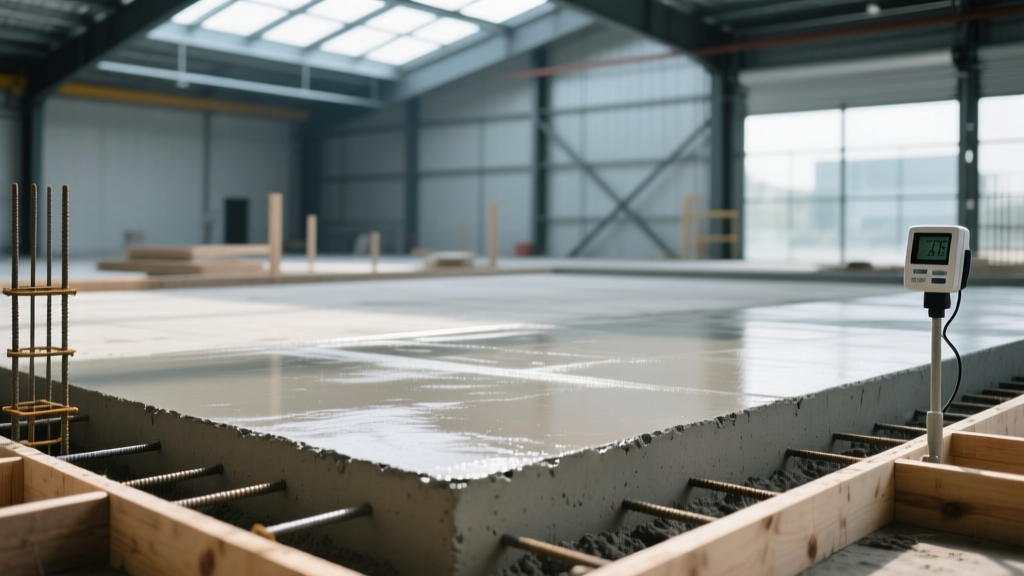
The Chemistry of Longevity: Why Most Slabs Fail Early
The structural integrity of a concrete slab is not determined solely by its compressive strength at 28 days, but by the microstructural density achieved during the first 72 hours of hydration. When pouring concrete, the primary enemy of longevity is capillary porosity. If the water-to-cement (w/c) ratio exceeds 0.45, or if moisture evaporates too rapidly during the plastic state, a network of interconnected capillary pores forms. These pores become highways for chloride ingress, freeze-thaw damage, and sulfate attack, effectively cutting the slab's lifespan from a potential 75+ years down to 20 years.
According to durability frameworks established by the Portland Cement Association, improper curing accounts for nearly 80% of early-age surface degradation, including plastic shrinkage cracking, dusting, and scaling. To achieve century-grade durability, contractors and engineers must move beyond standard 3000 PSI commodity mixes and implement strict environmental controls, advanced supplementary cementitious materials (SCMs), and rigorous 7-day curing protocols.
Temperature Thresholds When Pouring Concrete
Hydration is an exothermic chemical reaction. The ambient and internal temperatures during the pour dictate the rate of calcium silicate hydrate (C-S-H) gel formation. Pouring concrete in extreme temperatures without thermal mitigation guarantees microstructural defects.
Never place concrete when the ambient temperature is below 50°F (10°C) and falling, unless you are utilizing heated enclosures or accelerating admixtures per ACI 306 cold-weather guidelines. Below 40°F, hydration slows to a near halt, and any free water in the matrix can freeze, expanding by 9% and causing immediate, irreversible internal micro-fracturing.
| Ambient Temp Range | Hydration Rate | Primary Failure Mode | Required Mitigation |
|---|---|---|---|
| Below 40°F (4°C) | Severely Retarded | Freeze-thaw scaling, delayed set | Insulated blankets, heated water in mix |
| 50°F - 75°F (10-24°C) | Optimal | Standard plastic shrinkage if windy | Standard wet curing or membrane compounds |
| Above 90°F (32°C) | Accelerated | Flash set, thermal cracking, high permeability | Chilled mixing water, liquid nitrogen, retarders |
Advanced Mix Designs for Century-Grade Durability
Standard ready-mix designs relying entirely on Ordinary Portland Cement (OPC) are highly susceptible to permeability. To maximize lifespan when pouring concrete for exterior flatwork, driveways, or structural foundations, the mix must be engineered for low permeability and high abrasion resistance.
Supplementary Cementitious Materials (SCMs)
As of 2026, the most effective method for reducing capillary porosity is the integration of SCMs. Replacing 15% to 25% of OPC with Slag Cement (ASTM C989 Grade 100) or Class F Fly Ash (ASTM C618) triggers a secondary pozzolanic reaction. This reaction consumes the weak calcium hydroxide byproduct of primary hydration and converts it into additional C-S-H gel. The result is a denser, less permeable matrix that dramatically slows chloride ion penetration, protecting embedded rebar from corrosion.
Water-to-Cement (w/c) Ratio Optimization
The percolation threshold for concrete capillary pores occurs at a w/c ratio of roughly 0.45. Below this threshold, the pores become disconnected, effectively sealing the interior of the slab. For high-durability exterior slabs, specify a maximum w/c ratio of 0.40 to 0.42. To maintain workability at this low water content, utilize polycarboxylate ether (PCE) based high-range water reducers (HRWRs) rather than adding excess water on-site, which instantly compromises the slab's lifespan.
The 7-Day Curing Protocol for 50-Year Performance
Curing is not merely keeping the surface wet; it is the strict management of moisture loss to ensure continuous hydration. The American Concrete Institute mandates that concrete must retain sufficient moisture to achieve its designed durability properties. Follow this sequential protocol immediately after finishing:
- Evaporation Rate Monitoring (Hour 0-4): Use a nomograph or digital evaporation meter to ensure the evaporation rate does not exceed 0.2 lb/ft²/hr. If it does, deploy temporary windbreaks or apply a monomolecular evaporation retarder (not a curing compound) to prevent plastic shrinkage cracking.
- Initial Membrane Application (Hour 4-8): Once the surface sheen disappears and the concrete can bear foot traffic without deformation, apply an ASTM C309 Type 1-D (white pigmented) curing compound. The white pigment reflects solar radiation, lowering the surface temperature and reducing thermal gradients that cause warping.
- Continuous Wet Curing (Days 1-7): For maximum surface hardness, override the membrane with continuous wet curing. Lay 10 oz wet burlap or specialized curing mats and keep them continuously saturated. This maintains a 100% relative humidity at the slab surface, allowing the top 1 inch of concrete to achieve up to 30% higher compressive strength than the core.
- Joint Sawing (Hour 6-18): Saw-cut control joints to a depth of 25% of the slab thickness before internal tensile stresses exceed the concrete's early tensile strength. Delaying this step guarantees random, uncontrolled cracking.
Real-World Cost vs. Lifespan Matrix
Investing in durability during the pour yields exponential lifecycle savings. Below is a comparative analysis of standard vs. optimized mixes for a 5,000 sq. ft. exterior commercial slab, reflecting current 2026 material and labor pricing.
Lifecycle Cost Analysis (5,000 Sq. Ft. Slab)
| Parameter | Standard 4000 PSI OPC Mix | Optimized 5000 PSI + 20% Slag |
|---|---|---|
| Material Cost per Cubic Yard | $145 - $160 | $165 - $185 (+$25 premium) |
| Total Mix Cost (Approx. 95 yds) | $14,500 | $16,850 |
| Curing Protocol | Spray-on clear cure (3 days) | Wet burlap + Type 1-D (7 days) |
| Expected Lifespan (Freeze-Thaw) | 20 - 25 Years | 60 - 75+ Years |
| 50-Year Maintenance Cost | $28,000 (1 Full Replacement) | $4,500 (Joint sealing only) |
Conclusion: The $2,350 upfront premium for SCMs and rigorous curing eliminates the need for a complete slab replacement at year 30, yielding a net savings of over $25,000.
Expert Troubleshooting: Early-Age Degradation
Even with optimal mix designs, environmental variables during the pour can introduce defects. Identifying the root cause of early-age distress is critical for implementing corrective maintenance before structural integrity is compromised.
- Surface Dusting (Laitance): Caused by finishing operations occurring while bleed water is still on the surface, or by carbonation from unvented propane heaters used during cold-weather pours. Fix: Apply a sodium or lithium silicate densifier to chemically harden the surface.
- Craze Cracking: A network of fine, shallow hexagonal cracks caused by rapid surface drying (high evaporation rate) while the underlying concrete remains wet. Fix: Preventative only; ensure evaporation rates stay below 0.2 lb/ft²/hr. Existing crazing is purely aesthetic but can be masked with penetrating sealers.
- Popouts and Scaling: Typically caused by the use of non-air-entrained concrete in freeze-thaw climates, or by porous chert aggregates absorbing water and expanding upon freezing. Fix: Specify an air-entrainment volume of 5% to 7% (ASTM C260) for all exterior flatwork in northern climates to provide microscopic relief chambers for expanding ice.
By treating the act of pouring concrete not as a mere placement task, but as the initiation of a highly sensitive chemical process, builders can engineer slabs that easily outlast the structures they support. The data is unequivocal: longevity is bought in the first seven days of curing, not in the decades that follow.