Quick Set Concrete Cost Calculator & 2026 Pricing Guide
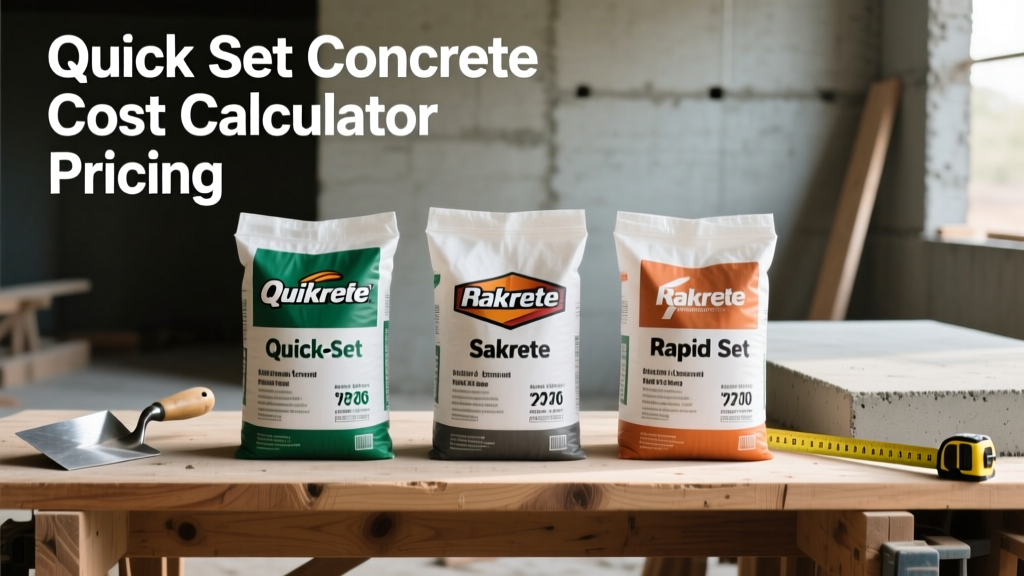
Calculate exact quick set concrete costs and quantities for 2026. Compare Quikrete, Sakrete, and Rapid Set pricing, yields, and hidden project expenses.
The True Cost of Quick Set Concrete in 2026
When project timelines demand immediate structural integrity, quick set concrete transitions from a convenience to a critical path necessity. Formulated with high-early-strength cements (often Type III Portland cement or calcium sulfoaluminate blends), these mixes achieve 3,000 PSI in hours rather than weeks. However, this chemical acceleration commands a premium. In 2026, the material cost for rapid-hardening bagged mixes ranges from 25% to 110% higher than standard 4,000 PSI bagged concrete, depending on the specific brand and set-time requirements.
Quick Set Concrete Quantity Calculator Framework
Accurate estimation prevents both catastrophic mid-pour shortages and expensive material waste. Because quick set concrete has a working time of just 20 to 30 minutes, returning to the store for an extra bag mid-mix is rarely an option. Use the following volumetric framework to calculate your exact requirements.
Step-by-Step Volume Math for Common Projects
The fundamental formula for rectangular or square forms is straightforward: Length (ft) × Width (ft) × Depth (ft) = Total Cubic Feet. For cylindrical applications like post holes, use the formula: 3.14 × Radius² (ft) × Depth (ft) = Total Cubic Feet.
- Standard Fence Post Hole: A 12-inch diameter hole dug 36 inches deep yields approximately 2.35 cubic feet. Subtract the volume of the 4x4 post (roughly 0.4 cubic feet submerged), leaving 1.95 cubic feet of required concrete.
- AC Condenser Pad: A standard 36-inch by 36-inch pad poured 4 inches thick requires exactly 3.0 cubic feet of material.
- Sidewalk Patch Repair: A 2-foot by 2-foot removal area at a 4-inch depth requires 1.33 cubic feet.
Once you have the net cubic footage, divide by the yield of your chosen bag size. A standard 50 lb bag of quick set mix yields approximately 0.375 cubic feet. Always multiply your final bag count by 1.10 to account for a 10% waste and over-excavation factor. For the fence post example above: 1.95 ÷ 0.375 = 5.2 bags. Multiply by 1.10 = 5.72. You must purchase and stage 6 bags before adding water.
Brand Pricing Matrix: Quikrete vs. Sakrete vs. Rapid Set
Not all fast-setting mixes are engineered equally. The chemical admixtures dictate not only the set time but the ultimate compressive strength and shrinkage characteristics. Below is a comparative matrix of the three dominant retail brands available in 2026, normalized for cost-efficiency.
| Brand / Product Line | Bag Weight | Yield (Cu Ft) | 2026 Avg Price | Cost / Cu Ft | 28-Day PSI | Initial Set |
|---|---|---|---|---|---|---|
| Quikrete Fast-Setting (Red Bag) | 50 lbs | 0.375 | $5.98 | $15.94 | 4,000 | 20-40 min |
| Sakrete Fast Setting | 50 lbs | 0.375 | $5.48 | $14.61 | 3,500 | 30 min |
| Rapid Set Cement All | 55 lbs | 0.400 | $10.49 | $26.22 | 9,000 | 15 min |
| Standard Concrete Mix (Baseline) | 80 lbs | 0.600 | $4.78 | $7.96 | 4,000 | 24+ hours |
For structural repairs where shrinkage compensation and extreme early strength are mandatory, Rapid Set Cement All justifies its premium. For general setting of metal fence posts or mailbox anchors, the Quikrete or Sakrete options provide the optimal balance of speed and cost.
Hidden Costs and Failure Modes to Budget For
Relying solely on the per-bag retail price will result in an underestimated budget. Quick set concrete introduces specific logistical and chemical variables that carry hidden financial penalties if mismanaged.
1. The 'Flash Set' Waste Penalty
Unlike standard concrete, which allows for a 90-minute slump retention window, rapid-hardening mixes utilizing calcium sulfoaluminate chemistries can experience 'flash set' if exposed to high ambient temperatures (above 85°F) or mixed with warm water. If a 60 lb batch hardens in the wheelbarrow before placement, you lose both the $12 material cost and the labor time. Mitigation Cost: Budget for ice or chilled water to mix the concrete during summer months, adding roughly $0.05 per cubic foot to your operational costs.
2. Specialized Mixing Equipment Wear
Fast-setting mixes are highly abrasive and cure rapidly on tools. Standard mortar hoes and plastic wheelbarrows are insufficient for large batches. You must budget for a heavy-duty 1/2-inch drill with a specialized mud-mixer paddle (approx. $35), or rent a gas-powered mortar mixer ($65/day). Failing to clean tools within 10 minutes of mixing will ruin them, turning a $40 rental into a $200 replacement expense.
Adding extra water to make quick set concrete 'easier to pour' destroys the chemical matrix. According to Portland Cement Association guidelines on mix design, every additional gallon of water beyond the manufacturer specification can reduce compressive strength by up to 10%. Never add water to a fast-setting mix once the initial hydration reaction (the warming phase) has begun.
3. Formwork and Anchor Hardware
Because quick set concrete is frequently used for vertical anchoring (posts, bollards, railings), the cost of the anchoring hardware itself must be factored into the unit cost. Hot-dipped galvanized post bases or epoxy-coated anchor bolts cost 30% to 50% more than standard zinc-plated alternatives but are required to prevent rust-jacking, which cracks high-early-strength concrete due to its lower initial creep tolerance.
When to Pay the Premium: A Decision Framework
Quick set concrete is not a universal substitute for standard mixes. Use this logic flow to determine if the premium is financially justifiable for your specific project phase.
- IF the project requires backfilling around a structural post that must bear lateral wind loads within 24 hours → USE Quick Set. The labor savings from removing temporary bracing early offsets the material premium.
- IF you are pouring a flatwork slab larger than 50 square feet → DO NOT USE Quick Set. The rapid cure time makes it impossible to strike off, float, and trowel the surface before it hardens, resulting in a ruined finish and total material loss.
- IF you are repairing a vertical concrete spall or overhead soffit → USE Rapid Set Cement All. Its non-shrink, high-viscosity properties eliminate the need for complex formwork, saving hundreds in carpentry labor.
- IF the project is a non-load-bearing sidewalk pour with a 7-day cure window → USE Standard Mix. Paying a 100% premium for speed provides zero return on investment when the site timeline allows for standard hydration.
Expert Sourcing and Bulk Discount Thresholds
Purchasing quick set concrete at big-box retail is only cost-effective for projects requiring less than 1.5 cubic yards (approximately 108 standard 50 lb bags). Once your volume exceeds this threshold, the labor cost of slitting and mixing 100+ bags destroys any financial benefit.
For projects requiring 2 to 10 cubic yards of rapid-hardening material, contact local batch plants to order High-Early-Strength Ready-Mix (often designated as a Type III cement mix with accelerating admixtures like calcium nitrate). While the per-yard cost of ready-mix will be $180 to $240 (compared to the $450+ equivalent in bagged quick set), the elimination of manual mixing labor and the guarantee of a consistent slump make it the only viable commercial choice. As noted in the National Ready Mixed Concrete Association ordering guidelines, always specify the exact required set time and ambient temperature to the dispatcher, as ready-mix accelerators are dosed dynamically at the plant based on daily weather conditions.