The Average Cost to Build a Bear Enclosure: Detailed Breakdown
Discover the average cost to build a bear enclosure, including detailed breakdowns for moats, heavy-gauge fencing, shotcrete rockwork, and holding dens.
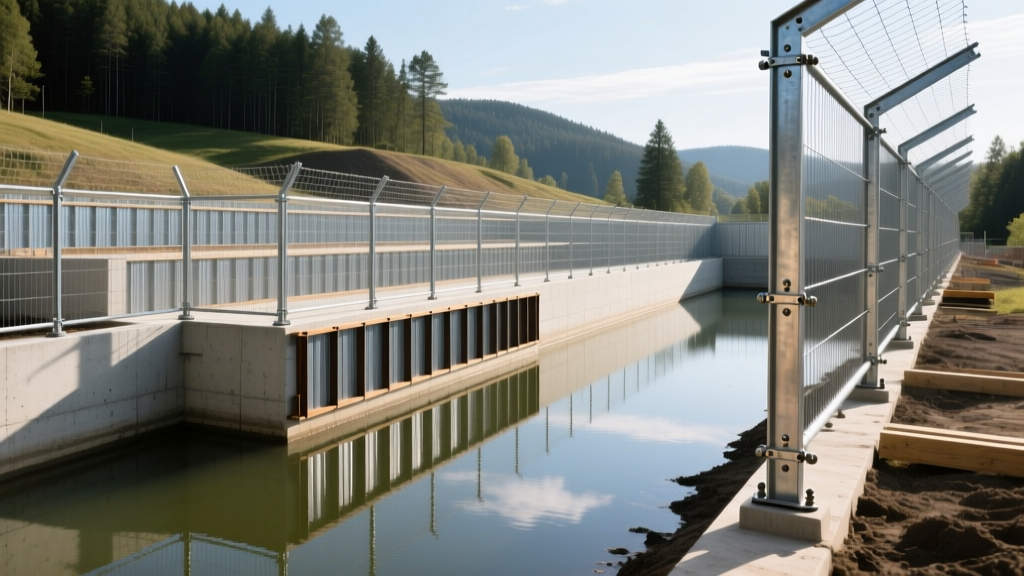
Engineering Containment: Beyond Standard Fencing
Constructing a habitat for the family Ursidae (bears) is one of the most complex and highly regulated niches in wildlife construction. Whether you are estimating for a zoo, a wildlife rehabilitation sanctuary, or a private exotic animal facility, the structural requirements are extreme. Bears possess immense physical strength, high intelligence, and relentless digging capabilities. A standard chain-link fence will fail catastrophically under the torsional force of a 600-pound grizzly or polar bear.
When calculating the average cost to build a bear enclosure, estimators must account for specialized metallurgy, deep concrete footers, artificial topography, and climate-controlled holding facilities. In 2026, material costs for heavy-gauge steel and specialized shotcrete have stabilized, but labor for thematic rockwork remains a premium expense. Below is a comprehensive, component-by-component breakdown of the construction costs and engineering specifications required for a modern, AZA-compliant bear habitat.
Perimeter Containment: Heavy-Gauge Fencing vs. Moats
The primary physical barrier of any bear enclosure relies on either vertical heavy-gauge fencing or a horizontal containment moat. Many modern facilities utilize a hybrid approach, using moats for visitor viewing areas and heavy fencing for off-exhibit boundaries.
Heavy-Gauge Welded Wire Fencing
Bear enclosures require galvanized welded wire mesh, typically 6-gauge (0.162 inches) or 4-gauge (0.225 inches) steel. The mesh aperture must not exceed 2x2 inches to prevent the animal from inserting paws and leveraging the wires apart. Fence posts are usually 4-inch to 6-inch schedule 40 steel pipes, set in concrete.
- Material Cost: $45 to $85 per linear foot for the mesh and framework.
- Installation & Concrete Setting: $90 to $150 per linear foot.
- Electric Offset Wire: An essential secondary deterrent. A 4,000-volt hot wire must be installed 12 inches inside the top of the fence and 12 inches down from the lip to prevent climbing. Add $15 to $25 per linear foot for the energizer and high-tensile wire setup.
Dry Containment Moats
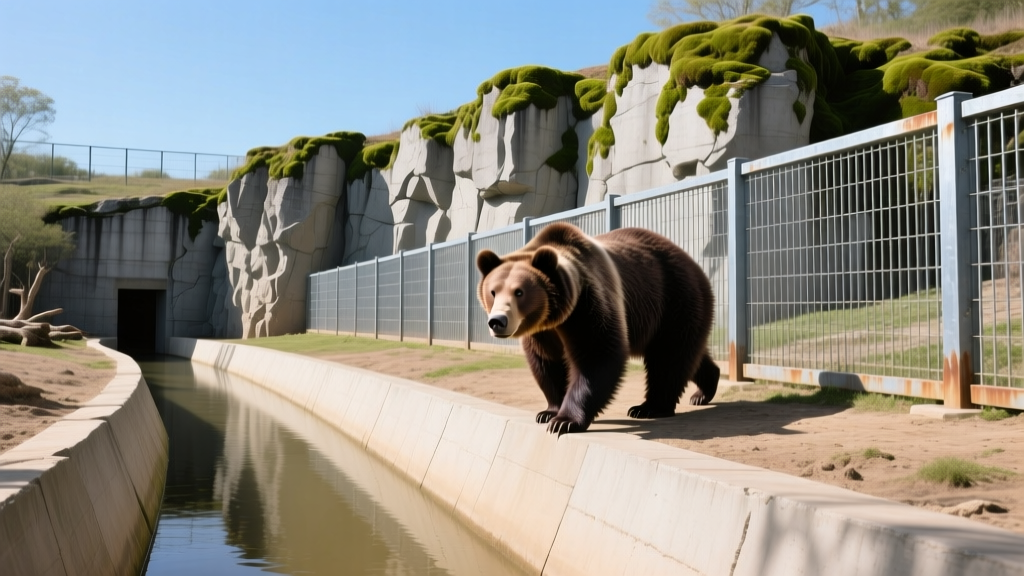
Moats provide unobstructed viewing and eliminate the visual clutter of fencing. However, bears are strong swimmers and capable climbers. A dry moat designed for grizzly or brown bears must be a minimum of 12 to 15 feet wide and 8 to 10 feet deep. Crucially, the moat must include an escape ramp with a maximum 1:3 slope on the visitor side, ensuring that if an animal falls in, it can exit the moat without human intervention, preventing stress and injury.
- Excavation and Earthmoving: $40 to $70 per linear foot.
- Forming and Concrete Pouring (4,000 PSI): $150 to $250 per linear foot.
- Total Moat Cost: $190 to $320 per linear foot.
Polar bears (Ursus maritimus) require vastly different specifications than brown or black bears. They are exceptional climbers and diggers. Polar bear enclosures mandate a minimum 16-foot wide moat, 10-foot deep, with inward-sloping walls at a 45-degree angle to prevent climbing out. Fencing for polar bears must be a minimum of 14 feet high with a 3-foot inward cantilever at the top. Expect polar bear containment costs to be 40% to 60% higher than standard brown bear enclosures.
Subterranean Security: Dig Barriers and Footers
Bears are natural excavators. A fence that simply sits on top of the soil is a critical failure point. To prevent tunneling, estimators must include a subterranean dig barrier in the foundation plan. There are two primary engineering solutions:
- Concrete Grade Beam: A continuous poured concrete footer extending 36 inches below grade and 12 inches wide. This is the most secure method but requires extensive trenching and forming. Cost: $85 to $130 per linear foot.
- Buried Wire Apron: An L-shaped extension of the primary fence mesh that extends 4 feet horizontally underground, pointing inward toward the habitat, buried under 6 inches of topsoil. Cost: $35 to $55 per linear foot.
Environmental Enrichment: Shotcrete Rockwork and Pools
Modern animal welfare standards dictate that enclosures must provide psychological enrichment and thermal regulation. For bears, this means artificial rock caves, climbing structures, and deep plunge pools. According to guidelines referenced by the American Shotcrete Association, artificial rockwork is constructed using a steel rebar armature (typically #4 rebar at 12 inches on center) covered with wire mesh, and sprayed with high-strength concrete.
| Element | Specification | Cost Range |
|---|---|---|
| Artificial Rock Cliffs | 4,000 PSI shotcrete, hand-carved, stained | $220 - $380 / sq ft |
| Den Caves | Reinforced arch, 8-inch shell thickness | $300 - $450 / sq ft |
| Plunge Pools | Gunite shell, commercial filtration, 6ft deep | $45,000 - $85,000 (flat) |
| Rubbing Rocks / Logs | Natural boulders or cast concrete | $1,500 - $4,000 / piece |
Climate-Controlled Holding Dens and Guillotine Doors
Bears require off-exhibit holding areas for veterinary care, feeding, and winter torpor (hibernation). These structures are built using reinforced Concrete Masonry Units (CMU) or poured-in-place concrete walls, minimum 12 inches thick, with epoxy-painted interiors for sanitation.
The most critical component of the holding den is the transfer door. Standard hinges will snap under bear pressure. Facilities must install heavy-duty stainless steel or powder-coated guillotine doors. These doors operate vertically via a manual winch or hydraulic piston and lock into a steel channel. A single 36" x 48" manual guillotine door costs between $3,500 and $6,000, while hydraulic automated systems range from $12,000 to $18,000 per unit.
Total Project Cost Estimator: 1-Acre Facility
The following matrix provides a realistic budget for a standard 1-acre (approx. 43,560 sq ft) brown bear enclosure. This assumes a perimeter of roughly 835 linear feet, incorporating a mix of dry moat (front) and heavy fencing (sides/rear), plus essential habitat features.
| Construction Phase | Estimated Cost | % of Total Budget |
|---|---|---|
| Site Prep, Grading & Excavation | $45,000 - $70,000 | 10% |
| Perimeter Fencing (500 LF) & Dig Barriers | $110,000 - $165,000 | 22% |
| Dry Containment Moat (335 LF) | $85,000 - $115,000 | 16% |
| Shotcrete Rockwork & Caves (2,500 sq ft) | $180,000 - $260,000 | 30% |
| Holding Den & Guillotine Doors | $90,000 - $140,000 | 15% |
| Plunge Pool & Water Filtration | $55,000 - $85,000 | 7% |
| Total Estimated Project Cost | $565,000 - $835,000 | 100% |
Regulatory Compliance and Accreditation Standards
Cost estimation must also factor in the engineering hours required to ensure compliance with federal and institutional regulations. In the United States, any facility exhibiting bears must adhere to the Animal Welfare Act, enforced by USDA APHIS Animal Care. These regulations dictate minimum square footage, den requirements, and structural integrity standards.
Furthermore, facilities seeking accreditation from the Association of Zoos and Aquariums (AZA) must meet significantly higher standards. The AZA Animal Care Manuals for bears mandate specific spatial complexity, multiple shift doors to prevent animal trapping, and specialized substrates that promote foraging behaviors. Designing to AZA standards typically increases initial architectural and engineering costs by 15% to 20%, but it ensures the highest level of animal welfare and facility longevity.
Key Takeaways for Estimators
When pricing a bear habitat, never substitute materials to save costs. A failure in a 6-gauge wire mesh or a shallow dig barrier can result in catastrophic liability and animal loss. Always allocate a 15% contingency fund for unforeseen subgrade conditions during moat excavation, and ensure your electrical contractor is licensed in agricultural/wildlife high-voltage offset systems.
Written by
Priya KapoorPriya Kapoor is a real estate market analyst and construction economics researcher with expertise in housing affordability, development feasibility, and infrastructure investment. She holds a Master of Regional Planning from Cornell University and previously worked as a senior analyst at CBRE's Investment Properties group, where she modeled returns for $4B in mixed-use development pipelines. Priya now runs an independent research practice advising developers, municipalities, and REITs on construction cost forecasting and market timing. She publishes the quarterly "BuildMat Market Pulse" report tracking material price indices across 12 commodity categories. Based in Austin, TX, Priya serves on the board of Habitat for Humanity Austin and is a marathon runner.
More from Priya Kapoor
View all
Construction Cost
Cost to Build a 1600 Sq Ft Home in 2026: Full Breakdown
Accurate 2026 cost to build a 1600 sq ft home—material, labor, and regional pricing breakdowns included. Plan your budget with real-time estimates.
Aug 11, 2026

Wood & Lumber
Name the Types of Wood for Pressure Treatment and Preservation
Learn how to name the types of wood best suited for pressure treatment. Compare species treatability, chemical retention levels, and 2026 preservation costs.
Aug 4, 2026

Stone & Masonry
Stone Veneer Suppliers Lindenhurst: 2026 Cost Analysis
Analyze 2026 stone veneer costs in Lindenhurst, NY. Compare local supplier pricing, delivery fees, and Suffolk County installation labor rates.
Aug 4, 2026