How Much Does It Cost to Build a B2 Bomber? Aerospace Cost Guide
Discover how much it costs to build a B2 bomber. We break down aerospace construction financing, material costs, and R&D expenses in this detailed guide.
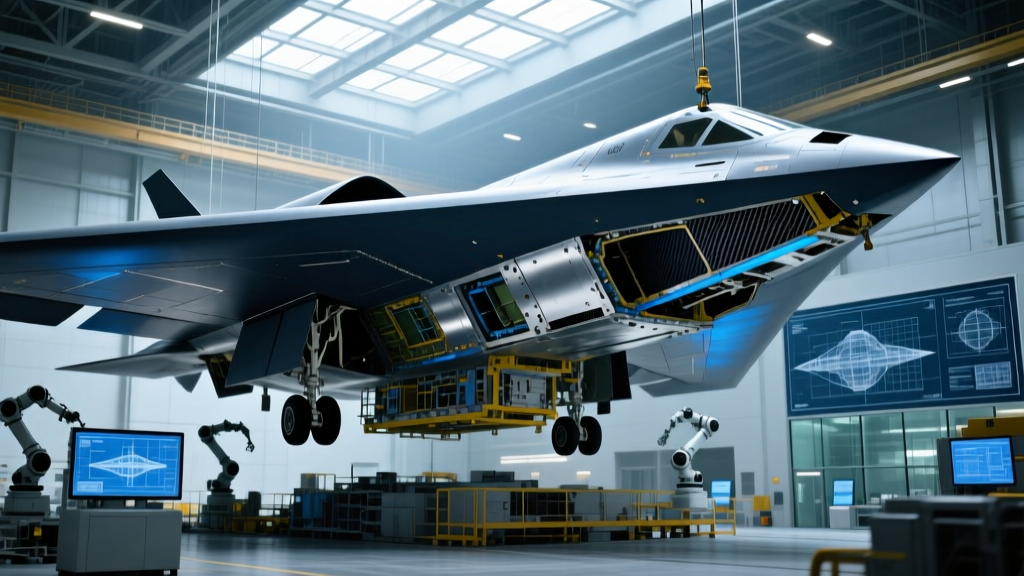
The Ultimate Mega-Project: B-2 Spirit Construction Economics
When analyzing the absolute apex of complex project financing and advanced material construction, aerospace manufacturing stands in a league of its own. For cost estimators and defense analysts, the question of how much does it cost to build a b2 bomber requires looking far beyond the raw assembly line. The Northrop Grumman B-2 Spirit is not merely an aircraft; it is a flying integration of advanced composites, radar-absorbent materials (RAM), and proprietary avionics, supported by billions in sunk research and development (R&D) costs.
To answer the baseline question: the flyaway cost (the marginal cost to manufacture one additional unit) was approximately $737 million per aircraft in 1997 dollars. However, when amortizing the total $44.75 billion program cost across the 21 units ultimately built, the effective cost per bomber ballooned to an unprecedented $2.13 billion. Understanding this discrepancy is critical for modern construction financing, as it highlights the massive financial risk of low-volume, high-complexity mega-projects.
Cost Estimator's Callout: Amortization vs. Flyaway
In traditional commercial construction, soft costs (architecture, engineering, permits) typically represent 15% to 25% of the total budget. In the B-2 program, R&D and tooling (the aerospace equivalent of soft costs) represented over 65% of the total program expenditure because the production run was slashed from an initially planned 132 aircraft down to just 21. This drastic reduction destroyed the economy of scale, making the B-2 the most expensive aircraft ever built on a per-unit basis.
Advanced Material and Manufacturing Cost Breakdown
The physical construction of the B-2 Spirit relies on materials that were, at the time of its development in the 1980s, largely experimental. Sourcing, fabricating, and curing these materials required entirely new supply chains and specialized manufacturing facilities.
| Material Category | Specific Application | Primary Cost Driver |
|---|---|---|
| Carbon-Epoxy Composites | Airframe skin, wing leading edges | Autoclave curing cycles, low-yield fabrication, high rejection rates during QA. |
| Titanium Alloys | Engine bays, exhaust troughs, structural load points | Extreme heat resistance requirements, difficult machining, raw material scarcity. |
| Radar-Absorbent Material (RAM) | Exterior coating, leading edges, intake baffles | Proprietary chemical formulations, labor-intensive hand-application, strict climate controls. |
| Gold-Filmed Polyimide | Cockpit canopy transparency | Prevents radar waves from entering the complex cockpit; requires precision vacuum deposition. |
According to the U.S. Air Force official B-2 Spirit fact sheet, the aircraft's low-observable (stealth) properties are derived from both its continuous flying-wing geometry and these specialized coatings. The application of RAM alone accounts for thousands of labor hours per airframe, as the material must be applied in precise thicknesses—often measured in thousandths of an inch—to effectively absorb specific radar frequencies.
Infrastructure: The Hidden Construction Cost of Stealth
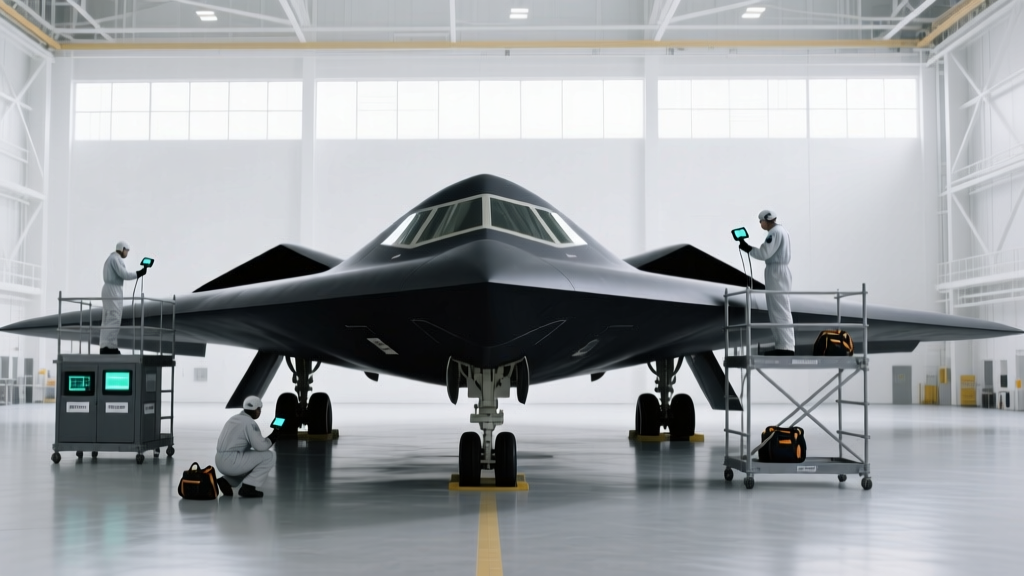
For construction professionals, the most relevant cost factor of the B-2 program extends beyond the aircraft itself to the specialized ground infrastructure required to house it. The B-2 cannot simply be parked on a standard concrete tarmac or housed in a conventional corrugated steel hangar.
Climate-Controlled Hangar Requirements
The radar-absorbent materials used on the B-2 are highly sensitive to environmental degradation. High humidity, extreme heat, and UV exposure can cause the RAM to blister, peel, or lose its dielectric properties. Consequently, every B-2 requires a dedicated, climate-controlled hangar.
- HVAC Specifications: These hangars require massive industrial dehumidification systems to maintain strict moisture thresholds, often keeping interior relative humidity below 40% year-round.
- Thermal Regulation: Heating and cooling systems must prevent the thermal expansion and contraction that stresses the composite-to-metal bonds on the airframe.
- RF Shielding: Maintenance facilities are often equipped with Radio Frequency (RF) shielding to allow technicians to safely test the aircraft's radar and avionics suites without emitting signals that could be detected by external sensors.
Constructing a single B-2 shelter involves specialized concrete foundations designed to bear the 336,500-pound maximum takeoff weight, integrated drainage systems for hazardous chemical runoff from RAM maintenance, and specialized ventilation for volatile organic compounds (VOCs). The construction cost for a single specialized stealth bomber hangar routinely exceeds $15 million to $25 million, a necessary capital expenditure that must be factored into the total basing footprint.
Defense Financing Mechanisms: Cost-Plus vs. Fixed-Price
The financing structure used to build the B-2 is a textbook case study in government procurement risks. The original B-2 contracts were largely structured as Cost-Plus-Fixed-Fee (CPFF) agreements. Under this financing model, the government reimbursed Northrop Grumman and its subcontractors for all allowable, reasonable, and allocable costs incurred during R&D and production, plus a guaranteed profit margin.
"Cost-plus contracting in low-volume aerospace manufacturing removes the financial incentive for the contractor to control material waste or optimize labor hours, directly leading to the massive per-unit cost overruns seen in the late 1980s and early 1990s."
Because the financial risk was entirely borne by the taxpayer, the contractors had little incentive to cap expenditures on experimental manufacturing techniques. When the end of the Cold War prompted Congress to slash the order from 132 to 21 aircraft, the fixed R&D costs were spread across a fraction of the intended units, resulting in the infamous $2.13 billion per-unit price tag.
Successor Benchmarking: The B-21 Raider Cost Cap
To understand modern aerospace construction financing, estimators must look at how the Department of Defense corrected the B-2's financial flaws with its successor, the B-21 Raider. Learning from the B-2's cost overruns, the Air Force mandated a strict cost cap for the B-21: approximately $550 million per unit in 2010 dollars (roughly $750 million adjusted for current inflation).
According to analysis outlined in the Congressional Research Service reports on the B-21 Raider, the Air Force achieved this through several structural financing shifts:
- Firm-Fixed-Price (FFP) Contracts: The engineering and manufacturing development (EMD) phase utilized fixed-price contracts, forcing Northrop Grumman to absorb cost overruns rather than passing them to the government.
- Open Architecture: Unlike the B-2, which required proprietary, expensive upgrades, the B-21 was designed with open-systems architecture, allowing cheaper third-party software and hardware integrations over its lifecycle.
- Manufacturing Readiness: The B-21 relies heavily on existing, mature composite curing technologies and automated tape-laying machines, avoiding the bespoke, hand-built manufacturing bottlenecks that plagued the B-2.
Key Takeaways for Extreme Construction Estimating
While most construction estimators will never price a stealth bomber, the B-2 program offers vital lessons for any complex, low-volume commercial or industrial mega-project:
- Protect the Economy of Scale: If a project's design and engineering (soft costs) are highly specialized, ensure the production run or facility footprint is large enough to amortize those costs effectively. A 70% reduction in planned volume will exponentially increase per-unit costs.
- Account for Lifecycle Infrastructure: The true cost of advanced materials (like specialized facade cladding or RAM) includes the environmental controls required to maintain them. Never estimate material costs without estimating the HVAC and facility requirements needed to preserve them.
- Align Contract Incentives: In design-build or cost-plus commercial contracts, implement shared-savings clauses to ensure the general contractor is financially motivated to optimize labor and reduce material waste during experimental construction phases.
For further reading on defense acquisition economics and historical cost assessments, the Government Accountability Office's defense acquisition portal provides extensive audits on how megaproject financing structures directly impact final construction and manufacturing deliverables.
Written by
Priya KapoorPriya Kapoor is a real estate market analyst and construction economics researcher with expertise in housing affordability, development feasibility, and infrastructure investment. She holds a Master of Regional Planning from Cornell University and previously worked as a senior analyst at CBRE's Investment Properties group, where she modeled returns for $4B in mixed-use development pipelines. Priya now runs an independent research practice advising developers, municipalities, and REITs on construction cost forecasting and market timing. She publishes the quarterly "BuildMat Market Pulse" report tracking material price indices across 12 commodity categories. Based in Austin, TX, Priya serves on the board of Habitat for Humanity Austin and is a marathon runner.
More from Priya Kapoor
View all
Construction Cost
Cost to Build a 1600 Sq Ft Home in 2026: Full Breakdown
Accurate 2026 cost to build a 1600 sq ft home—material, labor, and regional pricing breakdowns included. Plan your budget with real-time estimates.
Aug 11, 2026

Wood & Lumber
Name the Types of Wood for Pressure Treatment and Preservation
Learn how to name the types of wood best suited for pressure treatment. Compare species treatability, chemical retention levels, and 2026 preservation costs.
Aug 4, 2026

Stone & Masonry
Stone Veneer Suppliers Lindenhurst: 2026 Cost Analysis
Analyze 2026 stone veneer costs in Lindenhurst, NY. Compare local supplier pricing, delivery fees, and Suffolk County installation labor rates.
Aug 4, 2026