Cost to Build Home in Los Angeles: 2026 Price Breakdown
Discover the true cost to build home in Los Angeles in 2026. Detailed breakdown of hard costs, soft costs, LADBS fees, and hillside premiums.
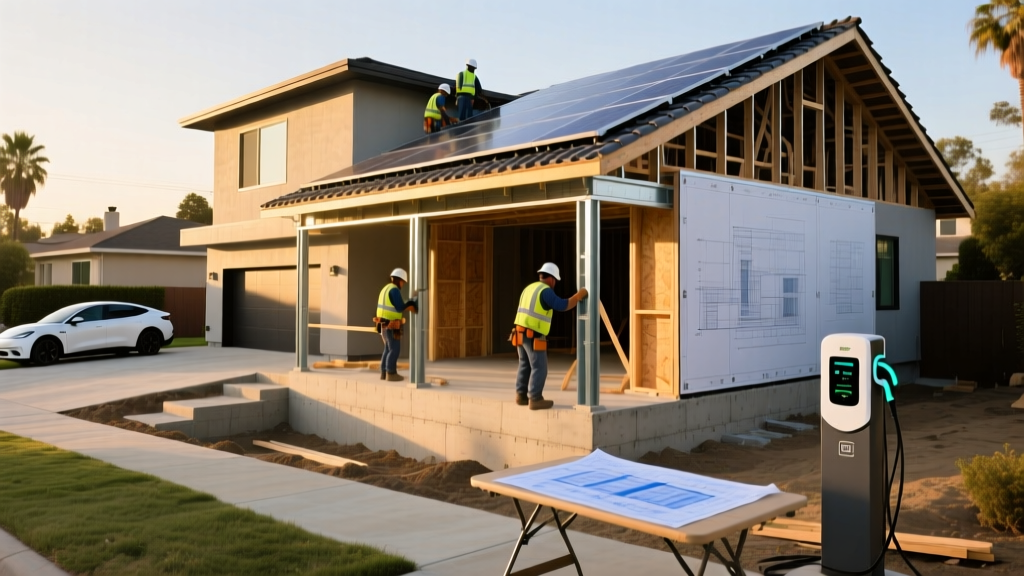
The Baseline: 2026 Construction Costs per Square Foot
Building a custom home in Los Angeles requires navigating a complex matrix of high labor rates, stringent environmental codes, and challenging topography. As of 2026, the cost to build home in Los Angeles ranges from $400 to $750+ per square foot for hard construction costs, excluding land acquisition. For a standard 2,500-square-foot single-family residence, expect to spend between $1,000,000 and $1,875,000 before factoring in soft costs, landscaping, or site-specific premiums.
2026 LA Quick Cost Snapshot
- Entry-Level Custom (Flat Lot, Standard Finishes): $400 - $480 / sq. ft.
- Mid-Tier Custom (Flat/Mild Slope, Premium Finishes): $500 - $620 / sq. ft.
- High-End Luxury (Hillside, Architectural Concrete/Glass): $650 - $850+ / sq. ft.
- Soft Costs (Permits, Design, Engineering): 18% - 25% of hard costs
Hard Cost Breakdown: Where the Money Goes
Hard costs represent the physical construction of the home. In the LA basin, material transport, prevailing wage requirements on certain tracts, and specialized seismic engineering push these baselines higher than the national average.
| Construction Phase | Cost Range (per sq. ft.) | LA-Specific Variables |
|---|---|---|
| Site Prep & Grading | $15 - $60+ | Hillside grading, soil export, retaining walls |
| Foundation | $30 - $55 | Grade beams, caissons for expansive soils |
| Framing & Structure | $65 - $110 | Steel moment frames, engineered lumber |
| Exterior Envelope | $45 - $85 | Fire-rated stucco, high-performance glazing |
| Roofing | $12 - $25 | Title 24 cool roof mandates, flat TPO systems |
| MEP (Mechanical, Electrical, Plumbing) | $55 - $85 | Solar PV integration, EV charging, heat pumps |
| Interior Finishes | $120 - $300+ | Custom millwork, natural stone, smart home tech |
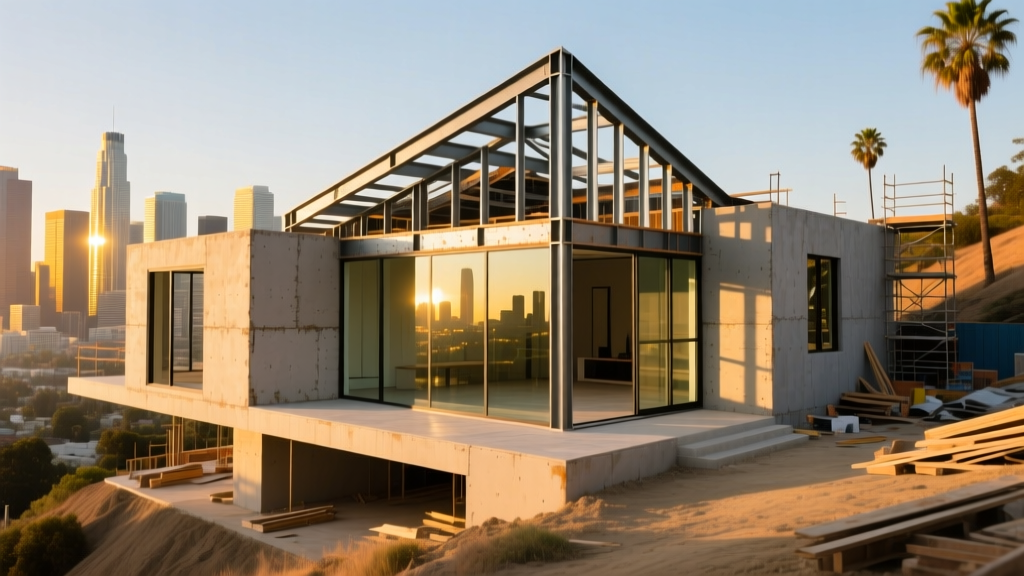
The 'LA Premium': Navigating Local Code and Topography
The base square-footage cost only tells half the story. Los Angeles imposes unique regulatory and geographical premiums that can easily add $100,000 to $300,000 to your budget.
Title 24 Energy Mandates & Solar Integration
California's Title 24 Building Energy Efficiency Standards dictate strict thermal and electrical requirements. Under the current code cycle enforced in 2026, all new low-rise residential builds must include a solar photovoltaic (PV) system sized to offset a significant portion of the home's electrical load. Furthermore, battery storage readiness is now heavily scrutinized during plan check. Expect to allocate $25,000 to $40,000 for a fully compliant solar array and upgraded electrical panels (often 400-amp service) to support heat pump HVAC systems and EV charging.
According to the California Energy Commission, the shift toward mandatory electrification and solar integration adds upfront capital costs but significantly reduces long-term operational expenses in Southern California's high-tariff utility zones.
Seismic Retrofitting & Structural Steel
Los Angeles sits on a complex fault network. While wood framing is common in the broader US, many LA architects and structural engineers specify structural steel moment frames or heavily reinforced concrete shear walls to resist lateral seismic loads. A single custom steel moment frame can cost $15,000 to $25,000 installed, and a luxury home may require four or more to accommodate open-concept floor plans with massive glass expanses.
Hillside Grading & LADBS Expediting
If your lot is in the Hollywood Hills, Sherman Oaks, or the Palisades, you are subject to the LADBS Hillside Grading Ordinance. This requires extensive geotechnical soil reports, compaction testing, and engineered retaining walls (often shotcrete or cast-in-place).
Los Angeles has strict regulations regarding soil import/export. Hauling away 1,000 cubic yards of dirt from a hillside site can cost upwards of $45,000 in trucking and disposal fees alone. Designing a 'balanced site' where cut-and-fill earth volumes match is a critical cost-saving strategy.
Site Topography Cost Matrix
The physical slope of your lot is the single largest variable in LA site work. Use this matrix to estimate your foundational risk:
| Lot Type | Slope Grade | Foundation Type Required | Estimated Site Prep Premium |
|---|---|---|---|
| Flat Inland | < 5% | Slab-on-grade or standard stem wall | Base Cost ($0 premium) |
| Mild Upslope | 5% - 15% | Stepped footings, minor retaining | +$40,000 - $75,000 |
| Steep Downslope | > 15% | Deep caissons, grade beams, pilings | +$120,000 - $250,000+ |
| Coastal Bluff | Variable | Mat slab, tie-backs, drainage systems | +$150,000 - $300,000+ |
Material Selections for Fire Zones and Coastal Air
Material selection in LA must balance aesthetics with survival. If you are building in a Very High Fire Hazard Severity Zone (VHFHSZ) like Topanga Canyon or Griffith Park, the Wildland-Urban Interface (WUI) code mandates specific exterior materials.
- Siding: Avoid wood clapboard. Specify James Hardie fiber cement siding or three-coat traditional Portland cement stucco. Both offer a 1-hour fire rating and resist ember intrusion.
- Windows: Dual-pane tempered glass is mandatory in WUI zones. For coastal properties (Malibu, Venice), specify anodized aluminum frames with marine-grade finishes to prevent salt-air pitting and corrosion.
- Decking: Composite decking (like Trex Transcend) or heavy timber (Ipe) are preferred. Avoid untreated pine or cedar, which act as kindling during Santa Ana wind events.
Soft Costs: The Hidden Budget Killers
Industry data from the National Association of Home Builders (NAHB) consistently highlights that soft costs are rising faster than material costs. In Los Angeles, soft costs routinely consume 20% to 25% of your total project budget.
- Architectural & Design Fees: 8% to 15% of construction costs. Complex hillside geometry pushes this toward the higher end.
- Structural & Geotechnical Engineering: $15,000 to $45,000. Soil borings and peer-reviewed structural calculations are non-negotiable for LADBS approval.
- LADBS Permit Fees: Calculated via valuation formulas. Expect to pay $40,000 to $85,000 in municipal fees for a luxury custom build, plus school district developer fees.
- Insurance & Liability: Builder's risk and general liability insurance premiums have spiked in California due to wildfire risks and litigation environments.
Frequently Asked Questions
Does building an ADU cost the same per square foot as the main home?
No. Accessory Dwelling Units (ADUs) in Los Angeles typically cost $500 to $700 per square foot. While the absolute cost is lower, the per-square-foot cost is higher because you are duplicating expensive fixed costs (kitchen, bathroom, utility hookups, Title 24 solar panels) across a much smaller footprint. A 600 sq. ft. ADU will likely cost between $300,000 and $420,000 turnkey.
How long does it take to build a custom home in LA?
Expect a timeline of 24 to 36 months from land acquisition to move-in. The design and LADBS permitting phase alone takes 9 to 14 months. Physical construction takes 12 to 18 months. Hillside projects or those requiring Coastal Commission approval can easily push the timeline past 40 months.
Are modular or prefab homes cheaper to build in Los Angeles?
Prefabricated homes can reduce on-site labor time by 30%, but they do not bypass LADBS foundation requirements, Title 24 energy codes, or hillside grading ordinances. While the 'box' may be cheaper, the site prep, crane rentals (often $15,000+ per day in tight LA streets), and soft costs remain high. Expect a maximum savings of 10% to 15% compared to traditional stick-built methods, primarily in flat inland lots.
Written by
Priya KapoorPriya Kapoor is a real estate market analyst and construction economics researcher with expertise in housing affordability, development feasibility, and infrastructure investment. She holds a Master of Regional Planning from Cornell University and previously worked as a senior analyst at CBRE's Investment Properties group, where she modeled returns for $4B in mixed-use development pipelines. Priya now runs an independent research practice advising developers, municipalities, and REITs on construction cost forecasting and market timing. She publishes the quarterly "BuildMat Market Pulse" report tracking material price indices across 12 commodity categories. Based in Austin, TX, Priya serves on the board of Habitat for Humanity Austin and is a marathon runner.
More from Priya Kapoor
View all
Construction Cost
Cost to Build a 1600 Sq Ft Home in 2026: Full Breakdown
Accurate 2026 cost to build a 1600 sq ft home—material, labor, and regional pricing breakdowns included. Plan your budget with real-time estimates.
Aug 11, 2026

Wood & Lumber
Name the Types of Wood for Pressure Treatment and Preservation
Learn how to name the types of wood best suited for pressure treatment. Compare species treatability, chemical retention levels, and 2026 preservation costs.
Aug 4, 2026

Stone & Masonry
Stone Veneer Suppliers Lindenhurst: 2026 Cost Analysis
Analyze 2026 stone veneer costs in Lindenhurst, NY. Compare local supplier pricing, delivery fees, and Suffolk County installation labor rates.
Aug 4, 2026