How Much Does It Cost to Build a Baseball Field? (Size Guide)
Calculate baseball field construction costs by size and scope. Explore pricing for drainage, turf, lighting, and infield mixes for youth to pro levels.
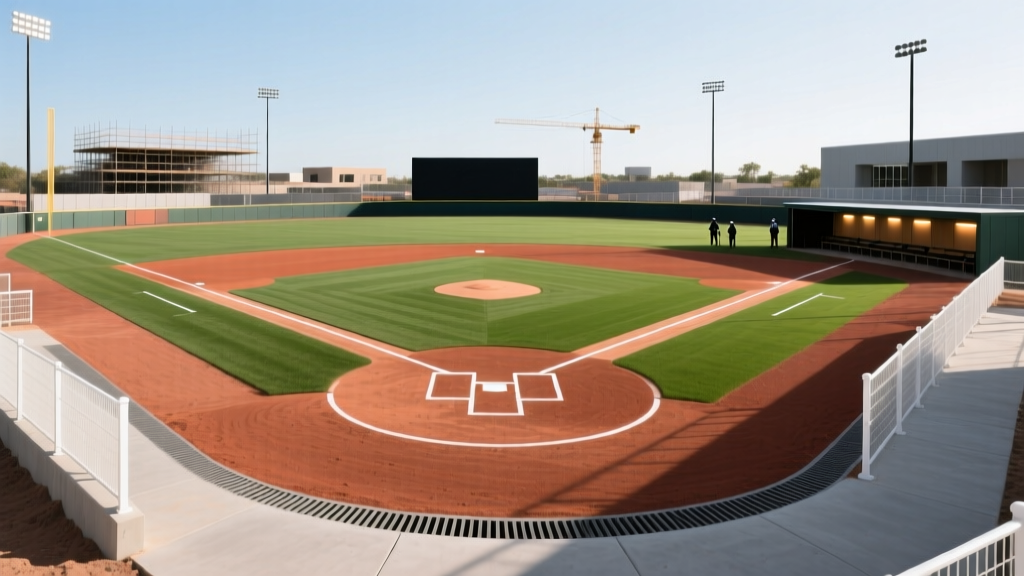
The True Scope of Baseball Field Construction
Estimating the cost to build a baseball field requires moving beyond simple square-footage calculations. A baseball diamond is a complex integration of precision agronomy, civil drainage engineering, and specialized sports architecture. When stakeholders ask how much does it cost to build a baseball field, the answer hinges entirely on the size, scope, and performance tier of the facility. A basic community youth field with native soil and minimal fencing can be realized for under $60,000, whereas a NCAA Division I or professional-grade facility featuring synthetic turf, subsurface heating, and broadcast-quality LED lighting routinely exceeds $3.5 million.
Quick Cost Summary by Facility Tier
- Youth / Little League (Basic): $45,000 – $120,000
- High School (Mid-Tier): $250,000 – $650,000
- College / Elite (High-Tier): $1,200,000 – $3,500,000+
Note: Land acquisition and site clearing are excluded from these baseline construction estimates.
Size & Scope Calculator: Breaking Down the Dimensions
The physical footprint of the field dictates the volume of materials required for earthwork, turfing, and fencing. According to the Little League International Field Specifications, youth fields require significantly less outfield territory and a smaller infield arc than high school or collegiate diamonds. Below is a matrix detailing the standard dimensions and the resulting approximate turfable acreage for each scope level.
| Facility Tier | Base Paths | Outfield Fence | Total Turf Area | Est. Base Cost |
|---|---|---|---|---|
| Youth (Ages 9-12) | 60 feet | 200 feet | ~1.5 Acres | $45k - $120k |
| High School | 90 feet | 325+ feet | ~3.0 Acres | $250k - $650k |
| College / Pro | 90 feet | 330-400 feet | ~4.5 Acres | $1.2M - $3.5M+ |
Core Cost Drivers: Where the Budget Goes
To build an accurate size and scope calculator for your project, you must isolate the primary cost centers. The most expensive phases of baseball field construction are not the visible elements like dugouts or scoreboards; they are the subsurface engineering and the playing surface itself.
1. Earthwork, Grading, and Drainage
A baseball field must be laser-graded to a tolerance of ±0.25 inches to ensure proper surface runoff without altering the true bounce of a ground ball. For high school and collegiate fields, this requires GPS-guided dozers and specialized laser-grading equipment. Subsurface drainage is non-negotiable for competitive fields. Contractors typically install a herringbone pattern of 4-inch corrugated, perforated HDPE pipe, enveloped in washed gravel and topped with ASTM C33 specification sand. This drainage matrix alone can cost between $35,000 and $85,000 for a standard high school outfield, but it prevents catastrophic soil compaction and standing water.
2. Turfgrass vs. Synthetic Turf Systems
The choice between natural grass and synthetic turf represents the largest single variable in your budget.
- Natural Turf: High-traffic sports fields require aggressive, wear-tolerant cultivars. In warm climates, Tifway 419 or Latitude 36 Bermudagrass is standard, installed via sprigging or sodding at a cost of $0.75 to $1.50 per square foot. In cool climates, Kentucky Bluegrass and Perennial Ryegrass blends are used. Ongoing agronomic maintenance (aeration, topdressing, fertilization) adds $15,000 to $30,000 annually.
- Synthetic Turf: Modern synthetic systems (e.g., FieldTurf Classic HD or AstroTurf Diamond) cost between $8.00 and $12.00 per square foot installed. For a 3-acre high school field, expect to pay $1,000,000 to $1,500,000 upfront. However, as of 2026, the industry is rapidly shifting away from traditional crumb rubber infill due to environmental and health regulations. Facilities are now opting for organic infills like cork, coconut fiber, or engineered sand alternatives like Envirofill, which can increase material costs by 15% to 20% but offer superior cooling and safety profiles. For a deeper understanding of turf management and selection, the University of Minnesota Turfgrass Science program provides extensive, up-to-date research on cultivar performance and soil dynamics.
3. Infield Soils and Warning Tracks
The infield dirt is not native topsoil; it is a highly engineered blend. A standard professional infield mix consists of approximately 60% sand, 20% silt, and 20% clay. To stabilize the clay and improve moisture retention, groundskeepers incorporate calcined clay amendments like Turface MVP or vitrified clay like Profile G2. An engineered infield mix costs $80 to $120 per ton, and a high school diamond requires roughly 150 to 200 tons. The warning track—a 15-foot-wide perimeter designed to provide tactile feedback to outfielders—is typically constructed from crushed aggregate, such as decomposed granite or specialized calcined clay, costing $4.00 to $6.00 per square foot.
Lighting, Fencing, and Ancillary Structures
Beyond the playing surface, the perimeter and vertical infrastructure demand significant capital allocation.
Fencing costs scale linearly with the field's perimeter. A standard chain-link outfield fence (20 feet high for high school/college) costs $45 to $75 per linear foot. However, modern safety standards mandate the installation of high-density polyethylene (HDPE) padding on all outfield walls and foul poles, adding $30 to $50 per linear foot. Dugouts range from basic $15,000 pre-fabricated aluminum structures to $150,000+ excavated, concrete-reinforced dugouts with integrated netting and equipment storage.
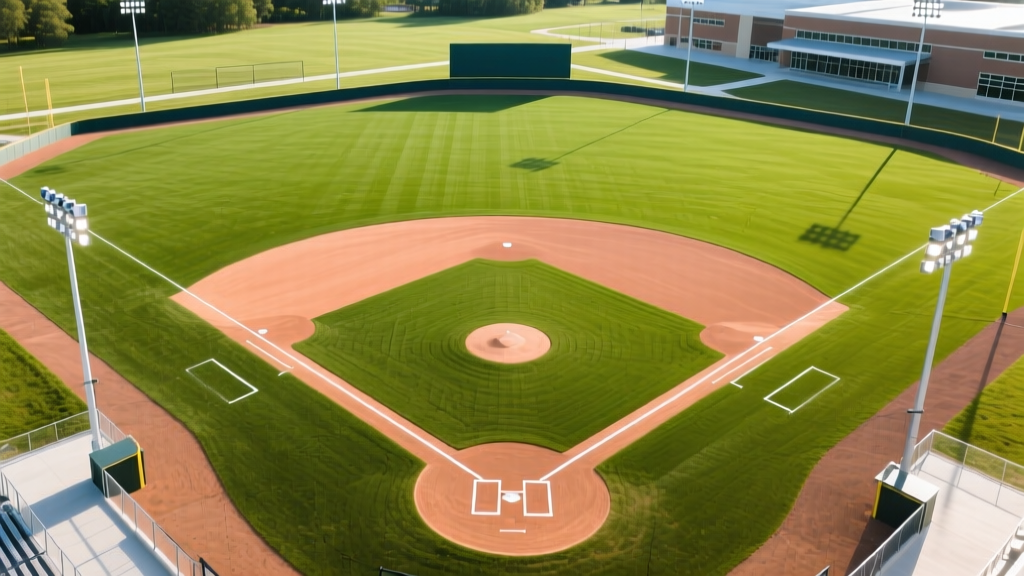
Hidden Costs and Edge Cases
When calculating the total scope, project managers frequently overlook site-specific geological and logistical edge cases that can inflate the budget by 20% or more.
"Never skip the geotechnical soil boring phase. If your site contains expansive clays or a high water table, the cost of importing engineered fill and installing deep French drains can easily double your initial earthwork estimate. Designing a field based on assumed soil conditions is the most common cause of budget overruns in municipal sports projects."
Additional hidden costs include:
- Utility Trenching: Running dedicated 480V electrical service for stadium lighting and water mains for automated irrigation systems (like Toro or Hunter) can add $30,000 to $80,000 if municipal tie-ins are distant.
- Bullpens and Batting Cages: Constructing auxiliary practice areas with synthetic turf mounds and netting enclosures typically adds $40,000 to $90,000 to the overall project scope.
- Scoreboards and Audio: A basic LED scoreboard starts around $25,000, but adding video-board capabilities, DAC audio systems, and Wi-Fi infrastructure for live streaming pushes this line item well past $150,000.
Step-by-Step Estimating Framework
To finalize your size and scope calculator, follow this sequential estimating framework to ensure no critical phase is omitted from your budget:
- Geotech & Surveying (2-4% of budget): Soil borings, topographical mapping, and boundary surveys.
- Sitework & Drainage (15-25%): Clearing, cut/fill balancing, laser grading, and subsurface HDPE pipe installation.
- Playing Surface (30-45%): Natural sod/sprigging or synthetic turf installation, including infield mix and warning track aggregates.
- Vertical Infrastructure (15-20%): Fencing, wind screens, wall padding, dugouts, and backstops.
- Electrical & Tech (10-20%): LED lighting poles, irrigation control systems, scoreboards, and PA systems.
- Contingency (10%): Reserved for weather delays, material price escalation, and unforeseen subgrade remediation.
By isolating these variables and applying current material costs to your specific field dimensions, you can generate a highly accurate, data-driven construction estimate that withstands the scrutiny of municipal boards and athletic directors alike.
Written by
David NakamuraDavid Nakamura is a licensed architect (AIA) and construction technology writer focused on sustainable building methods, mass timber engineering, and high-performance building envelopes. He holds a Master of Architecture from the University of Washington and is a certified Passive House Consultant (CPHC). David spent eight years at the Seattle firm Mithun, where he led the design of three LEED Platinum projects, before founding his own practice specializing in net-zero residential design. He serves on the editorial advisory board of GreenBuilder Magazine and has authored peer-reviewed papers on cross-laminated timber (CLT) connections for the Journal of Structural Engineering. In his spare time, David teaches woodworking at Pratt Fine Arts Center and kayaks the Puget Sound.
More from David Nakamura
View all
Construction Cost
Labor Cost to Build a Deck Per Sq Ft: 2026 Installation Guide
Discover the exact labor cost to build a deck per sq ft in 2026. This installation guide breaks down contractor rates, complexity factors, and hidden fees.
Aug 4, 2026

Construction Cost
How Much Does It Cost to Build a 3 Bedroom House? Financing Guide
Learn exactly how much it costs to build a 3 bedroom house and explore 2026 financing options, construction loan types, and budget frameworks for your build.
Aug 4, 2026

Construction Cost
Cost to Build a Tennis Court: 2026 Guide
How much does it cost to build a tennis court in 2026? Breakdowns for asphalt, concrete, and synthetic surfaces plus fencing and lighting.
Jul 30, 2026