How Much Does It Cost to Build a Bowling Alley? Savings Guide
Discover how much it costs to build a bowling alley. Explore per-lane pricing, equipment options, and expert money-saving strategies for your build.
The True Cost Breakdown: Per-Lane vs. Total Build-Out
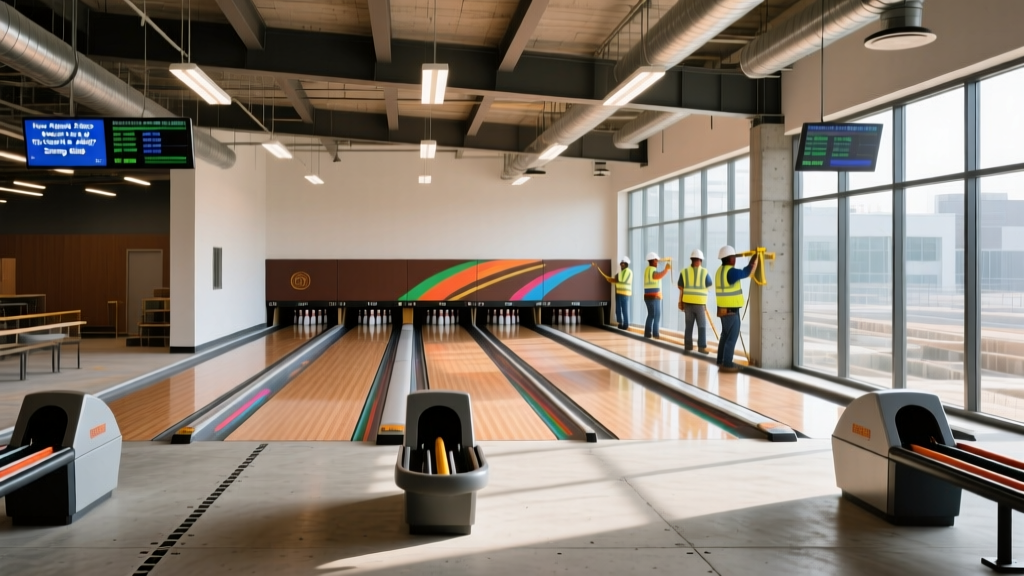
When evaluating how much does it cost to build a bowling alley, the most common mistake investors make is conflating lane equipment costs with total facility build-out expenses. The bowling equipment itself—lanes, pinsetters, ball returns, and scoring systems—represents only 40% to 50% of the total capital expenditure. The remainder covers site preparation, HVAC, acoustic treatments, lighting, and front-of-house amenities.
According to industry data tracked by the Bowling Proprietors' Association of America (BPAA), the baseline cost for commercial bowling lane equipment ranges from $45,000 to $75,000 per lane. However, a fully realized venue requires a much broader budget.
| Facility Type | Lane Count | Equipment Cost (Est.) | Total Build-Out Cost (Est.) |
|---|---|---|---|
| Residential / Home | 1 - 2 | $90,000 - $150,000 | $120,000 - $250,000 |
| Boutique / Entertainment Center | 4 - 8 | $250,000 - $500,000 | $800,000 - $1,500,000 |
| Traditional Commercial Center | 12 - 24 | $600,000 - $1,500,000 | $1,800,000 - $3,500,000+ |
Equipment Selection: Where the Budget is Won or Lost
The specific hardware you choose dictates not only your initial capital outlay but your long-term operational expenditure (OpEx). The market is dominated by two primary manufacturers: Brunswick Bowling and QubicaAMF. Understanding the mechanical differences between their product lines is critical for cost optimization.
Pinsetters: Free-Fall vs. String Technology
Traditional free-fall pinsetters (like the Brunswick GSX) use a complex system of mechanical arms, belts, and sweeps to clear and reset pins. They cost between $45,000 and $60,000 per lane installed. String pinsetters, which attach durable nylon cords to the pins, cost significantly less—typically $25,000 to $35,000 per lane.
OpEx Insight: The String Pinsetter Advantage
While purists debate the physics of string pins, the financial case is undeniable. String pinsetters use up to 75% less electricity, require no heavy-duty pit air conditioning, and reduce mechanical maintenance labor by roughly 60%. For a 10-lane center, switching from free-fall to string pinsetters can save $15,000 to $22,000 annually in utility and maintenance costs.
Lane Surfaces: Synthetic vs. Wood
Maple and pine wood lanes require annual sanding, re-lacquering, and daily oiling. Synthetic lanes, such as the Brunswick Anvilane or QubicaAMF HPL, cost roughly $12,000 to $18,000 per lane upfront but eliminate the need for resurfacing. Over a 15-year lifecycle, synthetic lanes save approximately $15,000 per lane in maintenance materials and specialized labor.
5 Proven Money-Saving Strategies for Bowling Alley Construction
To maximize ROI without sacrificing the guest experience, implement these targeted cost-reduction strategies during the design and procurement phases.
- Procure Certified Refurbished Free-Fall Equipment: If your target demographic demands traditional free-fall pinsetters, avoid buying new. The secondary market is flooded with well-maintained GSX and AMF 82-90XL machines from closing centers. A certified refurbished pinsetter, overhauled by a licensed technician, costs 40% to 50% less than new equipment and carries a comparable warranty.
- Optimize Ceiling Heights for String Pinsetters: Free-fall pinsetters require a minimum ceiling clearance of 10 to 11 feet in the pin deck area to accommodate the elevator mechanism. String pinsetters require only 7.5 to 8 feet. By designing a lower roofline over the back-of-house machine area, you can save $30,000 to $50,000 on structural steel and roofing materials in a new build.
- Implement Modular HVAC Zoning: Pinsetters generate significant heat, but the bowling approach and seating areas do not. Instead of sizing a single massive RTU (Roof Top Unit) for the entire space, use a VRF (Variable Refrigerant Flow) system. Zone the pinsetter pits with dedicated spot-cooling and the front-of-house with standard comfort cooling. This reduces initial HVAC CapEx by 20% and cuts monthly energy bills.
- Use Polished Concrete in Non-Lane Zones: Traditional bowling centers use expensive vinyl composition tile (VCT) or carpet in the concourse and seating areas. High-end polished and dyed concrete costs $4 to $7 per square foot installed, compared to $8 to $14 for commercial carpet or luxury vinyl plank. It also eliminates stripping and waxing maintenance.
- Lease Scoring and POS Systems: Modern scoring systems like the QubicaAMF BES X or Brunswick Sync require expensive local servers, touchscreens, and overhead monitors. Instead of purchasing outright ($8,000 to $12,000 per lane), lease the technology. This preserves your working capital for revenue-generating assets like bars and kitchens, while ensuring free hardware upgrades every 3 to 5 years.
Hidden Costs and Edge Cases to Anticipate
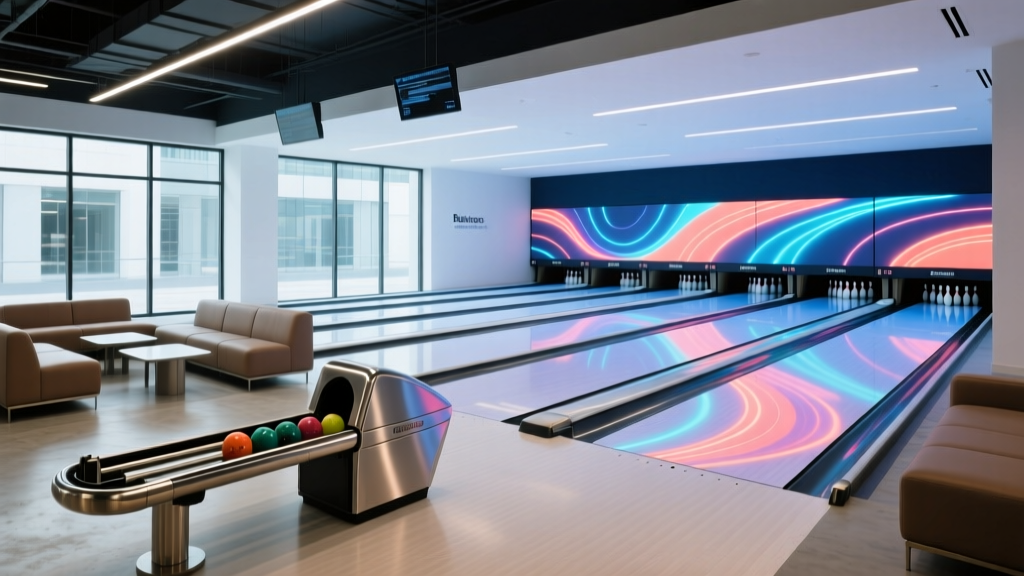
Budget overruns in bowling center construction rarely stem from the lanes themselves. They originate in the facility infrastructure. Factor these specific line items into your initial pro forma:
- Floor Trenching and Under-Lane Wiring: Modern scoring and security systems require extensive low-voltage wiring. Trenching a concrete slab to run conduit under the lanes costs $1,500 to $2,500 per lane if not coordinated before the foundation is poured.
- Acoustic Treatments: A busy bowling center generates ambient noise levels between 85 and 95 decibels. To prevent sound bleed into adjacent retail spaces or residential zones, you must install acoustic baffles, mass-loaded vinyl (MLV) in the walls, and specialized drop ceilings. Budget $3 to $5 per square foot for comprehensive sound attenuation.
- Heavy-Duty Electrical Service: A 12-lane center with traditional pinsetters, kitchen equipment, and arcade games typically requires a 1,200 to 1,600 amp, 3-phase electrical service. Upgrading a standard commercial pad from 400 amps to 1,600 amps can cost $40,000 to $80,000 in utility tap fees and transformer installations.
- Ball Return Trenching: If utilizing traditional under-floor ball returns, the sub-floor must be excavated to a depth of 18 to 24 inches. If building on a high-water-table site, this requires expensive waterproofing and sump pump systems to prevent flooded ball returns.
Phased Build-Out Framework
If capital is constrained, do not compromise on the quality of the first few lanes. Instead, use a phased build-out strategy. This allows you to open faster, generate cash flow, and fund expansion internally.
| Phase | Scope of Work | Estimated Timeline | Capital Allocation |
|---|---|---|---|
| Phase 1: Core Launch | Build out 4-6 lanes, bar, kitchen, and essential restrooms. Install infrastructure (HVAC/Elec) for full 12-lane capacity. | 6 - 8 Months | 65% of Total Budget |
| Phase 2: Capacity Expansion | Install remaining 4-6 lanes and seating. Activate pre-installed HVAC zones. | Month 18 - 24 | 25% of Total Budget |
| Phase 3: Ancillary Revenue | Add arcade, laser tag, or private event rooms utilizing remaining square footage. | Year 3+ | 10% of Total Budget |
Critical Warning: Infrastructure Oversizing
When executing a phased build, you must oversize your foundational infrastructure during Phase 1. Upgrading an electrical panel, expanding a grease trap, or replacing an HVAC compressor after the facility is open will cost 3x to 4x more than installing the larger capacity during initial construction. Pour the full foundation and run the main conduit immediately; only defer the interior finish-outs and lane installations.
Finalizing Your Pro Forma
Accurately forecasting how much does it cost to build a bowling alley requires moving beyond per-lane averages. By selecting string pinsetter technology, leveraging synthetic lane surfaces, and implementing modular infrastructure, developers can reduce initial CapEx by up to 30% while simultaneously lowering long-term OpEx. Consult with a specialized bowling architect and review current equipment lead times—often stretching 6 to 9 months for new manufacturing—to ensure your financial model aligns with real-world supply chain constraints.
Written by
David NakamuraDavid Nakamura is a licensed architect (AIA) and construction technology writer focused on sustainable building methods, mass timber engineering, and high-performance building envelopes. He holds a Master of Architecture from the University of Washington and is a certified Passive House Consultant (CPHC). David spent eight years at the Seattle firm Mithun, where he led the design of three LEED Platinum projects, before founding his own practice specializing in net-zero residential design. He serves on the editorial advisory board of GreenBuilder Magazine and has authored peer-reviewed papers on cross-laminated timber (CLT) connections for the Journal of Structural Engineering. In his spare time, David teaches woodworking at Pratt Fine Arts Center and kayaks the Puget Sound.
More from David Nakamura
View all
Construction Cost
Labor Cost to Build a Deck Per Sq Ft: 2026 Installation Guide
Discover the exact labor cost to build a deck per sq ft in 2026. This installation guide breaks down contractor rates, complexity factors, and hidden fees.
Aug 4, 2026

Construction Cost
How Much Does It Cost to Build a 3 Bedroom House? Financing Guide
Learn exactly how much it costs to build a 3 bedroom house and explore 2026 financing options, construction loan types, and budget frameworks for your build.
Aug 4, 2026

Construction Cost
Cost to Build a Tennis Court: 2026 Guide
How much does it cost to build a tennis court in 2026? Breakdowns for asphalt, concrete, and synthetic surfaces plus fencing and lighting.
Jul 30, 2026