Cost to Build a Built-In Bookcase: Complete Material & Labor Breakdown
Discover the exact cost to build a built-in bookcase. We break down material prices, labor rates, MDF vs. plywood choices, and hidden hardware expenses.
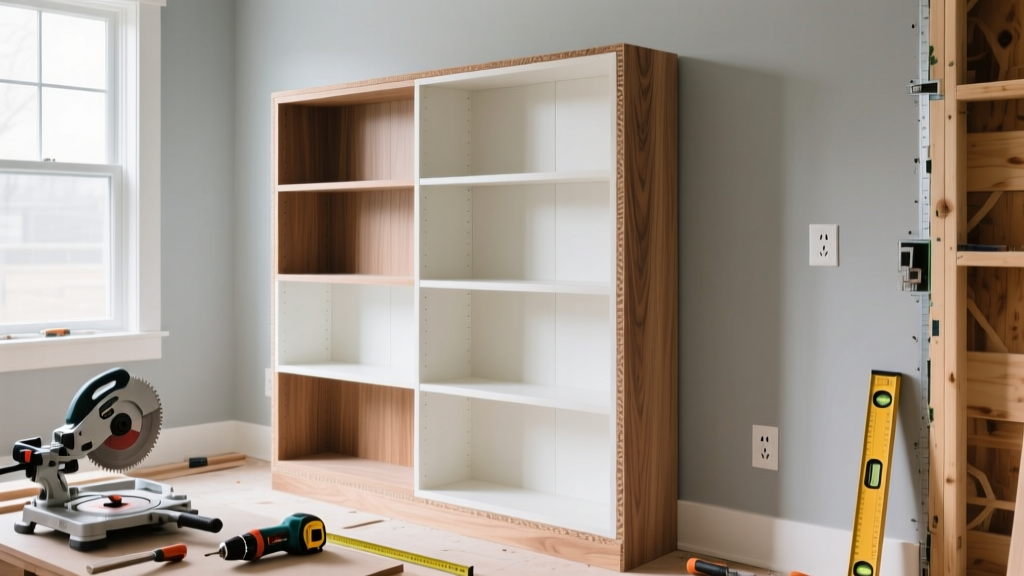
The Anatomy of Built-In Bookcase Pricing
Calculating the true cost to build a built-in bookcase requires moving beyond superficial square-footage estimates. Custom built-ins are priced based on linear width, material grade, structural complexity, and site-specific installation challenges. For a standard 8-foot wide, 8-foot tall wall unit featuring a mix of open shelving and closed base cabinets, homeowners typically spend between $2,200 and $5,500 in 2026. High-end architectural millwork utilizing solid hardwoods and custom lighting can easily push this figure past $8,500.
- Economy (MDF, Painted, Basic Hardware): $150 - $225 / linear ft.
- Mid-Range (Prefinished Plywood, Veneer Edgebanding): $250 - $375 / linear ft.
- Premium (Solid Hardwood, Custom Stain, Integrated Lighting): $400 - $650+ / linear ft.
Material Costs: Sheet Goods and Edge Banding
The primary cost driver is the sheet good used for the carcases (the structural boxes). Standard 4x8 sheets dictate your yield and waste factor. When estimating, always add a 15% waste factor for complex cuts and scribing.
| Material | Cost per 4x8 Sheet | Best Application | Edge Treatment Required |
|---|---|---|---|
| 3/4' MDF | $45 - $65 | Painted built-ins, smooth finish | Painted MDF banding or wood trim |
| 3/4' Prefinished Maple Plywood | $95 - $140 | Stained or clear-coated interiors | Iron-on veneer or PVC edgebanding |
| 3/4' Red Oak Hardwood Plywood | $110 - $160 | Traditional stained library walls | Solid hardwood face frames |
| Solid Hardwood (Poplar/Paint Grade) | $180 - $250+ | Face frames, thick shelf nosings | N/A (Solid wood) |
If you choose MDF for painted bookcases to save money, never use a water-based primer. MDF acts like a sponge and the exposed edges will swell, ruining the smooth profile. Always seal MDF edges with a solvent-based shellac primer like Zinsser B-I-N before applying your topcoat.
Hardware and Fasteners: The Hidden Expenses
Amateur estimators often forget hardware, which can consume 10% to 15% of the total material budget. Commercial-grade hardware ensures shelves do not sag and doors remain aligned over decades of use.
- Shelf Supports: Standard metal spoon pins cost pennies, but for a premium built-in, use Knape & Vogt (KV) 255 ANO concealed shelf supports or Hafele hidden shelf pins ($0.85 - $1.50 per pair). You will need 4 per adjustable shelf.
- Cabinetry Screws: Use Kreg 1-1/4' fine-thread pocket screws for plywood ($0.04 each) and coarse-thread for MDF. For structural joining to wall studs, 3-1/2' GRK Fasteners RSS structural screws ($0.45 each) provide superior shear strength compared to standard lag bolts.
- Face Frame Joinery: If building traditional face frames, Festool Domino tenons or standard biscuit joiners add $1.50 to $3.00 per joint in consumable costs but drastically reduce assembly time and prevent seasonal wood movement gaps.
- Lighting: Integrating WAC Lighting LED strip channels with recessed aluminum extrusions adds roughly $25 to $40 per linear foot of shelf, plus transformer costs.
Labor Rates and Installation Timelines
According to the U.S. Bureau of Labor Statistics, the median wage for carpenters hovers around $26.50 per hour, but licensed finish carpenters and custom millwork installers typically charge $75 to $135 per hour for residential built-in projects. Labor is generally calculated based on the complexity of the scribing and site conditions.
| Project Phase | Estimated Hours (10ft Unit) | Labor Cost (@ $95/hr) |
|---|---|---|
| Design, Cut List & Sheet Breakdown | 4 - 6 hours | $380 - $570 |
| Carcass & Face Frame Fabrication (Shop) | 12 - 18 hours | $1,140 - $1,710 |
| Finishing (Spray Booth / Off-site) | 8 - 12 hours | $760 - $1,140 |
| On-site Installation, Leveling & Scribing | 8 - 14 hours | $760 - $1,330 |
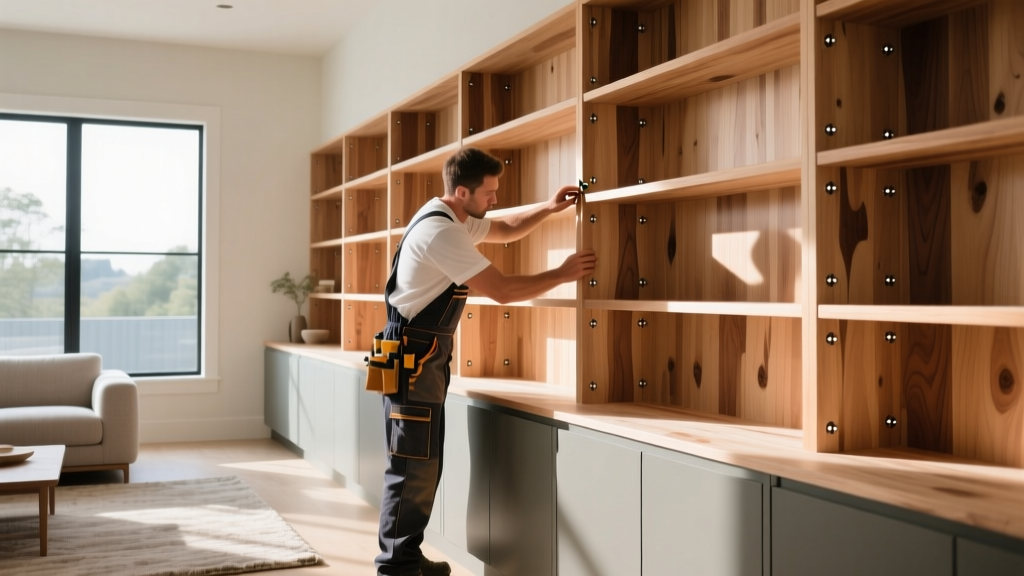
The most labor-intensive phase is on-site scribing. According to the Architectural Woodwork Institute (AWI) standards, premium custom millwork requires tight tolerances (often 1/32' or less) where the woodwork meets uneven drywall or plaster. If your walls are out of plumb by more than 1/4 inch, expect the installer to spend an additional 4 to 6 hours scribing filler strips and modifying crown molding.
Finishing: Paint, Stain, and Clear Coats
Site-finished built-ins are largely obsolete in high-end construction due to dust contamination and VOC exposure. Professional shops spray components off-site. For painted MDF or Poplar built-ins, a catalyzed polyurethane or high-quality waterborne alkyd is mandatory for shelf durability. Standard latex wall paint will peel off shelves when books are dragged across them.
- Primer: Zinsser B-I-N Shellac (MDF) or Zinsser Cover Stain (Wood). Cost: ~$95/gallon.
- Topcoat (Painted): Benjamin Moore Advance (Waterborne Alkyd) or Milesi Polyurethane. Cost: $110 - $140/gallon. Provides a hard, furniture-grade shell.
- Topcoat (Stained): Conversion varnish or post-catalyzed lacquer. Cost: $150+/gallon. Requires professional HVLP spraying equipment and proper ventilation.
When selecting finishes, ensure compliance with indoor air quality standards. The Environmental Protection Agency (EPA) notes that off-gassing from VOCs in inferior coatings can impact indoor air quality for months; factory-cured catalyzed finishes eliminate this issue entirely.
Step-by-Step Cost Scenario: 10-Foot Wide Wall Unit
To visualize the cost to build a built-in bookcase, consider a 10-foot wide, 9-foot tall unit. It features 24-inch deep base cabinets with doors, and 12-inch deep open upper shelves with a solid poplar face frame, painted off-white.
- Base Materials (Sheet Goods & Lumber): 6 sheets of 3/4' MDF ($55/ea), 2 sheets of 1/2' MDF for cabinet backs, 40 board feet of Poplar for face frames and shelf nosing. Subtotal: $750
- Hardware & Consumables: Blum soft-close hinges, KV shelf pins, Kreg screws, wood glue, sandpaper, pocket hole plugs. Subtotal: $320
- Finishing Materials: 2 gallons shellac primer, 3 gallons waterborne alkyd topcoat, caulk. Subtotal: $480
- Shop Labor (Fabrication & Finishing): 25 hours @ $95/hr. Subtotal: $2,375
- Site Installation Labor: 10 hours @ $95/hr (includes leveling base cabinets, scribing to uneven drywall, attaching to studs, and installing doors). Subtotal: $950
- Contractor Overhead & Margin (20%): Applied to total project cost. Subtotal: $975
Cost Per Linear Foot: $585 / linear ft. (Reflects premium paint-grade construction with professional off-site finishing).
Common Cost Overruns and How to Avoid Them
- HVAC Vents & Returns: Building over existing floor registers requires fabricating custom MDF or metal toe-kick ducting to route airflow to the new face. Add $250 - $400 per vent.
- Electrical Outlets: Code requires outlets on wide walls. If your built-in covers existing receptacles, an electrician must cut into the drywall and extend the boxes to the new face frame or cabinet back. Budget $150 - $250 per outlet relocation.
- Crown Molding & Baseboard Integration: Matching existing, complex historical baseboards or crown profiles requires custom router bits or ordering specialized stock moldings, which can add $300+ in materials and milling time.
Accurately estimating the cost to build a built-in bookcase hinges on evaluating the wall conditions before a single sheet of plywood is purchased. By selecting the appropriate sheet goods for your desired finish, investing in concealed structural hardware, and accounting for the labor-intensive reality of scribing to imperfect drywall, you can establish a realistic budget that ensures a flawless, permanent architectural feature.
Written by
James ThorntonJames Thornton is a construction industry veteran with 25 years of hands-on experience in wood framing, lumber grading, and residential building codes. He started as a framing carpenter in rural Oregon, earned his ICC Residential Building Inspector certification, and eventually became a senior plan reviewer for the City of Portland Bureau of Development Services. James holds a B.S. in Wood Science & Technology from Oregon State University and is a certified lumber grader through the West Coast Lumber Inspection Bureau (WCLIB). He has inspected over 3,000 residential construction sites and authored the city's internal guide on advanced framing techniques (2x6 at 24" O.C.). James lives in Bend, OR, where he builds custom timber-frame cabins and competes in lumberjack sports.
More from James Thornton
View all
Insulation
Best Home Insulation Materials: Complete 2026 Guide
Compare top home insulation materials for 2026. Find R-values, installed costs per square foot, and best uses for fiberglass, spray foam, and mineral wool.
Aug 4, 2026

Sustainable Building
Certify Your Green Building Material for LEED and WELL
Step-by-step guide to certifying a green building material for LEED v5 and WELL v2. Master EPDs, HPDs, and VOC limits for 2026 project specifications.
Aug 4, 2026

Stone & Masonry
Veneer Stacked Stone Panels: Interior Design & Style Showcase
Discover how veneer stacked stone panels transform interiors. Explore modern design profiles, material pairings, and technical installation specs.
Aug 4, 2026