Calculate the Cost to Build a Parking Lot: Size & Scope Guide
Learn how to calculate the exact cost to build a parking lot. Use our size and scope guide for asphalt, concrete, and paver pricing per square foot.
The Core Cost Matrix: Material Pricing per Square Foot
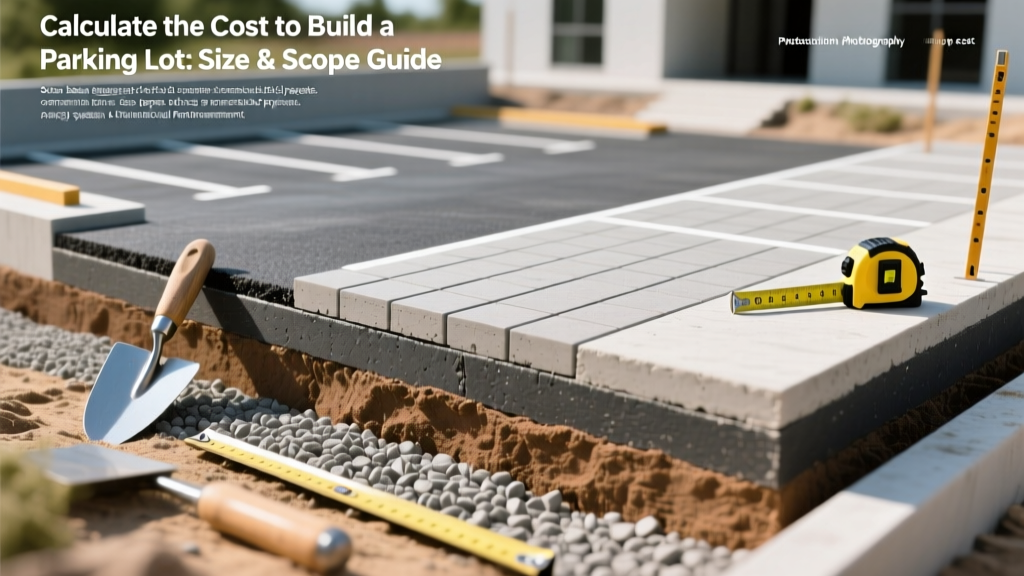
Determining the accurate cost to build a parking lot begins with selecting the surface material. The choice dictates not only the initial capital expenditure but also the long-term maintenance scope, load-bearing capacity, and stormwater management requirements. The pricing below reflects 2026 installed costs, factoring in current aggregate, binder, and labor rates for commercial-grade applications.
| Material Type | Installed Cost (per sq. ft.) | Structural Specification | Best Application Scope |
|---|---|---|---|
| Hot Mix Asphalt (HMA) | $4.50 - $7.50 | 3" compacted HMA over 6" aggregate base | High-traffic retail, office parks, municipal lots |
| Poured Concrete | $8.00 - $12.50 | 6" thick, 4,000 PSI air-entrained, dowel joints | Heavy-duty loading zones, long-term institutional use |
| Permeable Pavers (PICP) | $12.00 - $18.00 | 3.5" pavers over open-graded crushed stone reservoir | Municipal lots requiring on-site stormwater retention |
| Stabilized Gravel | $2.50 - $4.00 | Geocell confinement system with 3/4" crushed angular rock | Low-traffic overflow, rural event centers, parks |
Calculating Site Preparation and Earthwork Scope
The most frequent cause of budget overruns in parking lot construction is underestimating earthwork. The surface material is only as durable as the subgrade beneath it. According to the Federal Highway Administration, proper subgrade preparation is the primary defense against premature pavement fatigue and alligator cracking.
Soil Testing and Bearing Capacity
Before finalizing your scope, conduct a California Bearing Ratio (CBR) test or a Proctor test on the native soil.
- High CBR (Sandy/Gravelly soils): Requires minimal stabilization. Budget $1.00 - $1.50 per sq. ft. for basic grading and compaction.
- Low CBR (Expansive clays): Requires soil amendment. You must scope in lime or cement stabilization, or undercut 12-24 inches and replace with structural fill. This adds $2.50 - $4.50 per sq. ft. to your earthwork budget.
The Aggregate Base Course
Never skip the aggregate base. A standard commercial asphalt lot requires a 4 to 8-inch layer of crushed, angular aggregate (AASHTO M6 or M43). This layer distributes vehicular loads and prevents capillary water from wicking up into the pavement. Budget an additional $1.50 to $2.25 per square foot for a 6-inch compacted aggregate base.
Drainage and Stormwater Management Variables
Modern commercial parking lots are heavily regulated stormwater management facilities. Failing to scope adequate drainage will result in subbase saturation, leading to potholes and frost heaves. The Environmental Protection Agency increasingly mandates on-site runoff retention, which fundamentally alters the cost to build a parking lot.
Standard Drainage Scope Additions:
- Catch Basins and Trench Drains: $2,500 - $4,500 per installed unit, including connecting PVC/HDPE piping.
- Bioswales / Retention Ponds: $15 - $25 per linear foot of swale, plus $8,000 - $15,000 for excavation and seeding of a standard retention pond.
- Concrete Curbing: Extruded asphalt curbing is cheaper ($3.50/linear ft) but prone to degradation from snowplows. Specify slip-form concrete curbing ($7.00 - $9.50/linear ft) for northern climates.
Finishing Scope: Striping, Lighting, and EV Infrastructure
The final scope of work transforms a paved slab into a functional, code-compliant asset. These line items are frequently omitted from initial base bids.
Pavement Markings and ADA Compliance
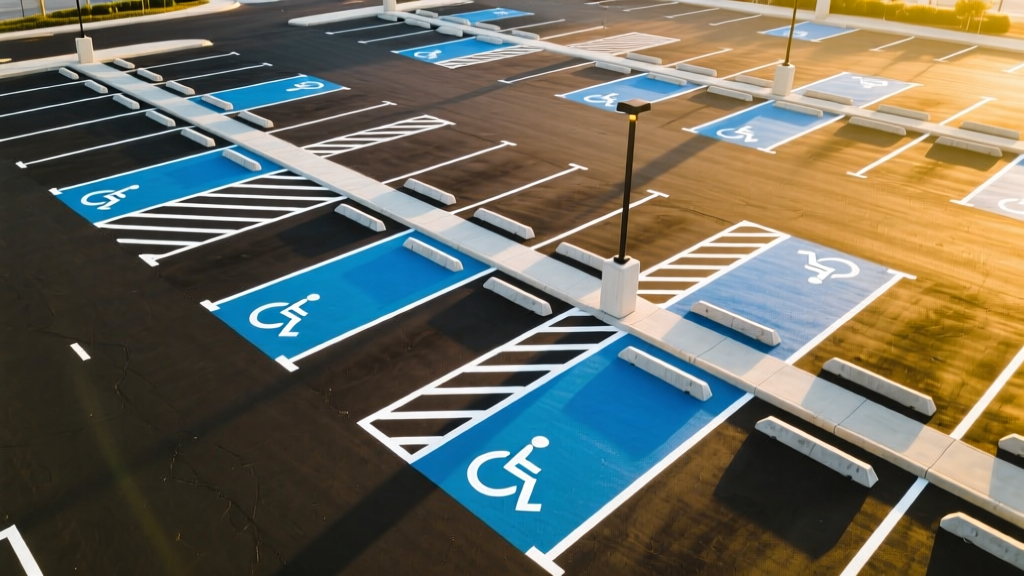
Standard water-based acrylic paint requires annual reapplication. For commercial lots, mandate thermoplastic or preformed methyl methacrylate (MMA) markings. Thermoplastic striping costs roughly $0.25 to $0.40 per linear foot but lasts 3 to 5 years. Furthermore, ADA compliance requires detectable warning pads (truncated domes) at all pedestrian transitions ($120 - $180 per pad) and strict slope tolerances. Accessible routes must not exceed a 1:48 (2.08%) cross-slope, which requires precision laser-grading during the paving phase.
LED Pole Lighting
The Illuminating Engineering Society (IES) recommends an average of 2 to 5 foot-candles for standard parking areas, with a maximum-to-minimum uniformity ratio of 4:1 to prevent dark spots that create security liabilities.
- Standard LED Pole Lights (20-30ft poles): $3,500 - $5,500 per pole, including foundation, conduit trenching, and fixture.
- Smart Controls: Adding photocells and wireless dimming nodes adds roughly $150 per fixture but reduces energy draw by 40% during off-peak hours.
EV Charging Conduit Trenching
Many 2026 commercial building codes require a minimum of 10% to 20% of parking spaces to be EV-ready. Even if you are not installing the chargers immediately, you must scope the trenching, PVC conduit runs, and oversized electrical panels during the initial build. Retrofitting asphalt for EV conduits later costs 300% more than laying it during the base installation. Budget $45 - $65 per linear foot for underground electrical trenching and backfill.
Step-by-Step Size and Scope Calculation Framework
Use this mathematical framework to build a precise budget for your specific site. This methodology aligns with standards published by the American Concrete Institute and national paving associations for commercial estimating.
- Calculate Net Paving Area: Total site area minus building footprint, landscaping, and retention ponds. (e.g., 50,000 sq. ft. total site - 10,000 sq. ft. landscaping = 40,000 sq. ft. net paving).
- Apply Material Base Rate: 40,000 sq. ft. x $6.00 (mid-range asphalt) = $240,000.
- Add Earthwork Factor: If soil is average, add 15% for grading and base prep ($36,000). If expansive clay, add 30% ($72,000).
- Add Drainage & Curbing: Estimate 1 linear foot of concrete curb per 40 sq. ft. of lot (1,000 LF x $8.00 = $8,000). Add catch basins (4 units x $3,500 = $14,000).
- Add Finishing Scope: Striping, lighting, and EV conduit typically add 8% to 12% to the total hard costs.
- Apply Contingency: Add a strict 10% contingency for unforeseen subgrade issues or utility conflicts.
By breaking down the cost to build a parking lot into these distinct scope categories—surface material, earthwork, drainage, and finishing—you eliminate guesswork. This granular approach ensures your capital allocation covers the structural necessities that dictate the lifespan of the pavement, rather than just the cosmetic surface layer.
Written by
Marcus ChenMarcus Chen is a licensed structural engineer (PE) and building materials analyst with over 12 years of experience across residential, commercial, and industrial construction. He holds a Master of Science in Civil Engineering from UC Berkeley and spent six years at Thornton Tomasetti before transitioning to independent consulting and technical writing. Marcus specializes in material selection for seismic-prone regions, concrete reinforcement strategies, and lifecycle cost analysis. His work has been cited by the American Concrete Institute (ACI) and the Structural Engineers Association of California (SEAOC). When he is not on a job site or at his desk, you will find him hiking the Sierra Nevada or restoring a 1920s craftsman bungalow in Oakland, CA.
More from Marcus Chen
View all
Construction Cost
How Much Did the Eiffel Tower Cost to Build?
How much did the Eiffel Tower cost to build in 1889? We adjust for inflation and compare its budget to modern skyscraper construction.
Aug 4, 2026

Fire Resistance
What Is a Fire Resistant Material? Testing & Certification Guide
Discover what is a fire resistant material through ASTM and UL testing. Learn how fire ratings, certifications, and assemblies work in construction.
Aug 4, 2026

Construction Cost
How Much Did the Burj Khalifa Cost to Build?
How much did the Burj Khalifa cost to build? We break down the $1.5B project and extract 5 money-saving strategies for your next build.
Jul 30, 2026