How Much Does It Cost to Build a House in Ohio? 2026 Budget Guide
Discover how much it costs to build a house in Ohio in 2026. Get regional pricing, foundation specifics, and expert budget planning frameworks.
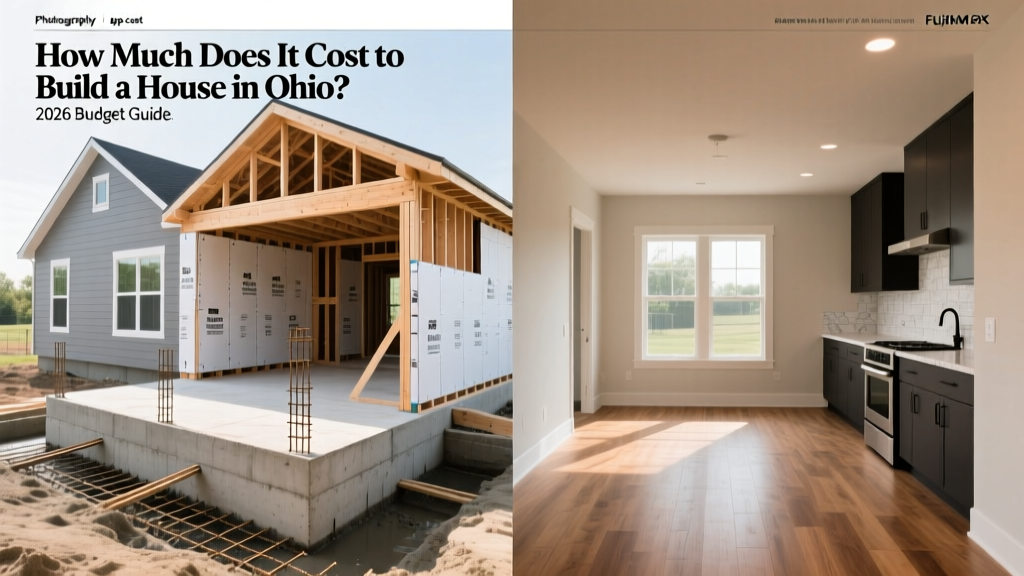
The Baseline: Ohio Home Building Costs in 2026
Average Cost Per Square Foot: $140 to $185
Total Average Cost (2,200 sq. ft. home): $308,000 to $407,000
Note: Land acquisition, site clearing, and utility tap fees are excluded from this baseline and typically add 15% to 22% to the total project budget.
Calculating exactly how much does it cost to build a house in Ohio requires moving past national averages. While the national average for custom home construction hovers around $175 to $225 per square foot, Ohio's labor markets, material supply chains, and geological factors create a distinct pricing environment. According to data tracked by the U.S. Census Bureau Construction Cost Index, the Midwest region has seen stabilized material costs entering 2026, though specialized labor premiums in metropolitan corridors continue to push localized budgets higher.
For budget planning purposes, a production-grade builder utilizing standardized floor plans and vinyl siding will land near the $140 per square foot mark. Conversely, a semi-custom build featuring engineered hardwood, quartz countertops, and upgraded insulation packages will push costs toward $185 or higher. Understanding where your specific build falls on this spectrum requires analyzing regional variances and site-specific geological challenges.
Regional Cost Variations Across the Buckeye State
Ohio is not a monolith; the cost to build in Cuyahoga County differs vastly from a rural parcel in Vinton County. Labor availability, local zoning requirements, and topographical challenges dictate these regional premiums.
| Region / Metro | Cost Per Sq. Ft. (2026) | Primary Budget Drivers |
|---|---|---|
| Central Ohio (Columbus) | $155 - $195 | High subcontractor demand, expansive clay soil mitigation, strict municipal zoning. |
| Northeast Ohio (Cleveland) | $160 - $205 | Lake-effect snow load engineering, deeper frost line excavation, union labor influence. |
| Southwest Ohio (Cincinnati) | $145 - $185 | Hilly terrain requiring retaining walls, limestone bedrock excavation. |
| Rural / Appalachian | $130 - $165 | Lower labor rates offset by well/septic installation and long-distance material delivery. |
Ohio-Specific Site Prep and Foundation Costs
The most volatile line items in any Ohio construction budget are hidden underground. The state's diverse geology and climate zones mandate specific engineering solutions that directly impact your foundation costs.
The Frost Line Factor
Ohio's building codes dictate that foundation footings must extend below the local frost line to prevent structural heaving during freeze-thaw cycles. In Southern Ohio (e.g., Cincinnati, Ironton), the frost depth is typically 32 inches. However, as you move north toward Lake Erie (Cleveland, Toledo), the required frost depth increases to 48 inches. This additional 16 inches of excavation and poured concrete can add $3,500 to $6,000 to your foundation budget for a standard 2,000-square-foot footprint.
Expansive Soils and Bedrock
Material and Labor Breakdown for Ohio Climates
Ohio experiences a true four-season climate, characterized by hot, highly humid summers and freezing, wind-swept winters. Your material selections must address both extremes to pass local energy codes and ensure longevity.
- Insulation & Envelope: Ohio enforces strict energy conservation codes. Plan for R-20 cavity insulation or R-13 plus R-5 continuous exterior rigid foam for 2x4 walls. Upgrading to 2x6 framing with R-21 closed-cell spray foam adds roughly $6,500 to $9,000 to a 2,200 sq. ft. build but drastically reduces winter heating loads.
- Roofing & Snow Loads: In the 'Snowbelt' counties (Ashtabula, Geauga, Lake), roof trusses must be engineered for higher ground snow loads (up to 30 psf compared to 15 psf in the south). Specify architectural asphalt shingles (e.g., GAF Timberline HDZ) with ice and water shield extending at least 24 inches past the interior wall line to prevent ice damming.
- HVAC Systems: A dual-climate approach is mandatory. A 95% AFUE natural gas furnace paired with a 16 SEER2 air conditioning unit is the baseline for comfort. For rural builds lacking natural gas infrastructure, budget $14,000 to $22,000 for a cold-climate air-source heat pump system (such as the Mitsubishi Hyper-Heat series) which maintains efficiency down to -13°F.
- Exterior Cladding: While vinyl siding remains the budget default ($4.50 - $7.00 per sq. ft. installed), the high UV index and freeze-thaw cycles make fiber cement (like JamesHardie ColorPlus) a superior long-term investment ($9.50 - $13.00 per sq. ft. installed), resisting warping and woodpecker damage common in Ohio's wooded suburbs.
Hidden Budget Killers in Ohio Construction
First-time builders frequently blow their contingency funds on localized requirements that out-of-state contractors or generic online estimators fail to flag.
1. Radon Mitigation Systems
According to the EPA Radon Zone Maps, a massive portion of Ohio—including nearly all counties in the central and eastern halves of the state—falls into Zone 1, indicating the highest potential for dangerous radon gas levels. Installing an active soil depressurization system during the pouring of the slab or basement floor costs between $1,200 and $1,800. Retrofitting this system after the concrete is cured will cost upwards of $3,500 and requires disruptive core drilling.
2. Rural Water and Wastewater
If building outside municipal limits, particularly in Appalachian or western rural counties, you will need a private well and a septic system. The Ohio Department of Health regulates septic designs. A standard leach field system costs $8,000 to $12,000, but if your soil percolation test fails (common in heavy clay areas), you will be required to install an engineered mound system, which can push wastewater costs to $22,000 or more.
3. Driveway and Setback Approvals
Ohio Department of Transportation (ODOT) and local county engineers require specific driveway culvert pipes and apron specifications when connecting to state or county roads. Budget $3,500 to $6,000 for the culvert installation, gravel base, and concrete apron, plus potential impact fees.
Step-by-Step Budget Allocation Framework
To maintain financial control over your Ohio build, structure your capital allocation using this percentage-based framework. This assumes a total project budget of $350,000 (excluding land purchase).
- Site Work & Foundations (14% - $49,000): Clearing, grading, well/septic, excavation, and poured concrete. Hold back 10% of this specific bucket for unforeseen bedrock or water table issues.
- Framing & Exterior Dry-In (22% - $77,000): Lumber packages, engineered trusses, roofing, windows, and exterior doors. This is where your snow-load engineering and ice-shield membranes are purchased.
- Major Systems (MEP) (16% - $56,000): Plumbing rough-in, HVAC units, electrical panels, and radon mitigation piping.
- Interior Finishes (28% - $98,000): Drywall, insulation, trim, cabinetry, flooring, and painting. This category experiences the highest rate of owner-initiated change orders.
- Final Site & Landscaping (8% - $28,000): Driveway paving, topsoil grading, and final municipal inspections.
- Soft Costs & Contingency (12% - $42,000): Architectural fees, permits, impact fees, and a strict emergency reserve for material price fluctuations or weather delays during the spring thaw.
By anchoring your budget to Ohio's specific geological realities and climate demands, you eliminate the guesswork that leads to mid-construction funding shortfalls. Prioritize spending on the structural envelope, foundation engineering, and mechanical systems, as these are the elements that dictate the long-term viability and resale value of a home in the Midwest market.
Written by
Marcus ChenMarcus Chen is a licensed structural engineer (PE) and building materials analyst with over 12 years of experience across residential, commercial, and industrial construction. He holds a Master of Science in Civil Engineering from UC Berkeley and spent six years at Thornton Tomasetti before transitioning to independent consulting and technical writing. Marcus specializes in material selection for seismic-prone regions, concrete reinforcement strategies, and lifecycle cost analysis. His work has been cited by the American Concrete Institute (ACI) and the Structural Engineers Association of California (SEAOC). When he is not on a job site or at his desk, you will find him hiking the Sierra Nevada or restoring a 1920s craftsman bungalow in Oakland, CA.
More from Marcus Chen
View all
Construction Cost
How Much Did the Eiffel Tower Cost to Build?
How much did the Eiffel Tower cost to build in 1889? We adjust for inflation and compare its budget to modern skyscraper construction.
Aug 4, 2026

Fire Resistance
What Is a Fire Resistant Material? Testing & Certification Guide
Discover what is a fire resistant material through ASTM and UL testing. Learn how fire ratings, certifications, and assemblies work in construction.
Aug 4, 2026

Construction Cost
How Much Did the Burj Khalifa Cost to Build?
How much did the Burj Khalifa cost to build? We break down the $1.5B project and extract 5 money-saving strategies for your next build.
Jul 30, 2026