How Much Does It Cost to Build a Cruise Ship?
How much does it cost to build a cruise ship? We compare European, Asian, and emerging shipyard pricing and labor rates for 2026.
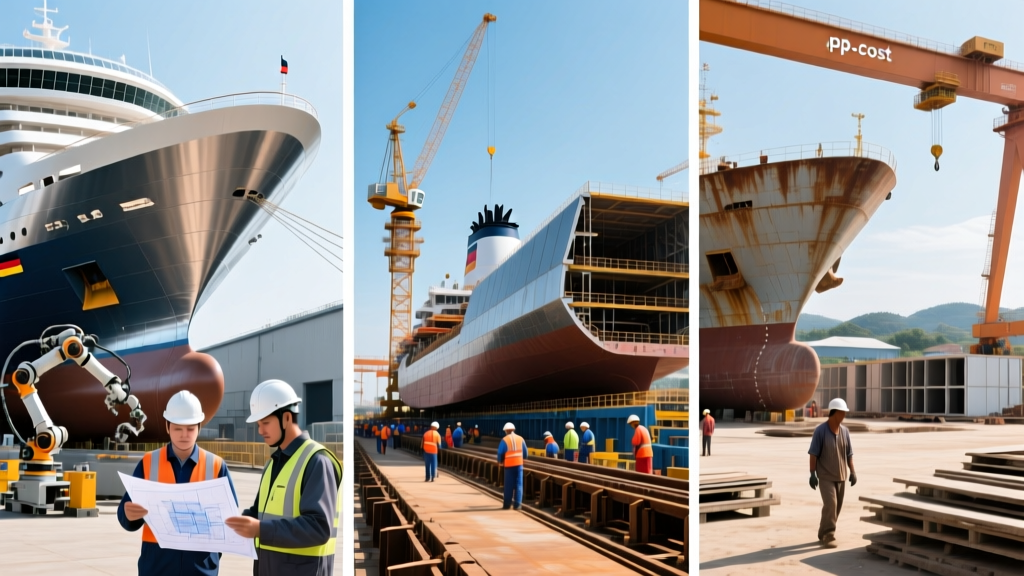
The Baseline: What Drives the Cost to Build Cruise Ship?
Estimating the cost to build cruise ship requires moving beyond standard maritime metrics. Unlike bulk carriers or container ships, which are priced primarily on deadweight tonnage (DWT), cruise vessels are evaluated using Compensated Gross Tonnage (CGT). CGT accounts for the complexity, labor hours, and technical difficulty of the build. While a standard cargo ship might cost $1,000 to $1,500 per CGT, a modern mega-cruise ship commands $4,500 to over $8,000 per CGT. For a 150,000 GT vessel, the base construction cost easily exceeds $1.1 billion before owner-furnished equipment (OFE) and interior outfitting are finalized.
The primary cost drivers include high-strength marine steel (such as AH36 and DH36 grades), complex propulsion systems like ABB Azipod azimuth thrusters, and rigorous safety compliance under the International Convention for the Safety of Life at Sea (SOLAS). However, the most significant variable in the final ledger is geography. The regional shipyard you select dictates labor rates, supply chain proximity, and access to specialized maritime subcontractors.
Regional Shipyard Price Matrix: Europe vs. Asia
The global cruise shipbuilding market is heavily concentrated, but regional pricing disparities remain stark. The table below outlines the baseline cost variations across major shipbuilding regions for a standard 130,000 GT to 150,000 GT cruise vessel.
| Region | Primary Shipyards | Estimated Cost per CGT | Total Build Cost (150k GT) | Labor Rate Index |
|---|---|---|---|---|
| Western Europe | Fincantieri, Meyer Werft, Chantiers de l'Atlantique | $6,500 - $8,500 | $1.2B - $1.5B+ | High ($45-$75/hr) |
| East Asia (China) | CSSC (Shanghai Waigaoqiao) | $4,000 - $5,500 | $850M - $1.05B | Low ($15-$25/hr) |
| East Asia (Japan/S. Korea) | Hyundai Heavy Industries, Mitsubishi (Historical) | $5,500 - $7,000 | $1.0B - $1.3B | Medium ($30-$50/hr) |
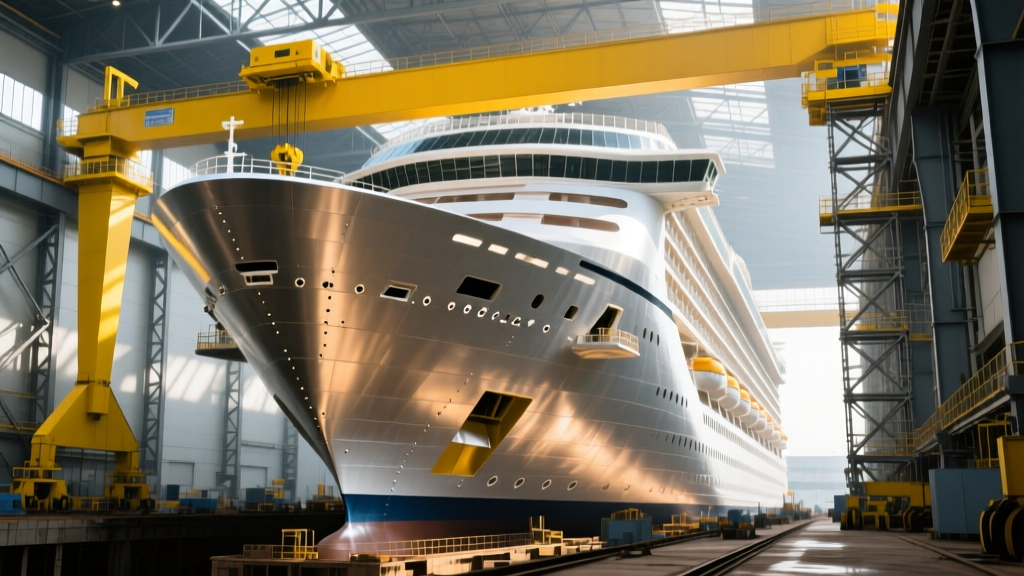
Deep Dive: European Shipyards (The Premium Tier)
Western Europe remains the undisputed leader in cruise ship construction, holding over 90% of the global order book for large ocean-going passenger vessels. Shipyards like Fincantieri in Italy, Meyer Werft in Germany, and Chantiers de l'Atlantique in France dominate the sector. The premium cost to build cruise ship in these facilities is justified by their deeply integrated supply chains and decades of specialized engineering.
The European Cost Advantage: Integration and Expertise
While European labor rates are the highest in the maritime sector, the total cost of ownership and build efficiency often offset the initial premium. European shipyards benefit from localized clusters of specialized subcontractors. For example, the cabin manufacturing and installation supply chain in Italy and Germany is highly optimized. A standard cruise cabin, fully prefabricated with wet units, HVAC, and marine-grade acoustic dampening (like Rockwool Marine 800), costs between $18,000 and $35,000 installed. European yards can install up to 40 prefabricated cabin modules per day using synchronized gantry systems.
Furthermore, European yards lead in integrating next-generation propulsion and environmental systems. The transition to LNG dual-fuel and methanol-ready engines requires complex cryogenic tank integration and specialized piping. European engineering teams have standardized these workflows, reducing the risk of costly drydock rework and sea-trial failures.
Deep Dive: Asian Shipyards (The Emerging Contenders)
Historically, Asian shipyards dominated commercial vessel construction but struggled with the immense complexity of passenger ships. The cost to build cruise ship in Asia is theoretically 20% to 30% lower than in Europe, primarily due to cheaper steel procurement and lower baseline labor costs. However, the reality of execution is more nuanced.
The Learning Curve and Historical Failures
The most critical E-E-A-T insight for estimators evaluating Asian shipyards is the historical failure rate in this specific niche. Mitsubishi Heavy Industries (MHI) famously attempted to enter the European cruise market, securing contracts for the AIDA and Costa brands. Due to severe underestimations of the engineering complexity, HVAC integration challenges, and fire safety compliance, MHI lost an estimated $2.3 billion on the projects and subsequently exited the cruise shipbuilding market entirely.
China, however, is aggressively pushing into the sector. China State Shipbuilding Corporation (CSSC) successfully delivered the Adora Magic City, the first domestically built large cruise ship. While the headline cost to build cruise ship at the Shanghai Waigaoqiao shipyard is lower, estimators must account for heavy reliance on European technology transfer. The propulsion systems, elevator packages, and advanced hotel HVAC systems are still largely imported from Western suppliers, eroding the theoretical regional discount through high logistics and tariff costs.
Outfitting and Interior Supply Chain: The Hidden Cost Center
The hull and propulsion represent only about 40% of the total cost to build cruise ship. The remaining 60% is consumed by hotel outfitting, interior architecture, and entertainment systems. This is where regional price analysis becomes highly granular.
- Acoustic and Fire Insulation: SOLAS regulations mandate strict fire zoning and acoustic separation. Marine-grade mineral wool and specialized intumescent coatings add $12M to $18M to a mega-ship build. Sourcing these materials regionally in Asia often requires importing from European manufacturers like Rockwool or Promat, negating local material discounts.
- Public Space Architecture: Theaters, casinos, and multi-deck atriums require structural reinforcements and custom rigging. A Broadway-style theater on a modern cruise ship costs between $15M and $25M to engineer and outfit, requiring specialized vibration-dampening mounts to isolate bass frequencies from the passenger cabin decks above.
- Galley and Provisioning: Marine galleys must feed up to 7,000 people daily. Stainless steel marine-grade kitchen packages, blast chillers, and automated waste digestion systems cost upwards of $20M. European shipyards often utilize local Italian or German marine kitchen fabricators, whereas Asian yards must factor in heavy freight costs for these specialized units.
Estimator's Risk Framework: Choosing a Shipyard Region
When evaluating the cost to build cruise ship across regions, apply this risk-adjustment multiplier to the base quote:
- Western Europe: Base Cost x 1.0. Lowest risk of delivery delay; highest integration maturity for green fuels.
- China (State-Owned): Base Cost x 1.15. Apply a 15% contingency for supply chain friction, imported marine-grade HVAC delays, and technology transfer friction.
- Non-Traditional Yards: Base Cost x 1.40+. High risk of SOLAS compliance failures during sea trials, requiring expensive post-delivery drydock retrofits.
Hidden Regional Costs: Logistics, Sea Trials, and Tariffs
A common error in maritime construction estimating is ignoring the post-float-out logistics. The cost to build cruise ship extends well beyond the shipyard gate. Once the vessel is floated out, it must undergo extensive sea trials, noise and vibration measurements, and regulatory surveys.
In Northern Europe, shipyards like Meyer Werft in Papenburg face unique geographical challenges. The shipyard is located inland on the river Ems. Navigating a 350-meter-long mega-ship down a shallow, narrow river to the North Sea requires precise tidal timing, specialized dredging operations, and temporary closure of regional infrastructure. These river transit operations add $2M to $4M in logistical and environmental mitigation costs per vessel.
Conversely, Asian shipyards located on deep-water coastlines avoid river transit costs but face heavier oceanic towing and sea-trial logistics. Furthermore, if a vessel built in Asia is intended for the North American or European market, the owner must factor in international maritime tariffs, import duties on specific steel grades, and the cost of flying European classification society surveyors (like DNV or Lloyd's Register) to Asia for multi-month inspection periods.
Propulsion and Green Tech: The New Cost Multiplier
According to industry data tracked by The Maritime Executive, the regulatory push toward decarbonization is fundamentally altering the cost to build cruise ship. The International Maritime Organization (IMO) mandates strict Energy Efficiency Existing Ship Index (EEXI) and Carbon Intensity Indicator (CII) ratings.
To comply, modern builds are shifting from heavy fuel oil (HFO) to LNG dual-fuel, and increasingly, methanol-ready architectures. Integrating LNG dual-fuel systems requires Type C cryogenic bunker tanks, specialized stainless-steel double-walled piping, and gas combustion units (GCUs). This propulsion upgrade adds $45 million to $70 million to the baseline build cost. Regional shipyards that have standardized these green-tech installations (primarily in France and Germany) offer more predictable pricing, whereas yards still developing these workflows are prone to severe change-order inflation during the construction phase.
Conclusion for Estimators
The cost to build cruise ship is not a static figure; it is a highly volatile metric dictated by regional labor maturity, supply chain localization, and green-technology integration. While Asian shipyards offer attractive baseline CGT pricing, the total risk-adjusted cost often narrows the gap with Western Europe. For owners and estimators, the most accurate financial models must look beyond the shipyard contract price and rigorously quantify the hidden costs of interior outfitting logistics, sea-trial compliance, and regional supply chain friction.
Written by
Elena RodriguezElena Rodriguez is a civil engineer and technical writer specializing in concrete technology, masonry systems, and ASTM/ACI compliance. She earned her B.S. in Civil Engineering from Texas A&M University and spent a decade at a materials testing laboratory, performing over 2,000 concrete compressive strength tests and masonry prism evaluations. Elena is an ACI-certified Field Testing Technician (Grade I) and a member of ASTM Committee C12 on Natural Building Stone. She currently consults on forensic engineering cases involving concrete failures and moisture intrusion. Based in San Antonio, TX, Elena is a proud member of the Society of Women Engineers (SWE) and coaches her daughter's FIRST Robotics team.
More from Elena Rodriguez
View all
Walls & Panels
Cost Analysis: Light Gauge Steel Framing Advantages and Disadvantages
Evaluate light gauge steel framing advantages and disadvantages through a strict cost analysis lens, comparing material, labor, and lifecycle expenses.
Aug 4, 2026

Walls & Panels
Gypsum Board Types: Exact Specifications, Thickness & Dimensions
Compare standard, Type X, and moisture-resistant gypsum board types. Get exact specifications, thicknesses, dimensions, and ASTM standards for your project.
Aug 4, 2026

Fire Resistance
Best Fire-Resistant Outdoor Decking Materials: 2026 Buyer Guide
Discover the best fire-resistant outdoor decking materials for 2026. Compare Class A PVC, aluminum, and hardwood options for WUI compliance and safety.
Aug 4, 2026