How Much Does It Cost to Build a Pickleball Court? Size & Scope Guide
Calculate exactly how much it costs to build a pickleball court. Break down pricing by size, surface type, fencing, and scope for your project.
The Baseline: USA Pickleball Dimension Standards
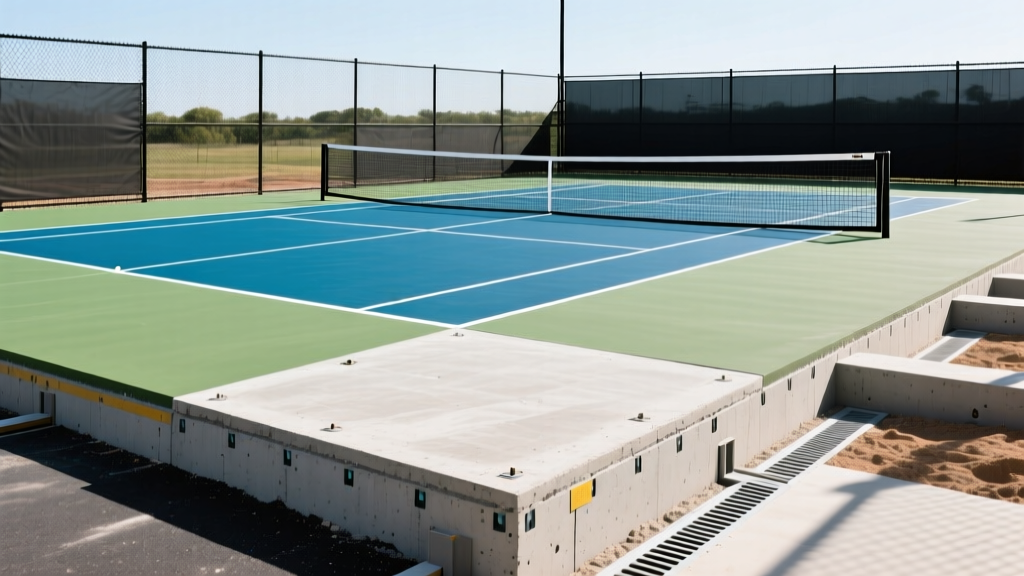
To accurately determine how much it costs to build a pickleball court, you must first separate the playing area from the total construction footprint. The official playing dimensions for a pickleball court are 20 feet wide by 44 feet long (880 square feet). However, building a slab exactly to these dimensions is a critical failure point that results in unplayable, unsafe courts.
According to the USA Pickleball Association (USAPA), the minimum total footprint for a single court is 30 feet by 60 feet (1,800 square feet). For tournament play and optimal safety, the recommended footprint is 34 feet by 64 feet (2,176 square feet). This extra perimeter space accounts for player run-off, momentum deceleration, and fence clearance. When running your size and scope calculations, always base your concrete, surfacing, and fencing estimates on the 34x64 foot recommended footprint to avoid severe scope creep mid-project.
The 'Footprint' vs. 'Playing Area' Trap
Many novice estimators calculate material costs based on the 880-square-foot playing area. If you order 880 square feet of acrylic surfacing or pour an 880-square-foot concrete slab, the court will fail inspection and lack necessary drainage slopes. Always calculate base materials using the 2,176-square-foot total footprint.
Size & Scope Cost Calculator: Breaking Down the Variables
The cost to build a pickleball court scales based on site conditions, material tiers, and perimeter requirements. Below is the baseline cost matrix for a standard outdoor, single-court build (34x64 footprint) on a level, cleared site.
| Construction Phase | Specification Standard | Cost per Sq. Ft. / Unit | Total Single Court Cost |
|---|---|---|---|
| Site Prep & Earthwork | Clearing, grading, 1% slope | $2.50 - $4.50 / sq. ft. | $5,440 - $9,792 |
| Concrete Base Slab | 4-inch, 3000 PSI, #3 rebar grid | $6.00 - $9.00 / sq. ft. | $13,056 - $19,584 |
| Acrylic Surfacing | 5-coat color system (non-cushioned) | $3.00 - $4.50 / sq. ft. | $6,528 - $9,792 |
| Fencing | 10-ft high, 9-gauge chain link | $30.00 - $45.00 / linear ft. | $5,880 - $8,820 |
| Lighting & Electrical | 4 LED poles, 50 foot-candles | Lump Sum | $4,500 - $7,500 |
| Nets & Hardware | USAPA approved center-strap nets | Lump Sum | $600 - $1,200 |
Total Estimated Single Court Cost: $36,004 to $56,688. This range assumes favorable soil conditions and existing utility access at the property line.
Surface Material Matrix: Concrete vs. Asphalt vs. Modular
The base material dictates the longevity, maintenance cycle, and ultimate playability of the court. The American Sports Builders Association (ASBA) provides strict guidelines for sports surface tolerances. Here is how the three primary base materials compare for outdoor installations.
| Base Material | Lifespan | Cracking Risk | Resurfacing Cycle | Best Application |
|---|---|---|---|---|
| Post-Tensioned Concrete | 25+ Years | Extremely Low | 5-8 Years | Expansive clay soils, high-end commercial |
| Standard Concrete | 15-20 Years | Moderate | 5-8 Years | Stable soils, residential, municipal parks |
| Asphalt | 8-12 Years | High (Oxidation) | 3-5 Years | Budget builds, temporary installations |
| Modular Polypropylene | 10-15 Years | N/A (Floating) | N/A (Tile replacement) | Over existing cracked slabs, indoor/outdoor |
Expert Warning on Asphalt: While asphalt reduces initial base costs by roughly 20%, it is highly susceptible to oxidation, UV degradation, and thermal cracking. In regions with high freeze-thaw cycles, an asphalt pickleball court will typically require structural crack repairs and a full acrylic overlay within 36 months. For permanent 2026 installations, a 4-inch concrete slab reinforced with a #3 rebar grid at 18 inches on-center is the minimum acceptable standard per the American Concrete Institute (ACI).
The Perimeter: Fencing and Lighting Scope
Fencing and lighting represent the most common areas of budget overruns because estimators frequently miscalculate linear footage and lux requirements.
Fencing Linear Footage Calculator
For a single 34x64 court, the perimeter is exactly 196 linear feet. However, you must account for gate swings, wind load bracing, and terminal posts. Order 210 linear feet of materials for a single court to allow for waste and structural corner bracing.
- Mesh Size: Standard 2.5-inch chain link allows pickleballs to wedge into the mesh or push through under tension. Specify 2-inch or 2.25-inch mesh.
- Gauge: Use 9-gauge galvanized steel with a vinyl coating. 11-gauge is too flimsy for high-wind zones and will bow when players lean against it.
- Height: 4-foot fencing is acceptable for single residential courts. For multi-court facilities, 10-foot fencing is mandatory to prevent balls from migrating between active courts and causing ankle-roll injuries.
Lighting Specifications
Recreational pickleball requires a minimum of 50 foot-candles (fc) of illumination, while tournament play demands 100 fc. Modern LED systems with asymmetric lenses are required to direct light downward, minimizing spill into neighboring properties and reducing glare for players tracking high lobs. A standard 4-pole LED setup (two 20-foot poles per side) costs between $4,500 and $7,500, excluding the trenching and electrical conduit runs from the main breaker panel.
Multi-Court Economies of Scale (The 2-Court and 4-Court Advantage)
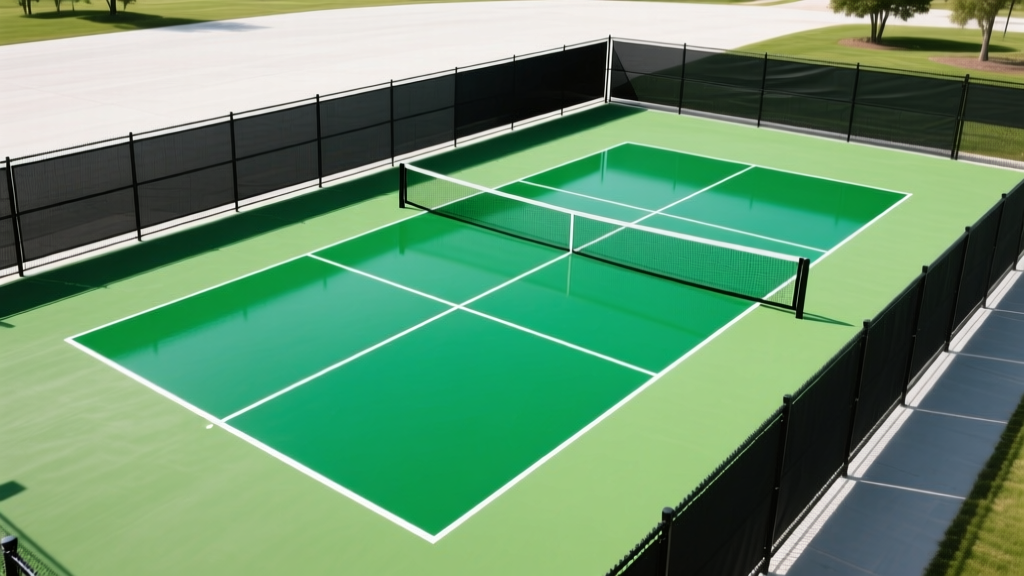
The cost per court drops significantly as you scale the project. This is due to shared mobilization costs, shared interior fencing, and optimized lighting pole placement. When calculating the footprint for side-by-side courts, USAPA mandates a minimum 10-foot buffer between the court boundaries.
| Facility Scope | Total Footprint Dimensions | Total Square Footage | Estimated Cost Per Court |
|---|---|---|---|
| Single Court | 34 ft x 64 ft | 2,176 sq. ft. | $36,000 - $56,000 |
| 2-Court Facility | 78 ft x 64 ft (Includes 10ft center buffer) | 4,992 sq. ft. | $28,000 - $42,000 |
| 4-Court Facility | 156 ft x 64 ft (Side-by-side configuration) | 9,984 sq. ft. | $22,000 - $34,000 |
Notice the footprint math for a 2-court facility: 34 ft (Court 1) + 10 ft (Buffer) + 34 ft (Court 2) = 78 ft width. The length remains 64 ft. By sharing the 10-foot interior fence line and utilizing 6 lighting poles instead of 8, the per-court cost decreases by up to 30%.
Site Preparation: The Hidden Cost Multiplier
The most volatile variable in your size and scope calculator is earthwork. A pickleball court requires a strict 1% slope (1/8 inch per foot) on a single plane to ensure water runoff without creating a perceptible tilt that alters ball bounce. If your site is not naturally level, grading costs will escalate.
- Flat, Cleared Site: $2.50 per sq. ft. Minor laser-grading and compaction.
- Moderate Slope (1-3 feet of cut/fill): $5.00 - $7.50 per sq. ft. Requires retaining walls, import/export of soil, and engineered fill compaction.
- Expansive Clay or Peat Soils: Requires over-excavation and importing a structural base of crushed aggregate (ABC gravel), or upgrading to a post-tensioned concrete slab to prevent differential settlement.
Step-by-Step Estimation Framework
To finalize your budget, follow this sequential calculation framework:
- Determine Total Footprint: Multiply the number of courts by the required footprint, adding 10 feet to the width for every adjacent court.
- Calculate Base Volume: Multiply total square footage by 0.33 (for a 4-inch slab depth) to get cubic feet, then divide by 27 for cubic yards of concrete. Add 10% for waste.
- Measure Perimeter: Calculate the linear footage of the outer boundary for fencing. Add 10 linear feet per interior court divider.
- Assess Electrical Trenching: Measure the linear distance from the court lighting panels to the nearest utility transformer. Trenching typically costs $15 to $25 per linear foot.
- Select Surfacing Tier: Choose a 5-coat standard acrylic system for budget builds, or an 8-coat cushioned system (like Plexipace or DecoTurf) for premium joint-protection and tournament play.
By inputting your specific site dimensions and material choices into this framework, you will generate a highly accurate, contractor-ready estimate that accounts for the true scope of modern pickleball construction.
Written by
Elena RodriguezElena Rodriguez is a civil engineer and technical writer specializing in concrete technology, masonry systems, and ASTM/ACI compliance. She earned her B.S. in Civil Engineering from Texas A&M University and spent a decade at a materials testing laboratory, performing over 2,000 concrete compressive strength tests and masonry prism evaluations. Elena is an ACI-certified Field Testing Technician (Grade I) and a member of ASTM Committee C12 on Natural Building Stone. She currently consults on forensic engineering cases involving concrete failures and moisture intrusion. Based in San Antonio, TX, Elena is a proud member of the Society of Women Engineers (SWE) and coaches her daughter's FIRST Robotics team.
More from Elena Rodriguez
View all
Walls & Panels
Cost Analysis: Light Gauge Steel Framing Advantages and Disadvantages
Evaluate light gauge steel framing advantages and disadvantages through a strict cost analysis lens, comparing material, labor, and lifecycle expenses.
Aug 4, 2026

Walls & Panels
Gypsum Board Types: Exact Specifications, Thickness & Dimensions
Compare standard, Type X, and moisture-resistant gypsum board types. Get exact specifications, thicknesses, dimensions, and ASTM standards for your project.
Aug 4, 2026

Fire Resistance
Best Fire-Resistant Outdoor Decking Materials: 2026 Buyer Guide
Discover the best fire-resistant outdoor decking materials for 2026. Compare Class A PVC, aluminum, and hardwood options for WUI compliance and safety.
Aug 4, 2026