How Much Does It Cost to Build a Laundromat in 2026?
Discover exactly how much it costs to build a laundromat in 2026. Explore CapEx breakdowns, hidden impact fees, and SBA financing strategies.
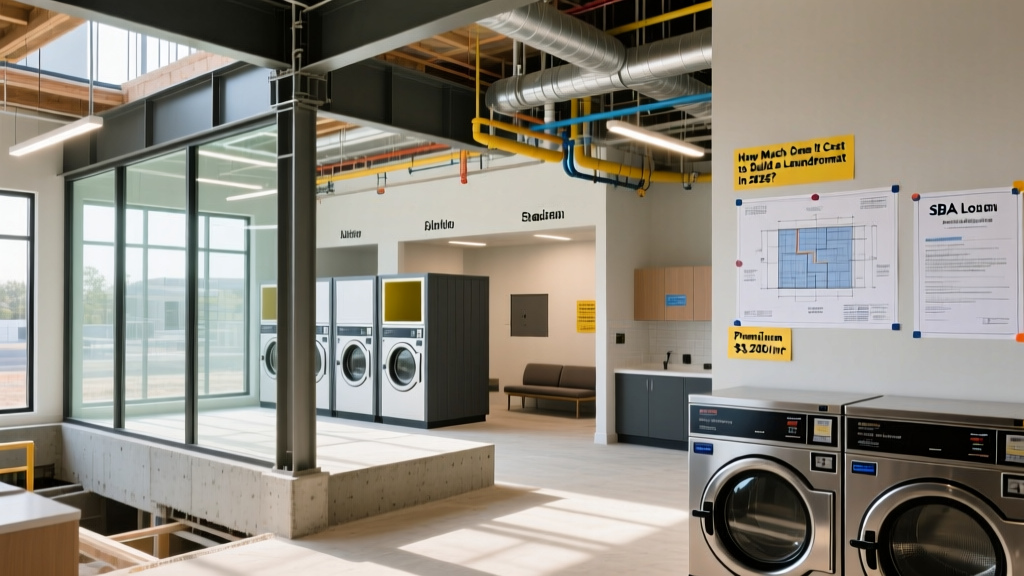
The Real Price Tag: How Much Does It Cost to Build a Laundromat?
Opening a coin-operated or card-operated laundry facility is a capital-intensive commercial real estate venture. When investors ask how much does it cost to build a laundromat, the baseline answer for a standard 2,500 to 4,000-square-foot build-out in 2026 ranges from $250,000 to $850,000. However, this wide variance is dictated by municipal utility impact fees, the condition of the existing shell, and the ratio of soft-mount to hard-mount equipment.
Unlike retail build-outs where cosmetic finishes drive the budget, a laundromat's capital expenditure (CapEx) is heavily weighted toward subterranean plumbing, high-capacity electrical or gas infrastructure, and commercial-grade extraction equipment. According to industry data from the Coin Laundry Association, a well-capitalized new store must also carry at least $40,000 in working capital to survive the initial 12-month customer acquisition phase.
Capital Expenditure (CapEx) Breakdown Matrix
| Cost Category | Estimated Range (2026) | Percentage of Total Budget | Key Variables |
|---|---|---|---|
| Leasehold Improvements (Plumbing, Electrical, HVAC) | $120,000 - $350,000 | 35% - 45% | Concrete trenching depth, make-up air requirements, utility upgrades |
| Commercial Laundry Equipment | $150,000 - $400,000 | 40% - 50% | Hard-mount vs. soft-mount, boiler systems, card payment integration |
| Utility Impact Fees & Deposits | $15,000 - $80,000 | 5% - 15% | Municipal water/sewer fixture unit calculations, meter upsizing |
| Security, Signage & Amenities | $15,000 - $35,000 | 5% - 8% | IP camera systems, bulkheads, seating, vending, automatic doors |
| Working Capital & Soft Costs | $40,000 - $60,000 | 10% | Architectural permits, legal, initial marketing, 6-month reserve |
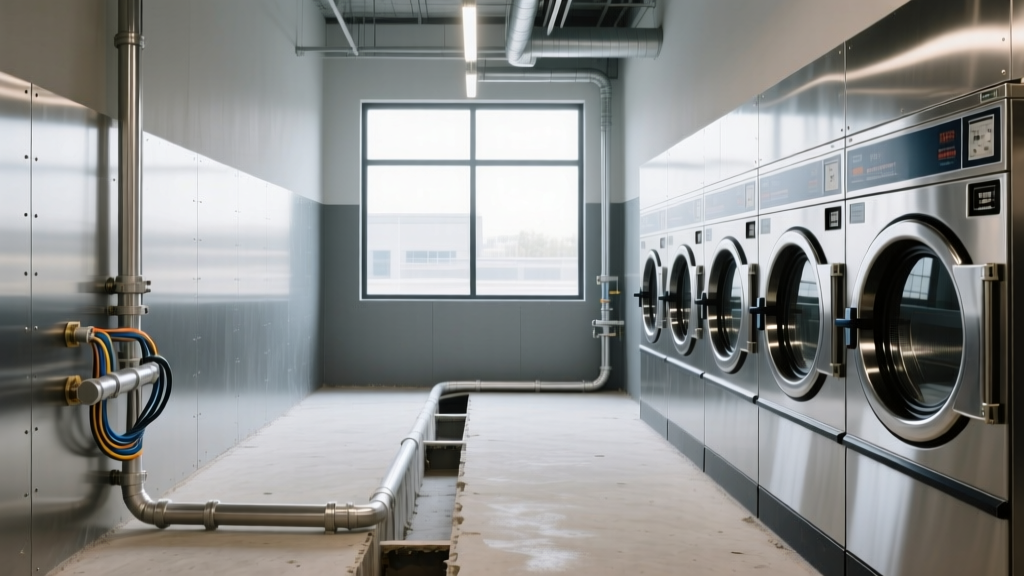
The Hidden Budget Killers in Laundromat Build-Outs
First-time laundromat operators frequently underestimate the structural and municipal requirements of the facility. Before signing a commercial lease, you must conduct rigorous due diligence on the following three budget killers.
Municipalities calculate impact fees based on 'fixture units' or the diameter of the incoming water meter. Upgrading an existing 2-inch commercial water meter to a 3-inch or 4-inch meter to support high-capacity washers can trigger $30,000 to $80,000 in one-time municipal impact fees. Always request a 'will-serve' letter and a fee schedule from the local water authority before executing a lease.
Concrete Trenching and Core Drilling
Washers require 2-inch to 3-inch PVC drain lines sloped at a precise 1/4-inch per foot. If you are taking over a vanilla shell or a former retail space, you will need to saw-cut and trench hundreds of linear feet of concrete. In 2026, commercial concrete trenching, core drilling for vent stacks, and subsequent backfilling and sealing averages $65 to $95 per linear foot. A 3,000-square-foot store requiring 300 linear feet of trenching will spend roughly $25,000 before a single pipe is laid.
Make-Up Air (MUA) and HVAC Negative Pressure
A bank of 30 commercial dryers exhausts massive volumes of conditioned air (often exceeding 15,000 CFM). Without a dedicated Make-Up Air (MUA) system, the building will suffer severe negative pressure, causing dryers to overheat, trip high-limit thermostats, and drastically increase drying times. Installing a commercial MUA unit (such as a Greenheck or Modine system) with integrated tempered heating adds $18,000 to $30,000 to your HVAC budget, but it is non-negotiable for operational efficiency.
Structuring Your Capital Stack: Financing Options
Because laundromats are highly equipment-dependent, traditional commercial real estate loans are rarely sufficient on their own. Operators must structure a 'capital stack' combining real estate financing, equipment leasing, and working capital loans. The U.S. Small Business Administration (SBA) remains the premier vehicle for funding these complex commercial build-outs.
SBA 7(a) vs. Captive Equipment Financing
| Feature | SBA 7(a) Loan | Captive Equipment Financing (e.g., Dexter/Speed Queen) |
|---|---|---|
| Best Used For | Total project cost (build-out, equipment, working capital) | Purchasing the hard laundry equipment only |
| Down Payment Required | 10% - 20% (depending on real estate inclusion) | 10% - 30% (or 0% for highly qualified existing operators) |
| Collateral | First lien on all business assets; personal guarantee | UCC-1 lien strictly on the laundry equipment |
| Term Length | Up to 10 years (or 25 years if purchasing real estate) | 5 to 7 years (matching equipment depreciation life) |
| Approval Speed | 45 - 90 days (heavy underwriting) | 7 - 14 days (streamlined manufacturer underwriting) |
Rollover for Business Startups (ROBS)
For investors with substantial retirement savings, a ROBS arrangement allows you to use your 401(k) or IRA to fund the laundromat build-out without incurring early withdrawal penalties or tax liabilities. This is highly effective for covering the $50,000 to $100,000 gap that SBA lenders require as a cash injection, effectively eliminating the need for out-of-pocket liquidity.
Maximizing ROI Through Equipment & Infrastructure Selection
The equipment you select dictates your utility overhead for the next 15 years. Modern laundromat financing must account for the premium of high-efficiency extraction technology.
- Hard-Mount vs. Soft-Mount Washers: Hard-mount washers extract water at roughly 100 G-force. Soft-mount washers (utilizing heavy-duty shock absorbers and spring systems) extract at up to 200 G-force. While a 60-lb soft-mount Speed Queen or Dexter unit costs roughly $1,500 to $2,000 more upfront, it reduces residual water weight in the fabrics by 30%. This translates to a 15% reduction in dryer gas consumption and faster customer turnover.
- Water Heating Infrastructure: Traditional 500-gallon storage tanks (like Lochinvar commercial models) require significant floor space and continuous recirculation pumps to maintain temperature. Modern tankless manifold systems (using multiple Navien or Rinnai commercial units chained together) provide on-demand hot water, eliminating standby heat loss. However, tankless systems require upgrading the incoming gas line to 2-inch or 3-inch black iron to support 1,000,000+ BTU peak demands.
- Payment Technology: The industry has shifted entirely away from coin sliders. Retrofitting or buying new machines with integrated NFC/credit card readers (such as PayRange or SpyderWash) costs $150 to $250 per drop. This increases upfront CapEx but boosts store revenue by 20% to 30% by capturing unbanked and card-only demographics.
Step-by-Step Funding & Construction Timeline
- Months 1-2: Site Selection & SBA Pre-Qualification. Secure a Letter of Intent (LOI) on a lease contingent upon municipal water/sewer approval and SBA loan pre-qualification.
- Months 3-4: Permitting & Utility Upgrades. Submit architectural and MEP (Mechanical, Electrical, Plumbing) drawings. Pay municipal impact fees and schedule water meter upsizing with the city.
- Month 5: Rough-In & Trenching. Concrete saw-cutting, trenching for drain lines, core drilling for dryer vents, and running heavy-gauge electrical to the main distribution panels.
- Month 6: Equipment Delivery & Setting. Equipment arrives. Washers are bolted to the concrete pads (using chemical anchors for hard-mounts). Dryers are vented and gas lines are pressure-tested.
- Month 7: Finishes & Certificate of Occupancy (C of O). Install bulkheads, lighting, security cameras, and payment kiosks. Pass final municipal inspections to receive the C of O and open for business.
Because laundromat plumbing is permanently embedded in the slab, it adds long-term value to the commercial shell. Negotiate a Tenant Improvement (TI) allowance with your landlord to cover 10% to 20% of the concrete trenching and utility upgrade costs in exchange for a longer 10-year lease term.
Frequently Asked Questions
Is a laundromat a good investment in 2026?
Yes, provided the location has a high renter demographic (minimum 35% renters within a 2-mile radius) and the facility is equipped with modern, high-capacity machines. Laundromats historically maintain an 85% to 95% five-year survival rate, vastly outperforming traditional retail or restaurant startups.
How much does it cost to build a laundromat if I buy an existing one?
Acquiring and retooling an existing, underperforming laundromat typically costs between $100,000 and $250,000. This covers swapping out obsolete equipment, upgrading the payment systems, and refreshing the cosmetic finishes, while bypassing the most expensive municipal impact fees since the utility infrastructure is already grandfathered in.
Written by
Elena RodriguezElena Rodriguez is a civil engineer and technical writer specializing in concrete technology, masonry systems, and ASTM/ACI compliance. She earned her B.S. in Civil Engineering from Texas A&M University and spent a decade at a materials testing laboratory, performing over 2,000 concrete compressive strength tests and masonry prism evaluations. Elena is an ACI-certified Field Testing Technician (Grade I) and a member of ASTM Committee C12 on Natural Building Stone. She currently consults on forensic engineering cases involving concrete failures and moisture intrusion. Based in San Antonio, TX, Elena is a proud member of the Society of Women Engineers (SWE) and coaches her daughter's FIRST Robotics team.
More from Elena Rodriguez
View all
Walls & Panels
Cost Analysis: Light Gauge Steel Framing Advantages and Disadvantages
Evaluate light gauge steel framing advantages and disadvantages through a strict cost analysis lens, comparing material, labor, and lifecycle expenses.
Aug 4, 2026

Walls & Panels
Gypsum Board Types: Exact Specifications, Thickness & Dimensions
Compare standard, Type X, and moisture-resistant gypsum board types. Get exact specifications, thicknesses, dimensions, and ASTM standards for your project.
Aug 4, 2026

Fire Resistance
Best Fire-Resistant Outdoor Decking Materials: 2026 Buyer Guide
Discover the best fire-resistant outdoor decking materials for 2026. Compare Class A PVC, aluminum, and hardwood options for WUI compliance and safety.
Aug 4, 2026