Cost to Build an ADU in San Diego: Detailed 2026 Breakdown
Discover the true cost to build an ADU in San Diego. Get a detailed 2026 breakdown of permits, materials, labor, and hidden fees for your backyard project.
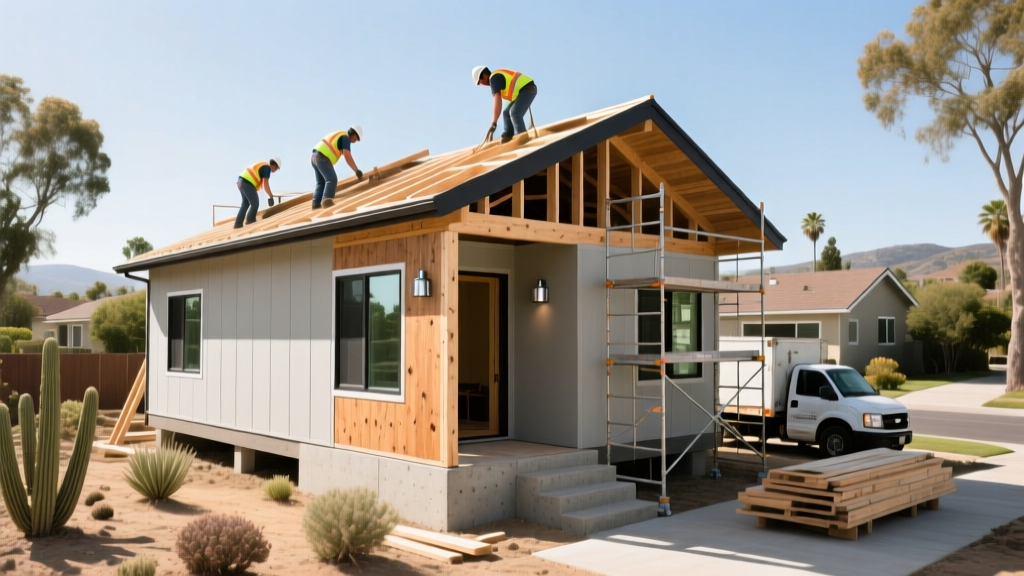
Building an Accessory Dwelling Unit (ADU) in San Diego is one of the most effective ways to generate rental income, house extended family, or increase property value in Southern California's competitive real estate market. However, the financial commitment requires precise planning. The cost to build an ADU in San Diego varies wildly depending on site conditions, zoning overlays, and material selections. This detailed breakdown dissects the exact pricing, hidden municipal fees, and material specifications you need to budget for in 2026.
The Real Numbers: San Diego ADU Cost Tiers
Not all ADUs are priced equally. A garage conversion leverages an existing shell, while a two-story detached unit requires extensive foundational and structural work. Below is the current 2026 pricing matrix for turnkey ADU construction in San Diego County.
| ADU Type | Average Size | Cost Per Sq. Ft. | Total Estimated Cost |
|---|---|---|---|
| Garage Conversion | 400 - 600 sq ft | $200 - $280 | $110,000 - $165,000 |
| Detached New Build (1-Story) | 600 - 800 sq ft | $300 - $380 | $210,000 - $305,000 |
| Detached New Build (2-Story) | 800 - 1,000 sq ft | $350 - $450 | $315,000 - $450,000 |
| Junior ADU (JADU) | Max 500 sq ft | $150 - $220 | $75,000 - $110,000 |
Where Your Money Goes: Line-Item Breakdown
For a standard 600-square-foot detached ADU budgeted at $240,000, the capital is distributed across several critical phases. Understanding these allocations prevents budget shock during construction.
1. Soft Costs & San Diego Permit Fees (12% - 18%)
Before a shovel hits the dirt, you will spend between $25,000 and $40,000 on soft costs. This includes architectural drafting ($6,000 - $12,000), Title 24 energy compliance calculations ($400 - $600), and structural engineering ($2,500 - $5,000). The City of San Diego Development Services Department charges plan check and building permit fees that typically scale with the project's valuation, averaging $8,000 to $14,000 for a standard detached unit.
2. Site Work & Foundation (10% - 15%)
San Diego's topography is notoriously varied. If you are building in the hills of Scripps Ranch or Mission Trails, you may encounter expansive clay or bedrock. A standard slab-on-grade foundation costs $15,000 to $22,000. However, if your site requires a raised foundation with engineered retaining walls or caissons to meet seismic and soil stability requirements, foundation costs can easily exceed $40,000.
3. Vertical Construction & Materials (45% - 55%)
This covers framing, roofing, insulation, drywall, and exterior finishes. To meet California's strict Title 24 energy codes, builders must use high-efficiency materials. Expect to pay for 2x6 exterior wall framing to accommodate R-19+ batt insulation, dual-pane low-E vinyl windows, and cool-roof compliant architectural shingles or TPO membrane roofing. Exterior siding typically utilizes fiber cement boards (like James Hardie) for fire resistance and durability, costing $9 to $14 per square foot installed.
4. MEP Rough-In & Finishes (20% - 25%)
Mechanical, Electrical, and Plumbing (MEP) systems represent a massive chunk of the budget. Installing a ductless mini-split HVAC system (such as a Mitsubishi or Daikin 12,000 BTU unit) costs around $4,500 to $6,000. Plumbing requires trenching to connect to the main sewer lateral, while electrical work often necessitates a heavy-upgrade to the main property's electrical panel.
Hidden San Diego Site Costs (The Budget Killers)
Many homeowners receive a base quote from a contractor, only to face massive change orders later. The California Department of Housing and Community Development (HCD) sets state baseline rules, but local San Diego overlays introduce unique financial hurdles.
- Wildland-Urban Interface (WUI) Zones: If your property is in a designated WUI zone (common in Carmel Valley, Rancho Bernardo, and Alpine), the fire marshal will require Class A fire-rated roofing, enclosed eaves, fire-resistant decking, and potentially an automatic fire sprinkler system. Sprinklers alone add $8,000 to $15,000 to your budget.
- Coastal Development Permits (CDP): Properties in Ocean Beach, Point Loma, or La Jolla often fall within the Coastal Commission's jurisdiction. Securing a CDP requires specialized environmental consulting, adding $5,000 to $12,000 in soft costs and delaying the project timeline by 3 to 6 months.
- SDG&E Electrical Upgrades:Most older San Diego homes have 100-amp or 125-amp main panels. Adding an ADU with an electric stove, heat pump water heater, and EV charger will require a 200-amp or 400-amp service upgrade. SDG&E upgrade coordination and panel replacement typically cost $4,000 to $7,500.
- Sewer Lateral Trenching: If your main sewer cleanout is located at the front of the property and the ADU is in the back, you must trench through hardscaping. Concrete demolition, trenching, pipe laying, and repaving cost between $150 and $250 per linear foot.
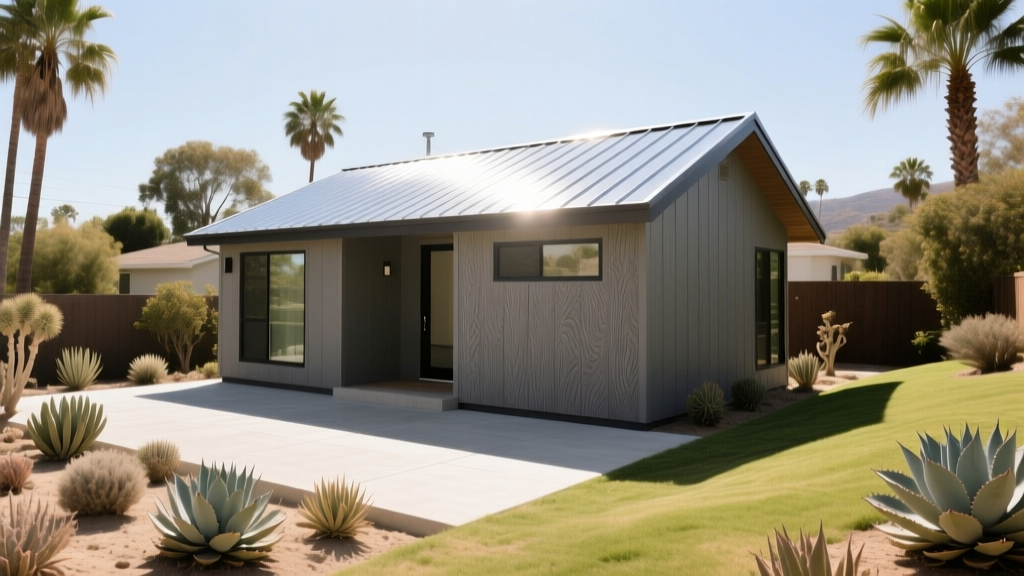
Material Specifications for San Diego Climates
San Diego's microclimates demand specific material choices to ensure longevity and minimize maintenance. When finalizing your bill of materials, specify the following to protect your investment:
Exterior Envelope
Avoid traditional wood lap siding, especially in coastal zones where salt spray accelerates rot and in eastern zones where fire risk is high. Specify 5/16-inch thick fiber cement siding with a factory-applied acrylic finish. For the weather-resistant barrier (WRB), use a fluid-applied membrane or a high-performance house wrap like Henry Blueskin VP100 to prevent moisture intrusion during the rare but intense atmospheric river events.
Roofing Systems
For flat or low-slope ADU roofs, avoid modified bitumen. Instead, specify a 60-mil TPO (Thermoplastic Polyolefin) single-ply membrane. TPO reflects UV radiation, keeping the interior cooling loads down during September heatwaves, and carries a 20-year commercial-grade warranty. For pitched roofs, use impact-resistant asphalt shingles (Class 4) or standing seam metal roofing, both of which satisfy WUI fire codes.
Financing Your San Diego ADU
Funding the construction requires strategic financial planning. In 2026, the most common financing routes for San Diego homeowners include:
- Home Equity Line of Credit (HELOC): Ideal if you have substantial equity and want to draw funds as construction milestones are met. Rates are variable, so this carries some market risk.
- Renovation Loans (FHA 203k or Fannie Mae HomeStyle): These allow you to borrow based on the projected future value of the property with the completed ADU, rather than its current value. This is excellent for house-hackers or investors.
- ADU-Specific Construction Loans: Several regional Southern California credit unions and specialized lenders offer ADU construction loans that convert to a standard mortgage upon certificate of occupancy issuance.
- CalHFA ADU Grant Program: Historically, the state has offered grants up to $40,000 to cover soft costs (permits, architectural plans, soil tests) for low-to-moderate-income homeowners. Check current state funding availability before starting your design phase.
Pre-Construction Checklist
Before signing a contract with a general contractor, ensure you have completed the following due diligence steps:
- Verify your property's exact zoning overlay (Coastal, Historical, WUI) via the City of San Diego's online zoning map.
- Obtain a preliminary title report to check for unrecorded easements that might block your proposed ADU footprint.
- Hire a private plumbing contractor to perform a video camera inspection of your existing sewer lateral to ensure it can handle the additional flow without requiring a $15,000 replacement.
- Request a detailed, line-item bid from at least three licensed general contractors, ensuring they explicitly include City of San Diego permit fees and Title 24 compliance in their scope of work.
Accurately estimating the cost to build an ADU in San Diego requires looking past the base construction price per square foot. By accounting for local zoning overlays, utility connection realities, and state-mandated energy codes, you can build a realistic budget that ensures your backyard project delivers a strong return on investment without unexpected financial derailments.
Written by
Marcus ChenMarcus Chen is a licensed structural engineer (PE) and building materials analyst with over 12 years of experience across residential, commercial, and industrial construction. He holds a Master of Science in Civil Engineering from UC Berkeley and spent six years at Thornton Tomasetti before transitioning to independent consulting and technical writing. Marcus specializes in material selection for seismic-prone regions, concrete reinforcement strategies, and lifecycle cost analysis. His work has been cited by the American Concrete Institute (ACI) and the Structural Engineers Association of California (SEAOC). When he is not on a job site or at his desk, you will find him hiking the Sierra Nevada or restoring a 1920s craftsman bungalow in Oakland, CA.
More from Marcus Chen
View all
Construction Cost
How Much Did the Eiffel Tower Cost to Build?
How much did the Eiffel Tower cost to build in 1889? We adjust for inflation and compare its budget to modern skyscraper construction.
Aug 4, 2026

Fire Resistance
What Is a Fire Resistant Material? Testing & Certification Guide
Discover what is a fire resistant material through ASTM and UL testing. Learn how fire ratings, certifications, and assemblies work in construction.
Aug 4, 2026

Construction Cost
How Much Did the Burj Khalifa Cost to Build?
How much did the Burj Khalifa cost to build? We break down the $1.5B project and extract 5 money-saving strategies for your next build.
Jul 30, 2026