The Cost to Build Epic Universe: Regional Construction Price Analysis
Analyze the cost to build Epic Universe through Central Florida regional pricing, labor rates, geotechnical challenges, and themed material logistics.
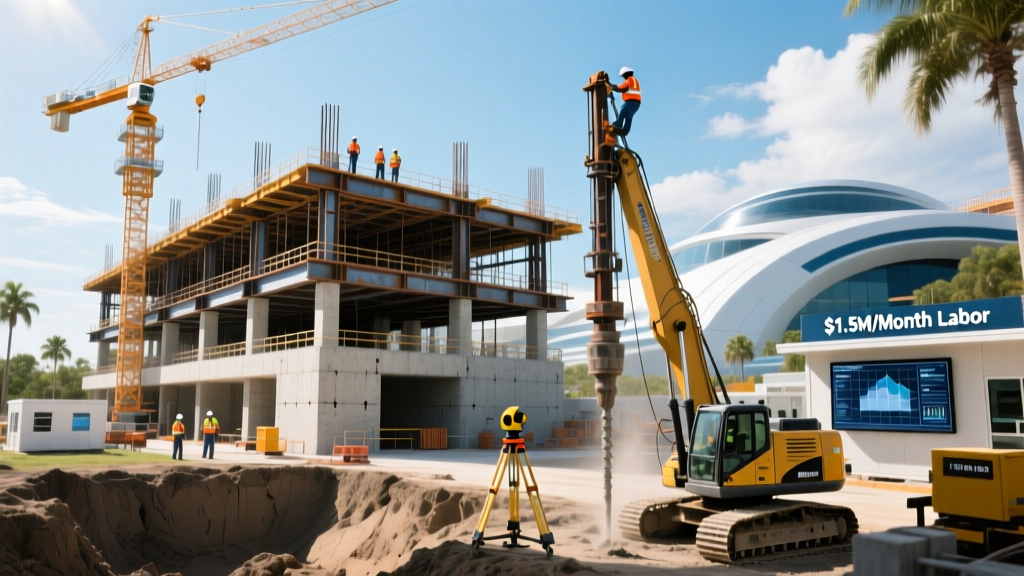
The $2.5 Billion Blueprint: Deconstructing the Epic Universe Budget
When Universal Orlando Resort announced Epic Universe, it represented the most significant single-site theme park investment in North American history. Now that the park has transitioned from active mega-project to operational reality, 2026 post-project cost audits provide an unprecedented look into the regional economics of Central Florida construction. The estimated cost to build Epic Universe sits at approximately $2.5 billion for the 110-acre theme park itself, part of a broader $3 billion campus development.
For construction estimators and commercial developers, analyzing this project is not about replicating a theme park; it is about understanding how extreme scope, specialized labor, and regional geotechnical realities inflate baseline commercial costs. By breaking down the regional price drivers in Orange County, Florida, we can extract actionable frameworks for estimating complex, high-fidelity commercial builds in the Southeast.
Central Florida Labor Economics: The Premium for Specialized Trades
The baseline labor market in the Orlando-Kissimmee-Sanford Metropolitan Statistical Area (MSA) is heavily skewed toward hospitality and residential construction. However, building Epic Universe required an influx of highly specialized trades that do not natively exist in the local labor pool at scale.
This labor scarcity forced general contractors to import specialized crews from Los Angeles, Las Vegas, and Europe. Estimators working on high-end retail, experiential museums, or luxury hospitality projects in Florida must apply a 35% to 50% premium over standard Bureau of Labor Statistics (BLS) regional wage data when the scope involves custom architectural millwork, animatronic integration, or scenic painting.
Labor Density and Shift Stacking
To meet aggressive deadlines, contractors utilized 'shift stacking'—running three distinct 8-hour shifts across 24 hours. In Central Florida, night-shift and weekend-shift differentials for specialized trades add an additional 15% to 22% to the base labor rate. Furthermore, the sheer density of workers on a 110-acre site created logistical bottlenecks, reducing overall labor productivity by an estimated 12% during peak vertical construction phases.
Geotechnical Realities: Engineering on Florida Karst Topography
Perhaps the most volatile cost variable in Central Florida is the subsurface. Orlando sits atop a karst topography characterized by porous, water-soluble limestone. This geological reality makes the region highly susceptible to sinkholes and differential settlement, requiring aggressive and expensive foundation strategies for heavy structures like roller coaster supports and towering themed castles.
"Building heavy, dynamic-load structures on Florida karst requires bypassing the shallow, unstable sand and clay layers entirely. We routinely design Continuous Flight Auger (CFA) piles driven 80 to 120 feet deep to socket directly into the stable Ocala Limestone formation." — Regional Geotechnical Engineering Consensus, Florida Department of Environmental Protection.
Deep Foundation Cost Drivers
For standard commercial buildings in Orlando, shallow spread footings might suffice, costing roughly $8 to $12 per square foot of foundation area. Epic Universe's massive ride systems and show buildings required deep piling.
- Augercast Piles (CFA): $45 to $65 per linear foot for depths exceeding 80 feet.
- Steel H-Piles (Driven): $70 to $95 per linear foot, utilized in areas with high dynamic vibration loads (e.g., launch coaster tracks).
- Sinkhole Remediation Grouting: Compaction grouting to stabilize shallow voids added an unpredictable $15,000 to $40,000 per localized grid before pile driving could even commence.
Material Logistics: Routing Themed Elements Through Port Canaveral
The supply chain for Epic Universe bypassed standard domestic building material distributors. Massive structural steel components, custom ride vehicles, and intricate Glass Fiber Reinforced Concrete (GFRC) facade panels were manufactured overseas and routed through Port Canaveral, located roughly 50 miles east of the construction site.
| Material Category | Standard Commercial Cost (Orlando) | Epic Universe Themed Cost | Primary Cost Driver |
|---|---|---|---|
| Structural Steel (Coaster Track) | $3,500 - $4,200 / ton | $12,000 - $18,000 / ton | Precision CNC milling, anti-corrosion marine coatings, overseas freight. |
| Exterior Facade (GFRC Panels) | $18 - $25 / sq. ft. | $45 - $75 / sq. ft. | Custom mold fabrication, hand-painted scenic finishes, embedded steel armatures. |
| Show Building HVAC (Precision) | $15 - $22 / sq. ft. | $40 - $60 / sq. ft. | Strict humidity control (45% RH) to protect projection mapping and animatronics. |
| Hardscape & Themed Paving | $8 - $12 / sq. ft. | $25 - $40 / sq. ft. | Custom-stamped concrete, hand-laid cobblestone, integrated fiber-optic lighting. |
According to regional tracking by the Engineering News-Record (ENR), Central Florida's material costs for standard structural concrete and rebar remained relatively stable leading into the mid-2020s. However, the bespoke nature of themed materials meant that Epic Universe was entirely insulated from local commodity fluctuations, instead bearing the brunt of international freight surcharges and specialized fabrication delays.
Climate-Resilient Construction and Weather Delays
Orlando averages over 80 days of measurable rainfall annually, with intense, localized thunderstorms dominating the summer months. For a project featuring massive outdoor earthworks, deep excavations for water rides, and towering unbraced steel structures, weather is a direct financial liability.
Estimators must account for 'weather days' not just as schedule extensions, but as hard costs. Dewatering operations for the extensive canal systems and moats required continuous pumping, adding $2,500 to $5,000 per day in equipment and fuel costs during the rainy season. Furthermore, Florida's strict hurricane building codes (HVHZ standards, though technically Miami-Dade, often adopted as best practice for mega-resorts) required enhanced structural connections and impact-resistant glazing for all guest-facing show buildings, adding an 8% to 12% premium to the exterior building envelope.
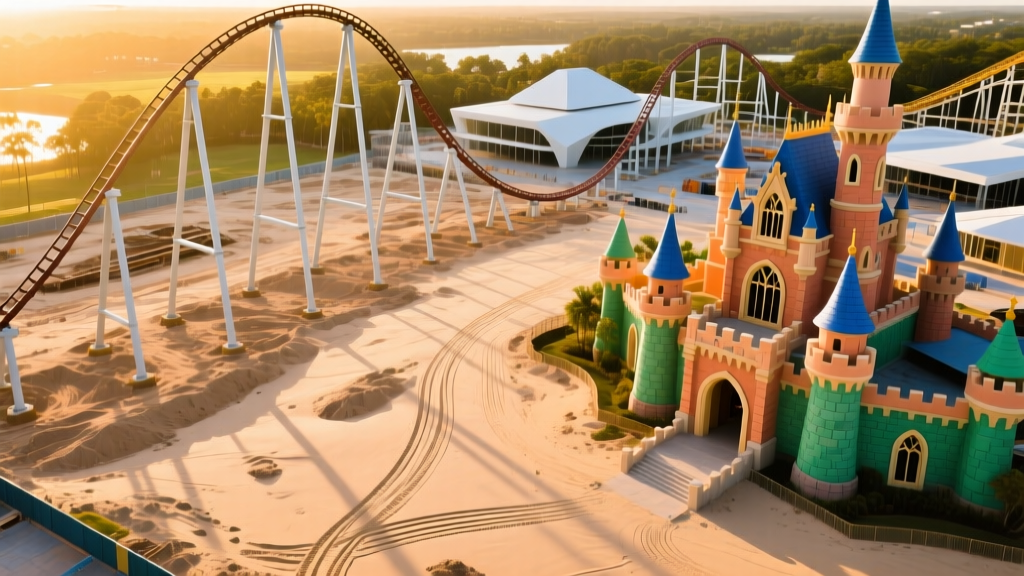
Regional Cost Comparison Matrix: Orlando vs. Anaheim vs. Las Vegas
To contextualize the cost to build Epic Universe, it is valuable to compare Central Florida's regional construction economics against other major entertainment construction hubs. The following matrix highlights how local factors shift the baseline costs for experiential builds.
| Cost Factor | Orlando, FL (Epic Universe) | Anaheim, CA (Disneyland Resort) | Las Vegas, NV (Sphere/Resorts) |
|---|---|---|---|
| Prevailing Wage Environment | Open Shop (Lower Base) | Heavy Union Influence (High Base) | Mixed / Prevailing Wage |
| Geotechnical Foundation Costs | Very High (Deep Karst Piling) | Moderate (Seismic Retrofitting) | Low (Stable Caliche Soil) |
| HVAC & Climate Control | High (Extreme Dehumidification) | Moderate (Standard Cooling) | High (Extreme Desert Cooling) |
| Specialized Labor Availability | Low (Requires Importation) | High (Established Local Hub) | High (Established Local Hub) |
Actionable Estimating Frameworks for Southeast Mega-Projects
The lessons extracted from the cost to build Epic Universe extend far beyond the theme park industry. Commercial estimators tackling large-scale mixed-use developments, airport expansions, or luxury resorts in the Southeast should adopt the following frameworks:
- Implement Geotechnical Risk-Sharing Contracts: Never assume standard shallow foundation costs in Central Florida. Mandate extensive soil boring grids (minimum 1 per 2,500 sq. ft.) during the design phase and utilize unit-price contracts for deep piling to avoid catastrophic change orders when limestone depths vary.
- Budget for Micro-Climate HVAC: Standard commercial HVAC load calculations fail when applied to spaces with high-density LED lighting, projection mapping, and massive guest occupancy. Increase baseline cooling tonnage estimates by 20% and specify dedicated desiccant dehumidification systems for any interior space housing sensitive AV equipment.
- Factor in 'Shift Stacking' Inefficiencies: If the project schedule demands 24/7 construction to meet a hard opening date, apply a 15% productivity loss factor to night shifts and a 20% cost premium for specialized trade overtime. The math of simply multiplying base rates by 1.5 for overtime severely underestimates the true cost of fatigue and shift-handoff delays.
- Secure Specialized Procurement Early: For custom architectural elements (e.g., GFRC, intricate metalwork), lock in fabrication slots with international suppliers 18 to 24 months in advance. Relying on local Central Florida suppliers for bespoke experiential elements will result in severe schedule delays and massive cost overruns.
Ultimately, the true cost of Epic Universe is a masterclass in managing regional friction. By understanding the hidden premiums of local geology, labor scarcity, and climate resilience, estimators can transform unpredictable mega-project risks into precisely calculated line items.
Written by
Sarah WhitfieldSarah Whitfield is a chartered quantity surveyor (MRICS) and construction cost analyst with 15 years of experience in material pricing, procurement strategy, and project budgeting. She earned her degree in Construction Management from the University of Reading (UK) and has worked on projects ranging from $2M custom homes to $180M mixed-use developments across North America and Europe. Sarah currently leads cost estimating for BuildMat Insight, maintaining a proprietary database of 4,000+ material price points updated quarterly. She is a frequent contributor to RSMeans cost data panels and has presented at the International Cost Engineering Council (ICEC) congress. Based in Denver, CO, Sarah is an avid trail runner and volunteer mentor for Women in Construction.
More from Sarah Whitfield
View all
Wood & Lumber
What Are the Different Types of Wood? A Builder's Guide
Compare structural softwoods, finish hardwoods, and engineered lumber. Analyze Janka ratings, MOE values, and 2026 pricing for construction.
Aug 4, 2026

Walls & Panels
Steel Framing vs Wood Framing: Corrosion and Moisture Defense
Compare steel framing vs wood framing for moisture resistance. Learn about galvanized coatings, condensation risks, and corrosion protection strategies.
Jul 21, 2026

Stone & Masonry
How to Cut Stone Veneer: Wet Saw vs Grinder Comparison
Compare the best tools for cutting stone veneer. We review wet saws, angle grinders, and chop saws to help you achieve clean, chip-free cuts.
Jul 21, 2026