Cost to Build Quadplex: 2026 Financing & Loan Guide
Discover the true cost to build quadplex projects in 2026. Compare FHA, DSCR, and conventional construction loans with exact down payments and ROI metrics.
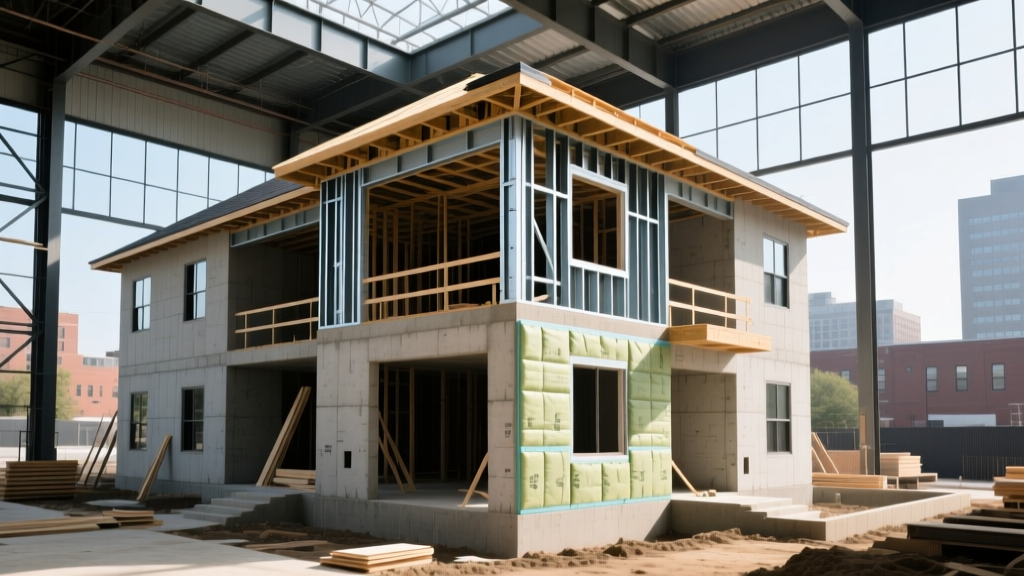
The True Cost to Build a Quadplex: Hard vs. Soft Costs
Calculating the exact cost to build quadplex structures requires separating hard construction costs from soft costs and land acquisition. In 2026, the national average for hard construction costs on a four-unit residential building ranges from $165 to $245 per square foot. For a standard 4,800-square-foot quadplex (1,200 square feet per unit), hard costs alone will total between $792,000 and $1,176,000.
However, securing construction financing requires a comprehensive pro forma that includes soft costs. Lenders will not approve a construction-to-permanent (C2P) loan without a fully burdened budget. Soft costs—including architectural plans, engineering, permits, impact fees, and insurance—typically add 18% to 25% to the hard construction costs.
| Cost Category | Estimated Range (4,800 sq ft) | Percentage of Total Budget |
|---|---|---|
| Land Acquisition | $120,000 - $250,000 | 15% - 20% |
| Site Prep & Foundation | $85,000 - $130,000 | 10% |
| Framing & Exterior Shell | $210,000 - $280,000 | 22% |
| MEP (Mechanical, Electrical, Plumbing) | $180,000 - $240,000 | 18% |
| Interior Finishes & Fixtures | $220,000 - $310,000 | 24% |
| Soft Costs & Permits | $140,000 - $190,000 | 15% |
| Contingency Reserve (Required by Lenders) | $80,000 - $110,000 | 10% |
Owner-Occupant vs. Investor Financing Pathways
Your financing strategy hinges entirely on whether you intend to occupy one of the four units. The distinction between owner-occupant and non-owner-occupant (investor) financing dictates your down payment, interest rate, and loan limits.
The FHA 203(k) and Owner-Occupant Advantage
If you plan to live in one unit for at least 12 months, you can leverage residential financing for a commercial-scale asset. Under HUD's FHA 203(k) guidelines, a quadplex is classified as residential property, allowing you to utilize FHA construction loans with a down payment as low as 3.5%.
For 2026, FHA 4-unit loan limits range from approximately $895,000 in standard areas to over $1.25 million in high-cost zones. This makes the FHA route the most capital-efficient way to build a quadplex, provided the total project cost (land + construction) remains under your county's specific ceiling.
DSCR and Conventional Investor Loans
If the quadplex is strictly an investment, you must pursue commercial or specialized investment property financing. Under Fannie Mae's property eligibility standards, conventional loans for 2-4 unit investment properties require a minimum 15% to 25% down payment, depending on your credit profile and debt-to-income (DTI) ratio.
Alternatively, Debt Service Coverage Ratio (DSCR) loans are increasingly popular for quadplex investors who want to underwrite the loan based on the property's rental income rather than their personal W-2 income. DSCR loans typically require 20% to 25% down and carry interest rates 0.75% to 1.50% higher than conventional owner-occupied mortgages.
| Loan Type | Down Payment | Underwriting Basis | Best Use Case |
|---|---|---|---|
| FHA Construction (203k) | 3.5% - 10% | Personal DTI & Credit | Owner-occupants maximizing leverage |
| Conventional C2P | 15% - 25% | Personal DTI & Income | High-income investors wanting lower rates |
| DSCR Construction Loan | 20% - 25% | Property Rental Income | W-2 income investors avoiding DTI limits |
Mastering the Debt Service Coverage Ratio (DSCR)
For non-owner-occupant quadplex financing, the DSCR is the single most critical metric lenders evaluate. The DSCR measures the property's ability to pay its own debt from its operating income.
DSCR Formula: Net Operating Income (NOI) / Annual Debt Service. A ratio of 1.20x or higher is typically required by DSCR and commercial lenders to approve the permanent phase of the loan.
The DSCR Stress Test: A 2026 Scenario
Assume you are building a quadplex with a total project cost of $1,100,000. You put 25% down ($275,000) and finance $825,000. At a 2026 investment rate of 7.75% (30-year fixed), your annual principal and interest payment is roughly $71,200. Adding property taxes, insurance, and HOA/landscaping reserves ($28,800/year), your total annual debt service is $100,000.
To achieve a 1.20x DSCR, your Net Operating Income (NOI) must be $120,000 annually. If your operating expense ratio is 40% (meaning 40% of gross rent goes to vacancies, maintenance, and management), your gross annual rent must be $200,000. This translates to $16,666 per month across all four units, or $4,166 per unit. If local market rents for 1,200-square-foot units only support $3,200/month ($12,800 total), your DSCR drops to 0.92x, and the lender will deny the permanent financing conversion.
Actionable Fix: If market rents cannot support the DSCR, you must increase your down payment to reduce the debt service, or redesign the quadplex to include rentable ancillary spaces (e.g., detached garage rentals or storage units) to boost gross NOI.
Navigating the Construction Draw Schedule
Construction loans do not disburse funds upfront. Lenders use a draw schedule, releasing capital in tranches as specific milestones are verified by a third-party inspector. Understanding this flow is vital for managing contractor relationships and avoiding work stoppages.
- Draw 1: Site Prep & Foundation (15%) - Released after lot clearing, grading, and pouring the foundation slab or footings.
- Draw 2: Framing & Drying In (25%) - Released when the structure is framed, roofed, and windows/doors are installed (the "dried-in" stage).
- Draw 3: Rough MEP (20%) - Released after mechanical, electrical, and plumbing rough-ins pass municipal inspections.
- Draw 4: Insulation & Drywall (15%) - Released post-insulation inspection and drywall hanging/finishing.
- Draw 5: Finishes & Trim (15%) - Released upon completion of cabinets, flooring, painting, and fixture installation.
- Draw 6: Final & Certificate of Occupancy (10%) - Released when the municipality issues the CO and the property is ready for tenant move-in.
Pro Tip: Ensure your general contractor's payment schedule aligns perfectly with the lender's draw milestones. If a contractor demands 40% upfront before the foundation is poured, the lender will flag this as a risk and may halt funding.
Three Hidden Costs That Derail Quadplex Approvals
When modeling the cost to build quadplex units, amateur developers frequently overlook localized soft costs. According to resources tracked by the Consumer Financial Protection Bureau, accurate loan sizing prevents mid-construction capital calls. Watch for these three budget-killers:
- Utility Tap Fees: In many high-growth municipalities, tapping into municipal water and sewer for four distinct units can cost $15,000 to $35,000 per unit in impact fees alone. This $60,000+ expense must be in the initial budget.
- Parking Minimums: Zoning boards often require 1.5 to 2.0 off-street parking spaces per unit. Paving or building a 16-space surface lot adds $25,000 to $45,000 to site prep costs, which lenders will require before approving the site plan.
- Acoustic Separation Upgrades: Standard residential framing fails quadplex soundproofing expectations. Upgrading to staggered-stud walls, resilient channels, and 5/8-inch Type X gypsum board between units adds roughly $12,000 to $18,000 to the framing and drywall budget, but is necessary to pass local fire and acoustic codes.
By meticulously modeling these costs and selecting the correct financing vehicle based on your occupancy intent, you can secure a construction loan that transitions seamlessly into a profitable permanent mortgage.
Written by
Marcus ChenMarcus Chen is a licensed structural engineer (PE) and building materials analyst with over 12 years of experience across residential, commercial, and industrial construction. He holds a Master of Science in Civil Engineering from UC Berkeley and spent six years at Thornton Tomasetti before transitioning to independent consulting and technical writing. Marcus specializes in material selection for seismic-prone regions, concrete reinforcement strategies, and lifecycle cost analysis. His work has been cited by the American Concrete Institute (ACI) and the Structural Engineers Association of California (SEAOC). When he is not on a job site or at his desk, you will find him hiking the Sierra Nevada or restoring a 1920s craftsman bungalow in Oakland, CA.
More from Marcus Chen
View all
Construction Cost
How Much Did the Eiffel Tower Cost to Build?
How much did the Eiffel Tower cost to build in 1889? We adjust for inflation and compare its budget to modern skyscraper construction.
Aug 4, 2026

Fire Resistance
What Is a Fire Resistant Material? Testing & Certification Guide
Discover what is a fire resistant material through ASTM and UL testing. Learn how fire ratings, certifications, and assemblies work in construction.
Aug 4, 2026

Construction Cost
How Much Did the Burj Khalifa Cost to Build?
How much did the Burj Khalifa cost to build? We break down the $1.5B project and extract 5 money-saving strategies for your next build.
Jul 30, 2026