How Much Does It Cost to Build a Road? Asphalt vs Concrete
Discover how much it costs to build a road in 2026. Compare asphalt vs. concrete pricing, base preparation expenses, and long-term lifecycle costs.
The Baseline: How Much Does It Cost to Build a Road?
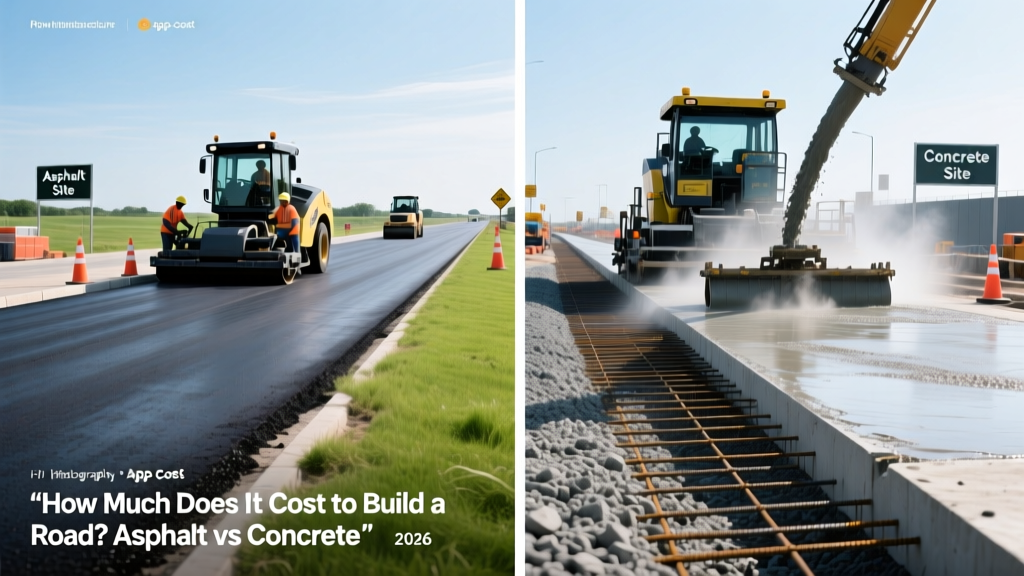
When estimating the capital expenditure for new infrastructure, the question of how much does it cost to build a road depends heavily on the pavement type, subgrade conditions, and traffic load requirements. In 2026, the national average cost to construct a standard two-lane rural highway ranges from $1.3 million to $2.8 million per mile. For urban arterials requiring complex drainage, curbing, and utility relocation, costs frequently exceed $4.5 million per mile. Translating these linear mile figures into area metrics, contractors typically bid between $45 and $130 per square yard for the paving phase alone.
However, surface paving represents only 40% to 60% of the total project budget. The remainder is consumed by earthwork, aggregate base courses, drainage infrastructure, and soft costs like environmental permitting. To build an accurate estimate, project managers must evaluate the two dominant surface materials: Hot Mix Asphalt (HMA) and Portland Cement Concrete (PCC). Each material presents a distinct cost profile, structural lifespan, and maintenance trajectory.
Material Showdown: Asphalt vs. Concrete Cost Matrix
The choice between flexible pavement (asphalt) and rigid pavement (concrete) dictates both the initial capital outlay and the structural design of the underlying base. Below is a comparative breakdown of material and installation costs for a standard 24-foot wide, two-lane road designed for medium-duty traffic.
| Metric | Hot Mix Asphalt (PG 64-22) | Portland Cement Concrete (4000 PSI) |
|---|---|---|
| Material Cost (Per Square Yard) | $22 - $35 | $45 - $70 |
| Installation & Paving (Per Sq. Yard) | $18 - $28 | $30 - $45 |
| Total Surface Cost (Per Sq. Yard) | $40 - $63 | $75 - $115 |
| Estimated Cost Per Mile (2-Lane) | $560,000 - $880,000 | $1,050,000 - $1,610,000 |
| Required Base Thickness | 6 to 10 inches (Aggregate Base) | 4 to 6 inches (Stabilized Subbase) |
| Design Lifespan | 15 - 20 Years | 30 - 40 Years |
Asphalt utilizes Performance Graded (PG) binders, such as PG 64-22, which are engineered to withstand specific regional temperature extremes. Concrete paving relies on slip-form extrusion and air-entrained mixtures to resist freeze-thaw scaling. While concrete demands nearly double the initial surface investment, its rigid structural properties often allow for a thinner underlying aggregate base, partially offsetting the material premium.
Subgrade Engineering: The Hidden Cost Multiplier
Surface material costs are predictable; subgrade conditions are not. The native soil's California Bearing Ratio (CBR) dictates the thickness and composition of the road's foundation. Building a road over expansive clay or peat requires aggressive soil stabilization, which can add $150,000 to $300,000 per mile to the earthwork budget.
For standard subgrades (CBR 8-15), a 6-to-8-inch layer of Crushed Aggregate Base (CAB) is required. Recycled Asphalt Pavement (RAP) and Recycled Concrete Aggregate (RCA) are increasingly utilized in 2026 to lower base material costs. Sourcing RAP from local milling operations can reduce aggregate base expenses by 20% to 30%, though it requires strict quality control to ensure proper drainage and compaction density (typically 95% Modified Proctor).
Lifecycle Cost Analysis (LCCA): Beyond the Initial Bid
The Federal Highway Administration (FHWA Pavement Design Guidelines) mandates Lifecycle Cost Analysis (LCCA) for federally funded projects, a framework that private developers should equally adopt. LCCA evaluates the net present value of initial construction plus all future maintenance, rehabilitation, and user delay costs over a 40-to-50-year analysis period.
Asphalt Maintenance Trajectory
Asphalt is a flexible pavement that degrades progressively. According to the National Asphalt Pavement Association (NAPA Design Resources), a properly designed HMA road will require a mill-and-overlay rehabilitation every 12 to 15 years. This process involves grinding off the top 2 inches of oxidized asphalt and replacing it with fresh mix, costing approximately $18 to $25 per square yard. Over a 40-year lifespan, an asphalt road will undergo two major overlays and routine crack sealing.
Concrete Maintenance Trajectory
Concrete pavements, as documented by the American Concrete Pavement Association (ACPA Design Manuals), require minimal structural maintenance for the first 20 to 25 years. The primary interventions are joint resealing (every 10 years at roughly $2.50 per linear foot) and diamond grinding to restore ride smoothness and correct faulting at the transverse joints. While the interventions are less frequent, diamond grinding and dowel bar retrofitting are highly specialized, expensive operations when they eventually become necessary.
Regulatory, Permitting, and Soft Costs
Estimating the physical materials is only half the battle. Road construction triggers a cascade of regulatory requirements that impact the final ledger:
- Stormwater Pollution Prevention Plans (SWPPP): Earthmoving requires strict erosion control. Installing silt fences, sediment basins, and stabilization matting adds $25,000 to $60,000 per mile.
- Right-of-Way (ROW) Acquisition: In suburban or urban environments, purchasing land easements can eclipse the actual construction costs. Rural greenfield projects avoid this but may face environmental impact studies regarding wetland mitigation.
- Traffic Control and Phasing: Maintaining traffic flow during construction on existing alignments requires flaggers, temporary concrete barriers, and dynamic message signs, typically consuming 8% to 12% of the total construction budget.
Decision Framework: Which Pavement Should You Build?
To determine the most cost-effective road for your specific project, apply this decision matrix:
Choose Hot Mix Asphalt If:
- The project has strict initial capital constraints.
- The road is located in a region with extreme freeze-thaw cycles where concrete joints are prone to rapid deterioration from de-icing salts.
- The route carries heavy, slow-moving industrial traffic (which can cause concrete joint spalling but is easily repaired in asphalt).
- Overnight construction phasing is required to minimize traffic disruption.
Choose Portland Cement Concrete If:
- The project lifecycle exceeds 30 years and municipal maintenance budgets are historically underfunded.
- The road will experience heavy channelized traffic (e.g., interstate highways or port access roads) where asphalt rutting is a primary concern.
- The subgrade consists of highly expansive clays; the rigid structural slab of concrete bridges minor subgrade inconsistencies better than flexible asphalt.
- Nighttime visibility is a priority, as concrete's high albedo reflects headlights better, potentially reducing municipal lighting infrastructure costs.
Ultimately, answering how much does it cost to build a road requires looking past the paver's bid sheet. A $60 per square yard asphalt road built on a poorly compacted, un-stabilized clay subgrade will fail in five years, resulting in a total cost of ownership that vastly exceeds a $100 per square yard concrete road engineered on a stabilized foundation. Invest heavily in geotechnical analysis and base preparation to protect your surface investment.
Written by
James ThorntonJames Thornton is a construction industry veteran with 25 years of hands-on experience in wood framing, lumber grading, and residential building codes. He started as a framing carpenter in rural Oregon, earned his ICC Residential Building Inspector certification, and eventually became a senior plan reviewer for the City of Portland Bureau of Development Services. James holds a B.S. in Wood Science & Technology from Oregon State University and is a certified lumber grader through the West Coast Lumber Inspection Bureau (WCLIB). He has inspected over 3,000 residential construction sites and authored the city's internal guide on advanced framing techniques (2x6 at 24" O.C.). James lives in Bend, OR, where he builds custom timber-frame cabins and competes in lumberjack sports.
More from James Thornton
View all
Insulation
Best Home Insulation Materials: Complete 2026 Guide
Compare top home insulation materials for 2026. Find R-values, installed costs per square foot, and best uses for fiberglass, spray foam, and mineral wool.
Aug 4, 2026

Sustainable Building
Certify Your Green Building Material for LEED and WELL
Step-by-step guide to certifying a green building material for LEED v5 and WELL v2. Master EPDs, HPDs, and VOC limits for 2026 project specifications.
Aug 4, 2026

Stone & Masonry
Veneer Stacked Stone Panels: Interior Design & Style Showcase
Discover how veneer stacked stone panels transform interiors. Explore modern design profiles, material pairings, and technical installation specs.
Aug 4, 2026