How Much Does It Cost to Build Steps? Budget & Savings Guide
Discover exactly how much it costs to build steps. Compare concrete, wood, and composite materials, and learn expert money-saving strategies.
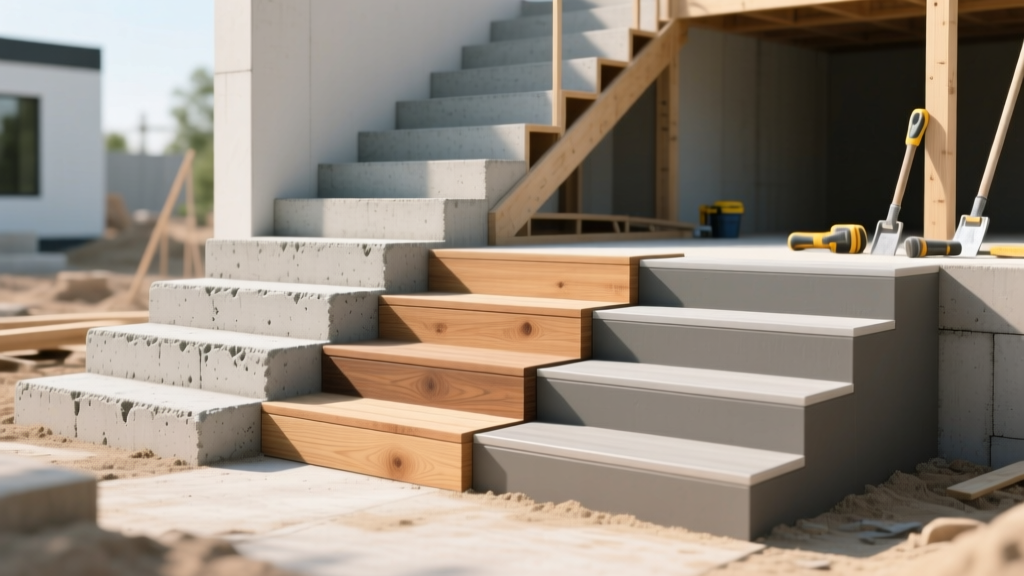
The True Cost Breakdown: How Much Does It Cost to Build Steps?
When homeowners ask, 'how much does it cost to build steps,' the answer depends entirely on material selection, site topography, and labor sourcing. In 2026, the national average for exterior step construction ranges from $1,200 to $5,500 for a standard 3-to-5 step staircase. However, this wide variance masks the specific unit economics that dictate your final bill. To effectively manage your budget, you must shift your focus from the total project cost to the cost per tread and riser.
• Pressure-Treated Wood: $150 – $250
• Precast Concrete: $200 – $350
• Poured-in-Place Concrete: $350 – $550
• Composite Decking Materials: $250 – $400
• Natural Bluestone/Granite: $600 – $900+
Material Selection: Where the Biggest Savings Hide
The most common budgeting mistake is selecting a material based solely on aesthetic preference without accounting for the hidden labor multipliers. Below is a direct comparison of the most common exterior step materials, analyzing both material and installed costs.
| Material Type | Material Cost (Per Step) | Labor Multiplier | Lifespan |
|---|---|---|---|
| Pressure-Treated Pine | $45 - $80 | 1.5x (Low) | 15-20 Years |
| Precast Concrete Treads | $80 - $150 | 2.0x (Medium) | 30-50 Years |
| Poured Concrete | $120 - $200 (in concrete) | 4.0x (High - Forming) | 50+ Years |
| Composite (e.g., Trex) | $90 - $140 | 1.8x (Medium) | 25-30 Years |
The Precast vs. Poured Concrete Decision
If you want the durability of masonry without the exorbitant labor costs, choose precast concrete treads. Poured-in-place concrete requires contractors to build custom wooden forms, tie rebar, pour, and finish the concrete on-site. According to the National Ready Mixed Concrete Association (NRMCA), short-load concrete deliveries and custom forming can push poured step costs past $500 per tread. Precast treads, manufactured off-site in controlled environments, simply require a compacted gravel base and a mason to set them with polyurethane construction adhesive. This eliminates forming labor entirely, saving roughly $150 to $250 per step.
The Mathematics of Savings: Optimizing Rise and Run
The physical dimensions of your stairs directly dictate your material volume and labor hours. The International Residential Code (IRC) mandates that the maximum riser height is 7.75 inches and the minimum tread depth is 10 inches. However, manipulating these numbers within the legal limits is a powerful money-saving strategy.
Suppose your total elevation change from the patio door to the grade is 46 inches. At a standard 7.6-inch rise, you need exactly 6 steps (46 / 7.6 = 6.05). By regrading the soil at the base of the stairs and adding 4 inches of compacted crushed stone, you reduce the total elevation change to 42 inches. At a 7-inch rise, you now only need 6 steps, but if you can push the rise to the legal maximum of 7.75 inches, you drop the requirement to 5 steps (42 / 7.75 = 5.4). Eliminating a single poured concrete step saves an average of $450 in materials and labor. Always calculate the math before finalizing your site prep.
Hidden Cost Multipliers to Avoid
When estimating how much it costs to build steps, contractors often exclude ancillary requirements from the initial quote. Watch out for these budget-killers:
- Code-Compliant Railings: Any stairway with four or more risers legally requires a handrail. Basic pressure-treated 2x4 railings cost $25-$40 per linear foot, but upgrading to powder-coated aluminum or glass balusters can add $100-$250 per linear foot. If your elevation change allows, designing a 3-step staircase legally bypasses the handrail requirement in many municipalities.
- Frost Heave Mitigation: In northern climates, attaching wooden steps directly to a house ledger board without independent footings below the frost line will result in structural tearing. Digging 4-foot deep sonotube footings adds $300-$600 to the project. Savings alternative: Build 'free-floating' steps that rest on a crushed gravel pad, allowing them to move independently of the house foundation during freeze-thaw cycles.
- Demo and Haul-Away: Removing existing masonry steps requires jackhammers, heavy lifting, and dumpster fees. Expect to pay $400 to $800 just for demolition. Doing this yourself and renting a local roll-off dumpster can cut this cost by 60%.
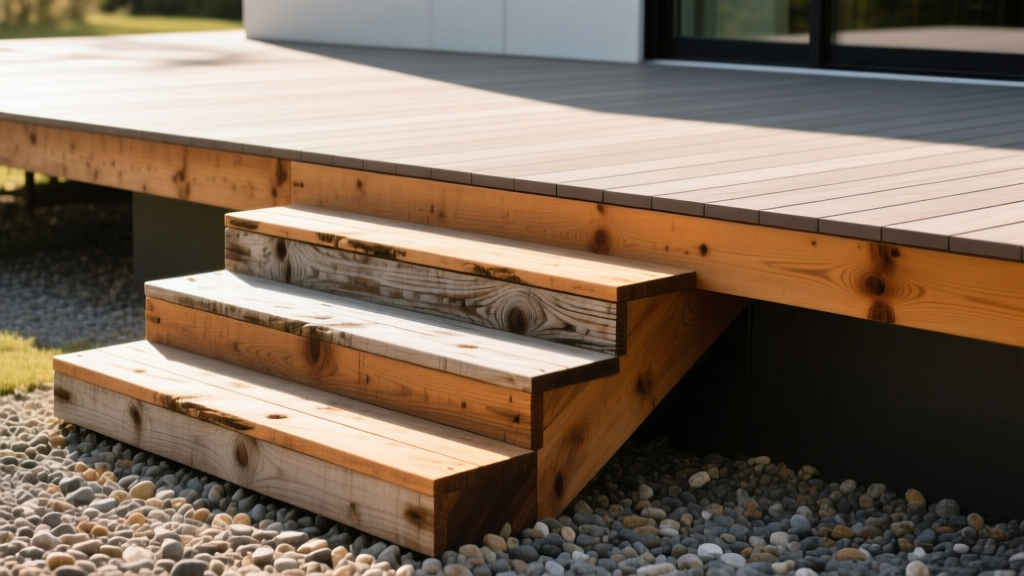
Lumber Grades: Don't Overbuy, Don't Underbuy
For wood steps, selecting the correct American Wood Protection Association (AWPA) use category is critical for balancing cost and longevity. Do not use standard above-ground treated lumber (UC3B) for exterior steps; it will rot within five years. Conversely, you do not need marine-grade lumber for a standard backyard staircase.
The Sweet Spot: UC4A Ground Contact Lumber
Specify UC4A (Ground Contact) pressure-treated southern yellow pine for your stringers, risers, and treads. UC4A lumber retains 0.40 PCF (pounds per cubic foot) of copper azole or ACQ preservative, which is sufficient for steps resting on or near soil. It costs roughly 15% more than above-ground lumber but 40% less than UC4B (Heavy Duty Ground Contact) or tropical hardwoods like Ipe. Ensure your hardware (joist hangers, structural screws) is rated for ACQ treated wood—specifically, hot-dipped galvanized (G185) or stainless steel—to prevent rapid galvanic corrosion.
Decision Framework: DIY vs. Professional Installation
To determine if you should self-perform the work, evaluate your project against this structural complexity matrix:
| Project Profile | Recommended Approach | Estimated Savings |
|---|---|---|
| Straight-run, 3 steps, wood or precast | 100% DIY | $800 - $1,500 |
| Straight-run, 4+ steps, poured concrete | DIY Demo & Prep, Pro Pour | $400 - $700 |
| Curved/Winder steps, any material | Professional Only | N/A (Avoid DIY errors) |
| Composite over complex framing | Pro Framing, DIY Decking | $500 - $900 |
Frequently Asked Questions
Are precast concrete steps cheaper than wood?
Initially, pressure-treated wood is cheaper in raw materials ($45-$80 per step vs. $80-$150 for precast). However, when factoring in the 15-year lifecycle cost, preast concrete becomes significantly cheaper. Wood requires annual sealing, board replacements due to warping, and eventual full rebuilds, whereas precast concrete requires zero maintenance beyond occasional power washing.
How much does it cost to build steps with a landing?
Adding a mid-stair landing increases the total project cost by $800 to $1,500. A landing requires additional footings, a larger framing footprint, and extra decking or concrete surface area. While expensive, landings are legally required by the OSHA stairway regulations and most residential codes if a door swings outward over the stairs, necessitating a flat platform equal to the width of the door.
Can I use gravel instead of building bottom steps?
Yes, transitioning from your final wooden or concrete tread into a compacted crushed stone (specifically 3/4-inch minus gravel) ramp or pad is an excellent way to eliminate the bottom one or two steps. This not only saves $300+ in construction costs but also improves drainage at the base of the stairs, preventing the frost heave and wood rot that typically destroy the bottom tread of exterior staircases.
Written by
Elena RodriguezElena Rodriguez is a civil engineer and technical writer specializing in concrete technology, masonry systems, and ASTM/ACI compliance. She earned her B.S. in Civil Engineering from Texas A&M University and spent a decade at a materials testing laboratory, performing over 2,000 concrete compressive strength tests and masonry prism evaluations. Elena is an ACI-certified Field Testing Technician (Grade I) and a member of ASTM Committee C12 on Natural Building Stone. She currently consults on forensic engineering cases involving concrete failures and moisture intrusion. Based in San Antonio, TX, Elena is a proud member of the Society of Women Engineers (SWE) and coaches her daughter's FIRST Robotics team.
More from Elena Rodriguez
View all
Walls & Panels
Cost Analysis: Light Gauge Steel Framing Advantages and Disadvantages
Evaluate light gauge steel framing advantages and disadvantages through a strict cost analysis lens, comparing material, labor, and lifecycle expenses.
Aug 4, 2026

Walls & Panels
Gypsum Board Types: Exact Specifications, Thickness & Dimensions
Compare standard, Type X, and moisture-resistant gypsum board types. Get exact specifications, thicknesses, dimensions, and ASTM standards for your project.
Aug 4, 2026

Fire Resistance
Best Fire-Resistant Outdoor Decking Materials: 2026 Buyer Guide
Discover the best fire-resistant outdoor decking materials for 2026. Compare Class A PVC, aluminum, and hardwood options for WUI compliance and safety.
Aug 4, 2026