Average Cost to Build a Gaming PC in 2026: Detailed Breakdown
Discover the average cost to build a gaming PC in 2026. Detailed component breakdown, budget tiers, and hidden fees for entry to enthusiast rigs.
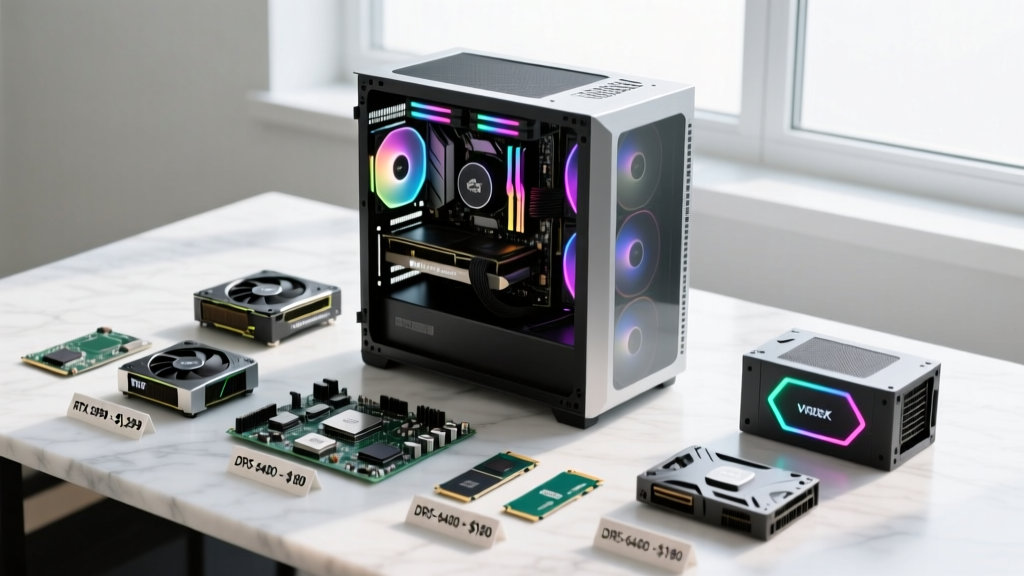
The 2026 Hardware Landscape: Pricing Realities
Determining the average cost to build a gaming PC requires navigating a hardware market defined by AI-driven silicon demand, matured DDR5 ecosystems, and the widespread adoption of PCIe 5.0 storage. In 2026, the baseline for a competent 1440p gaming experience has shifted. While entry-level 1080p machines remain accessible, the mid-range sweet spot now demands higher capital due to the baseline performance requirements of modern game engines utilizing advanced ray tracing and frame generation technologies.
The average cost to build a gaming PC that targets high-refresh-rate 1440p gaming currently sits between $1,550 and $1,850. This figure represents a fully functional tower, excluding peripherals and operating system licenses. Understanding where this money goes requires a granular look at individual component pricing and the technical specifications that justify the premium.
Component-by-Component Cost Breakdown
The following table outlines a highly optimized mid-range 2026 build designed for 1440p ultra-settings. This configuration leverages the ATX 3.1 power standard and AMD EXPO-certified memory to eliminate bottlenecking.
| Component | 2026 Specification Target | Estimated Cost |
|---|---|---|
| CPU | AMD Ryzen 7 9800X3D (8-Core, 3D V-Cache) | $449 |
| GPU | NVIDIA GeForce RTX 5070 Ti (16GB GDDR7) | $749 |
| Motherboard | B650E ATX (PCIe 5.0 GPU & M.2 support) | $220 |
| RAM | 32GB (2x16GB) DDR5-6000 CL30 EXPO | $115 |
| Storage | 2TB PCIe 4.0 NVMe M.2 SSD (e.g., WD Black SN850X) | $160 |
| Power Supply | 850W 80+ Gold ATX 3.1 (Native 12V-2x6 cable) | $130 |
| Case | Mid-Tower Dual-Chamber (Mesh front, included 120mm PWM fans) | $110 |
| CPU Cooler | 280mm AIO Liquid Cooler or High-End Dual-Tower Air | $95 |
| Total | Core System Build | $2,028 |
According to ongoing market analysis by Tom's Hardware, the premium for X3D cache-equipped processors remains steep but offers unparalleled 1% low frame rates in CPU-bound simulation and strategy titles. Pairing this with a 16GB GDDR7 GPU ensures sufficient VRAM for high-resolution texture packs, a critical factor as 2026 game releases routinely exceed 12GB of VRAM usage at maximum settings.
Budget Tiers: Entry, Mid, and Enthusiast
The average cost to build a gaming PC fluctuates wildly based on your target resolution and desired longevity. Below are the three primary build tiers for the current market.
Entry-Level (1080p High Refresh): $800 - $1,100
Target: 1080p at 144Hz+ in competitive shooters and medium-high settings in AAA titles.
Key Specs: Intel Core i5-14400F or AMD Ryzen 5 7600, RTX 4060 or RX 7600 XT, 16GB DDR5-5200, 1TB PCIe 4.0 SSD. At this tier, builders must compromise on motherboard VRM quality and case airflow, often relying on stock coolers or budget single-tower air coolers.
Mid-Range (1440p Ultra): $1,500 - $2,200
Target: 1440p at 144Hz+ with Ray Tracing enabled and frame generation active.
Key Specs: AMD Ryzen 7 9700X or Intel Core Ultra 7, RTX 5070 or RX 9070 XT, 32GB DDR5-6000 CL30, 2TB NVMe. This is the sweet spot for price-to-performance. You gain access to ATX 3.1 power supplies, premium dual-chamber cases, and robust motherboard power delivery capable of handling future CPU upgrades.
Enthusiast (4K Uncompromised): $3,500 - $5,000+
Target: Native 4K at 120Hz+ with full path tracing and maximum texture fidelity.
Key Specs: AMD Ryzen 9 9950X3D or Intel Core Ultra 9, RTX 5090 (24GB+ GDDR7), 64GB DDR5-6400+, 4TB PCIe 5.0 SSD (e.g., Crucial T705), 360mm/420mm AIO cooling, 1200W+ ATX 3.1 Titanium PSU. Diminishing returns hit hard here; you are paying a massive premium for the top 5% of performance.
Hidden Costs and Assembly Variables
First-time builders frequently underestimate the ancillary expenses required to make a custom rig fully operational. When calculating your total budget, factor in the following often-overlooked costs:
- Operating System: A retail Windows 11 Home license costs $139. While OEM keys are available for less on third-party marketplaces, they carry compliance and transferability risks for professional environments.
- Thermal Interface Material (TIM): High-end coolers include pre-applied paste, but enthusiast builders often purchase premium TIM like Thermal Grizzly Kryonaut Extreme ($25) for optimal heat transfer on delidded or high-TDP chips.
- Cable Extensions and Management: Aesthetics matter in modern dual-chamber cases. Sleeved PSU cable extension kits (e.g., CableMod Pro ModMesh) add $40 to $70 to the final bill.
- Peripherals: The average cost to build a gaming PC does not include the monitor, keyboard, and mouse. A high-quality 1440p 240Hz OLED monitor alone will add $600 to $900 to your total expenditure.
- Assembly Tools: A magnetic Phillips #2 screwdriver (iFixit Mako kit, $40) and an anti-static mat are highly recommended to prevent damage to sensitive PCB components during installation.
Strategic Sourcing: Maximizing Component Value
Securing the best pricing requires strategic timing and platform utilization. Component prices fluctuate based on supply chain constraints and retail promotional cycles.
Pro Tip: Never buy a motherboard and CPU separately if you can avoid it. Retailers like Micro Center and Newegg frequently offer 'Combo Bundles' that discount the motherboard by $30 to $50 when purchased with a compatible processor, significantly lowering the average cost of your core platform.
Utilize aggregation tools like PCPartPicker to track historical pricing and set alerts for specific SKUs. Furthermore, consult current benchmark databases such as TechPowerUp to verify that a cheaper, previous-generation component (like a last-gen PCIe 4.0 SSD) offers identical real-world gaming performance to a premium PCIe 5.0 drive, allowing you to reallocate funds toward a more powerful GPU.
Frequently Asked Questions
Is it cheaper to build or buy a pre-built gaming PC in 2026?
Building your own PC is almost always cheaper when comparing exact component specifications. Pre-built manufacturers charge a 'build fee' or markup of 15% to 30% to cover assembly, warranty support, and proprietary software. However, during major retail holidays (Black Friday, Prime Day), pre-built systems from major OEMs can occasionally undercut custom builds due to bulk-purchasing power on mid-range GPUs.
How long will a $1,500 gaming PC last?
A well-configured $1,500 system built in 2026 with 32GB of RAM and a 16GB VRAM GPU will comfortably handle 1440p gaming at high settings for 4 to 5 years. The primary upgrade path to extend longevity will be dropping in a newer CPU on the same AM5 or LGA1851 motherboard socket and adding additional NVMe storage as game file sizes continue to inflate.
Do I need a PCIe 5.0 power supply?
You do not strictly need a PCIe 5.0 (ATX 3.0/3.1) power supply if you are using older or mid-range graphics cards that rely on standard 8-pin PCIe connectors. However, if you are installing an NVIDIA RTX 40-series or 50-series card that utilizes the 12VHPWR or 12V-2x6 connector, an ATX 3.1 compliant PSU is highly recommended. It provides a native cable that eliminates the need for messy and potentially hazardous adapter dongles, ensuring stable power delivery under transient load spikes.
Written by
David NakamuraDavid Nakamura is a licensed architect (AIA) and construction technology writer focused on sustainable building methods, mass timber engineering, and high-performance building envelopes. He holds a Master of Architecture from the University of Washington and is a certified Passive House Consultant (CPHC). David spent eight years at the Seattle firm Mithun, where he led the design of three LEED Platinum projects, before founding his own practice specializing in net-zero residential design. He serves on the editorial advisory board of GreenBuilder Magazine and has authored peer-reviewed papers on cross-laminated timber (CLT) connections for the Journal of Structural Engineering. In his spare time, David teaches woodworking at Pratt Fine Arts Center and kayaks the Puget Sound.
More from David Nakamura
View all
Construction Cost
Labor Cost to Build a Deck Per Sq Ft: 2026 Installation Guide
Discover the exact labor cost to build a deck per sq ft in 2026. This installation guide breaks down contractor rates, complexity factors, and hidden fees.
Aug 4, 2026

Construction Cost
How Much Does It Cost to Build a 3 Bedroom House? Financing Guide
Learn exactly how much it costs to build a 3 bedroom house and explore 2026 financing options, construction loan types, and budget frameworks for your build.
Aug 4, 2026

Construction Cost
Cost to Build a Tennis Court: 2026 Guide
How much does it cost to build a tennis court in 2026? Breakdowns for asphalt, concrete, and synthetic surfaces plus fencing and lighting.
Jul 30, 2026