DeepSeek Cost to Build: AI Data Center vs Warehouse Construction
Compare the DeepSeek cost to build physical AI data center infrastructure against traditional commercial warehouse construction in 2026.
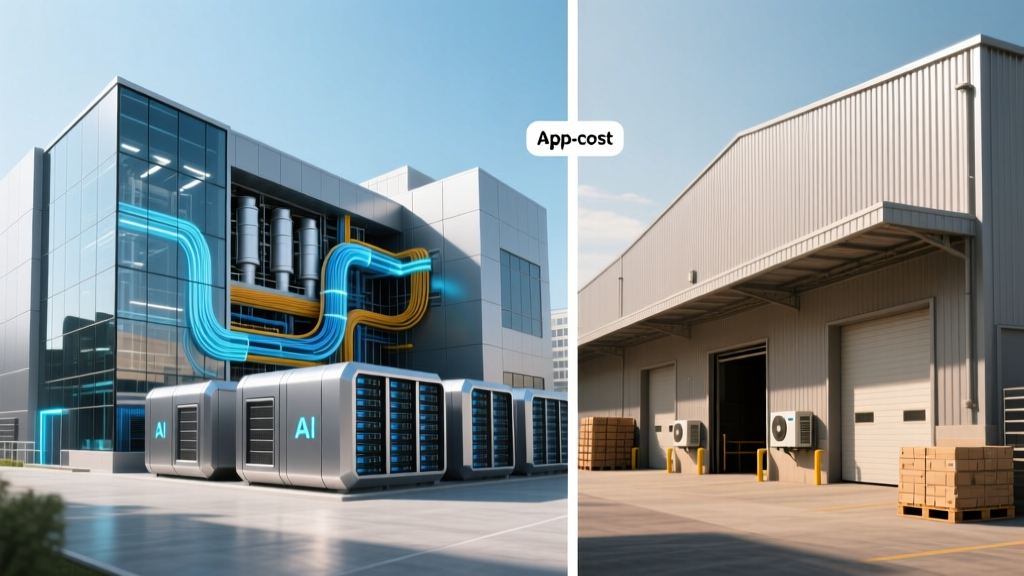
The Physical Reality: Compute vs. Construction
When DeepSeek released its V3 model, the tech industry was stunned by the reported $5.5 million training cost—a fraction of what US hyperscalers spend. However, commercial real estate developers and construction estimators look at a different metric: the physical infrastructure required to house those GPU clusters. The DeepSeek cost to build the actual Tier III or Tier IV data center facilities capable of supporting high-density AI compute is a massive capital expenditure that dwarfs traditional commercial builds.
While the algorithmic efficiency of DeepSeek's models reduces cloud compute rental fees, the physical bricks, mortar, copper, and cooling infrastructure required to host thousands of Nvidia H800 or H20 accelerators follow the unforgiving laws of construction economics. In 2026, building an AI-ready data center is less about erecting a shell and more about integrating extreme mechanical, electrical, and plumbing (MEP) systems into a reinforced structure.
Cost Comparison Matrix: AI Data Center vs. Standard Warehouse
To understand the premium of AI infrastructure, we must compare it to the baseline of commercial construction: the standard logistics warehouse. The following matrix breaks down the core construction and engineering differences that drive the DeepSeek cost to build physical facilities.
| Construction Feature | AI Data Center (DeepSeek Tier) | Standard Logistics Warehouse |
|---|---|---|
| Hard Construction Cost (per sq ft) | $1,200 - $1,800+ | $120 - $180 |
| Power Density Requirement | 50kW - 120kW per rack | 0.01kW - 0.05kW per sq ft |
| Structural Floor Load Capacity | 250 - 350 lbs/sq ft | 50 - 75 lbs/sq ft |
| HVAC & Cooling Infrastructure | 35% - 45% of total MEP budget | 5% - 10% of total MEP budget |
| Backup Power Redundancy | 2N (Fully mirrored UPS & Generators) | None or basic emergency lighting |
| Slab Thickness & Reinforcement | 12' - 18' thick, heavy rebar mesh | 6' - 8' thick, standard fiber mesh |
As noted by the U.S. Department of Energy, data centers consume significantly more energy per square foot than any other commercial building type, necessitating specialized structural and electrical designs that exponentially increase the initial build cost.
Breaking Down the DeepSeek Cost to Build by Construction Phase
Estimating the physical build requires segmenting the project into distinct construction phases. For a 100,000 square foot AI-focused facility, the cost distribution looks vastly different from a standard commercial project.
1. Site Work and Utility Routing (15% of Budget)
AI facilities require massive utility feeds. A standard warehouse might need a 2,000-amp electrical service. A DeepSeek-tier AI facility requires dedicated high-voltage substations (often 10MW to 50MW+ per building). Trenching, laying underground duct banks, and coordinating with local utility providers for high-voltage drop points can cost upwards of $15 million before the foundation is even poured.
2. Core and Shell (20% of Budget)
While the exterior might resemble a standard tilt-up concrete warehouse, the structural engineering is entirely different. The roof must support heavy rooftop chillers and cooling towers. The walls require higher R-value insulation to maintain strict climate control, and the building envelope must be sealed to positive pressure to prevent dust infiltration into the server aisles.
3. MEP and Commissioning (55% of Budget)
This is where the DeepSeek cost to build truly separates from traditional real estate. According to guidelines from the General Services Administration (GSA), the mechanical and electrical systems are the heart of the facility. This phase includes:
- Electrical Busways: Overhead busway systems replacing traditional cable trays to deliver high-amperage power directly to server racks.
- UPS Systems: Lithium-ion battery arrays capable of bridging the 10-to-15-second gap before backup diesel generators (like MTU or Caterpillar 2MW units) synchronize to the grid.
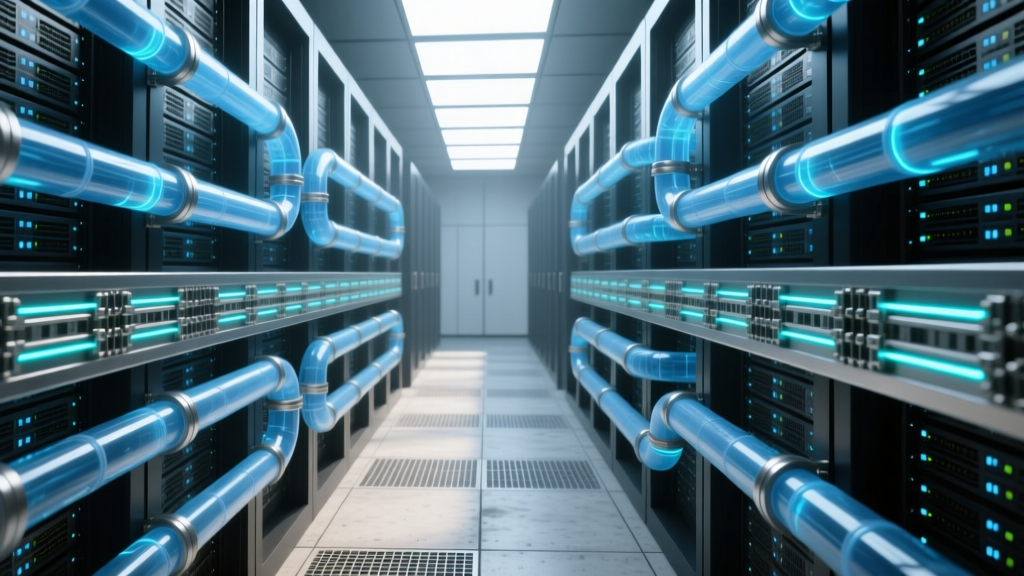
- Coolant Distribution Units (CDUs): For high-density GPU clusters, air cooling is insufficient. Facilities must be plumbed with CDUs and direct-to-chip (D2C) liquid cooling loops, requiring specialized piping, leak detection systems, and chemical treatment skids.
4. Architectural Finishes and Security (10% of Budget)
AI data centers require man-trap security vestibules, biometric access controls, and raised access flooring (or specialized slab-on-grade with under-floor air distribution) to manage airflow and cabling.
When calculating the DeepSeek cost to build, do not ignore the carrying costs associated with utility lead times. In 2026, procuring high-voltage transformers and switchgear can take 18 to 24 months. Developers must factor in the cost of land holding, temporary power solutions, and phased commissioning while waiting for heavy electrical equipment to arrive.
Structural and MEP Upgrades for High-Density GPU Clusters
Many commercial developers attempt to retrofit existing warehouse spaces to capture the AI hosting boom. However, converting a standard logistics building into a facility capable of supporting DeepSeek's compute density introduces severe structural and MEP friction points.
The Floor Load Problem
A fully loaded AI server rack, complete with liquid cooling manifolds and heavy GPU chassis, can weigh between 3,000 and 4,500 pounds. Standard warehouse slabs (designed for 50 lbs/sq ft distributed load) will crack and settle under this concentrated weight. Retrofitting requires micro-piling, slab thickening, and carbon-fiber reinforcement, which can add $40 to $85 per square foot to the renovation budget.
The Cooling Paradigm Shift
DeepSeek's architecture relies on pushing hardware to its thermal limits. Traditional Computer Room Air Conditioning (CRAC) units cannot dissipate the heat generated by 100kW racks. Builders must install secondary containment piping for dielectric fluids or treated water. This requires cutting trenches into existing slabs, installing stainless steel piping, and building dedicated outdoor pump houses, fundamentally altering the site's civil engineering footprint.
'The transition from air-cooled to liquid-cooled AI data centers is not just an IT upgrade; it is a fundamental shift in plumbing and structural engineering. Builders are now acting as much like industrial plant engineers as commercial contractors.' — Industry Analysis, Uptime Institute
Regional Variances and Utility Lead Times
The physical DeepSeek cost to build varies wildly depending on the geographic location, driven primarily by utility infrastructure, climate, and local labor rates.
- Northern Virginia (Data Center Alley): High labor costs and severe utility grid constraints. The cost to build here pushes the upper limit of $1,800+ per sq ft due to the necessity of building massive on-site substations and navigating complex zoning approvals.
- Phoenix, Arizona: Favorable tax incentives and available land, but extreme ambient temperatures require oversized cooling infrastructure. Evaporative cooling is less effective here, forcing reliance on energy-intensive mechanical chillers, increasing both initial CapEx and long-term OpEx.
- Reno, Nevada / rural Texas: Lower land and labor costs bring the baseline construction cost down to the $1,100 - $1,300 per sq ft range. The cooler ambient temperatures in Nevada also allow for 'free cooling' (using outside air to cool the facility) for several months a year, reducing the physical footprint of mechanical chillers.
Final Estimating Takeaways
While DeepSeek's software and algorithmic efficiencies have disrupted the cloud compute pricing model, the physical reality of housing that compute remains bound by heavy construction economics. The DeepSeek cost to build physical infrastructure is a premium, highly specialized endeavor that requires deep collaboration between structural engineers, high-voltage electricians, and thermal dynamics experts. For commercial estimators in 2026, success in the AI infrastructure sector means abandoning traditional warehouse square-foot metrics and adopting the complex, MEP-heavy frameworks of industrial power generation.
Written by
David NakamuraDavid Nakamura is a licensed architect (AIA) and construction technology writer focused on sustainable building methods, mass timber engineering, and high-performance building envelopes. He holds a Master of Architecture from the University of Washington and is a certified Passive House Consultant (CPHC). David spent eight years at the Seattle firm Mithun, where he led the design of three LEED Platinum projects, before founding his own practice specializing in net-zero residential design. He serves on the editorial advisory board of GreenBuilder Magazine and has authored peer-reviewed papers on cross-laminated timber (CLT) connections for the Journal of Structural Engineering. In his spare time, David teaches woodworking at Pratt Fine Arts Center and kayaks the Puget Sound.
More from David Nakamura
View all
Construction Cost
Labor Cost to Build a Deck Per Sq Ft: 2026 Installation Guide
Discover the exact labor cost to build a deck per sq ft in 2026. This installation guide breaks down contractor rates, complexity factors, and hidden fees.
Aug 4, 2026

Construction Cost
How Much Does It Cost to Build a 3 Bedroom House? Financing Guide
Learn exactly how much it costs to build a 3 bedroom house and explore 2026 financing options, construction loan types, and budget frameworks for your build.
Aug 4, 2026

Construction Cost
Cost to Build a Tennis Court: 2026 Guide
How much does it cost to build a tennis court in 2026? Breakdowns for asphalt, concrete, and synthetic surfaces plus fencing and lighting.
Jul 30, 2026